
Palantir CEO Alex Karp: AI Threat to Humanities Jobs
 Aime Summary
- Palantir CEO Alex Karp argues that artificial intelligence will devastate careers for humanities graduates while creating abundant opportunities for those with vocational training or neurodivergent aptitudes.
- He predicts a fundamental shift in economic power away from elite liberal arts degrees toward specialized skills and non-linear problem-solving abilities.
- Recent data shows elite business schools like Harvard facing unemployment rates as high as 23%, validating concerns about the diminishing returns of traditional higher education.
- Investors should note that companies are increasingly prioritizing aptitude testing over university pedigree, signaling a structural change in how human capital is valued.
- This transition challenges the long-held belief that a college degree is a guaranteed path to financial security.
The tech industry is undergoing a quiet but seismic shift in how it values human talent, and few voices are as vocal about it as Palantir TechnologiesPLTR-- CEO Alex Karp. At recent global forums, Karp issued a stark warning that the rapid rise of artificial intelligence is not just automating routine tasks but fundamentally devaluing the traditional academic credentials that have underpinned the American middle class for decades. His analysis suggests that the future belongs not to the generalist with a liberal arts degree, but to the trade worker with physical skills and the neurodivergent individual with unique cognitive patterns. For investors and job seekers alike, this represents a critical reevaluation of where economic value is moving in the post-AI era.
Why Will AI Destroy Humanities Jobs According To Alex Karp?
Alex Karp, a man who holds a PhD in philosophy himself, has become one of the most prominent critics of the traditional higher education model. Speaking at the World Economic Forum, Karp stated that AI will effectively destroy jobs for humanities graduates because generalized knowledge is difficult to market in an era where machines can process information faster and more accurately than any human. He argues that a degree in philosophy or a broad liberal arts education, without specific specialized skills, leaves graduates vulnerable to displacement as algorithms take over tasks involving data analysis, writing, and conceptual synthesis.
Karp contrasts this vulnerability with two groups he believes will thrive: trade workers and neurodivergent individuals. His reasoning centers on the limitations of current AI technology. While AI excels at processing digital data and writing code, it struggles immensely with physical environments, hands-on problem-solving, and unpredictable real-world conditions. Consequently, skilled trade workers in plumbing, electrical, and construction possess a natural barrier to automation. The combination of high demand, limited supply, and low automation risk suggests these roles will remain robust, creating a new economic tier that AI cannot easily disrupt.
Furthermore, Karp posits that AI does not reward rote knowledge but rather the ability to think differently. As companies shift value toward creativity, non-linear thinking, and the ability to challenge assumptions, neurodiversity becomes a significant asset. Karp has cited his own dyslexia as a factor in Palantir's success, noting that neurodivergent individuals often possess distinct cognitive patterns that allow for creative problem-solving that standard models might overlook. This represents a cultural shift where thinking differently is no longer a limitation but a competitive advantage that machines cannot replicate.
Does The MBA Unemployment Crisis Confirm The End Of Elite Degrees?
The theoretical arguments made by Karp are being reinforced by hard data emerging from the job market in 2025 and 2026. The job market is fracturing as elite business schools face unprecedented unemployment rates, suggesting that the college degree, once a golden ticket, now carries diminishing returns and high risk. Harvard Business School's Class of 2024 saw 23% of job-seeking MBAs still unemployed three months after graduation, a figure more than double the 10% rate seen in 2022. Similar spikes occurred at Duke Fuqua (21%) and Michigan Ross (15%), indicating a systemic issue rather than an anomaly at a single institution.
This trend reflects a broader structural shift where corporate cost-cutting and market saturation are colliding with an oversupply of traditional credentials. By early 2026, even the Class of 2025 showed only partial recovery, signaling that the demand for generic management talent is shrinking. The article attributes this to a system that prioritizes short-term investor wins over long-term human capital development, effectively rewriting how talent is valued in the modern economy. The data suggests that the linear career path of college and desk jobs is being disrupted, with companies increasingly prioritizing skills over degrees.
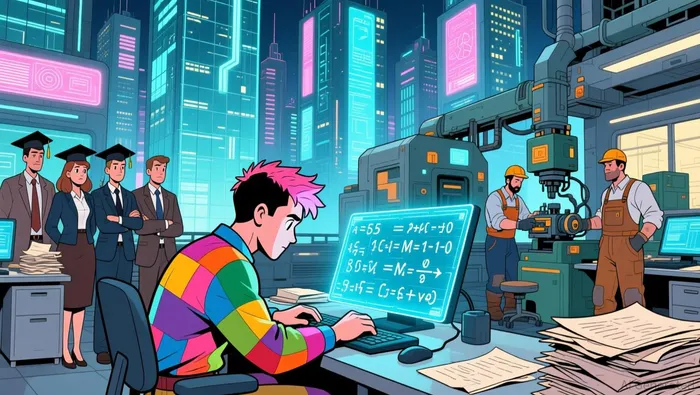
This market reality aligns with Karp's broader prediction that the economic power of humanities-trained voters is being disrupted while the power of working-class, vocationally trained voters is increasing. While other industry leaders like BlackRock and McKinsey still value liberal arts for creativity, the hard numbers from the job market suggest a growing gap between applicant skills and employer needs. Employers are struggling to find applicants with specific, needed skills despite high unemployment rates among young college graduates, forcing a fundamental restructuring of how society assesses and rewards human capability.
How Is PalantirPLTR-- Adapting Its Hiring Strategy For The AI Era?
Palantir is not just predicting this shift; it is actively implementing a strategy that bypasses traditional academic requirements to secure the talent it needs. The company has launched a Meritocracy Fellowship to hire based on skills rather than school prestige, criticizing American universities for displacing meritocracy. Karp emphasized that the company focuses on identifying individual outlier aptitudes rather than relying on traditional academic credentials, looking for people who can be quickly trained for specific, high-value tasks.
The company points to concrete examples of this strategy in action, such as a former police officer managing the Army's Maven system or battery technicians who were rapidly upskilled. These individuals were chosen not for their educational pedigree but for their demonstrated ability to adapt and solve complex problems. This approach highlights a growing labor market gap where employers struggle to find applicants with specific, needed skills despite high unemployment rates among young college graduates. By prioritizing aptitude testing, Palantir is signaling a potential rethinking of career success and the future of the white-collar workforce.
This shift implies that corporate value is moving away from "worker bees" who follow linear paths toward those who display unique problem-solving capabilities. For investors, this indicates that companies willing to adapt their hiring practices to the realities of the AI economy may gain a competitive advantage in talent acquisition. As the labor market continues to evolve, the ability to identify and leverage non-linear thinking and specialized vocational skills will likely become a key differentiator for successful organizations. The bottom line is that the future of work is not about replacing humans, but about redefining which human skills are truly irreplaceable.

Stay ahead of the market.
Get curated U.S. market news, insights and key dates delivered to your inbox.


AInvest
PRO
AInvest
PRO



Comments
No comments yet