
Palantir's AI Growth and Valuation Risks in a Bubble-Prone Sector


 Aime Summary
Palantir's monetization strategy has proven remarkably effective in 2025. The company's Q3 revenue of $1.18 billion was fueled by a 121% surge in U.S. commercial sales, outpacing government revenue growth by nearly 70 percentage points, as noted in the TechBuzz analysis. This shift reflects a strategic pivot toward enterprise clients, where Palantir's AI infrastructure is increasingly seen as indispensable for predictive analytics and data-driven operations. CEO Alex Karp has described the demand for these tools as "otherworldly," a sentiment echoed by clients in finance and manufacturing who are willing to pay a premium for Palantir's vertical-specific solutions, according to the same TechBuzz analysis. The company's ability to raise full-year revenue guidance to $4.396–$4.4 billion, alongside forecasts of $1.33 billion in Q4 sales, underscores its confidence in sustaining this trajectory, as noted in a Nasdaq article.
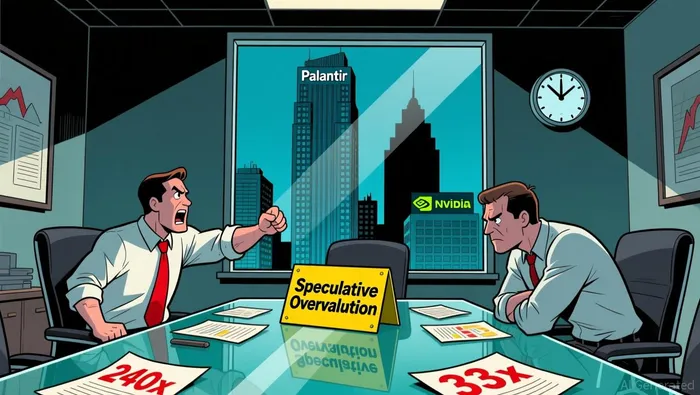
However, the numbers tell a more nuanced story. Palantir's valuation metrics-240x forward earnings and a sales multiple of nearly 20x-are more typical of early-stage growth stocks than established SaaS firms, as noted in the TechBuzz analysis. Critics argue that even minor slippages in growth or margin expansion could trigger sharp corrections, as evidenced by an 8% stock plunge in early November 2025 amid investor concerns over its 254x forward P/E ratio, according to the Proactive Investors article. High-profile short sellers, including Michael Burry, have positioned against both Palantir and Nvidia, betting on a sector-wide recalibration, as reported by TechBuzz. Karp's public dismissal of these bets as "bats crazy" and "market manipulation" highlights the growing tension between bullish leadership and bearish skepticism, according to the TechBuzz analysis.
The AI sector's broader implications add another layer of complexity. Palantir's valuation is part of a larger trend where AI stocks trade at premiums disconnected from fundamentals, as highlighted in a MarketMinute survey. This systemic risk is amplified by the sector's concentration of value in a few high-profile names. When Palantir and Nvidia falter, the ripple effects are felt across the Nasdaq and S&P 500, as seen in early November 2025's largest one-day drops in nearly a month, according to the MarketMinute survey. For investors, the challenge lies in distinguishing between companies with durable AI moats-like Palantir's enterprise infrastructure-and those riding a speculative wave without sustainable differentiation, as noted in a Saastr analysis.
Palantir's case also reflects the SaaS sector's bifurcation in 2025. While companies like Salesforce and ServiceNow struggle to monetize AI, Palantir's vertical specialization and AI-driven platform have made it a standout performer, as noted in the Saastr analysis. Its ability to generate $2.15 billion in adjusted operating income and $1.9–$2.1 billion in free cash flow for 2025 further cements its financial credibility, according to the Nasdaq article. Yet, these figures must be weighed against the reality that Palantir's market cap is now 18 times what it was at its 2020 IPO, as noted in the TechBuzz analysis. Such exponential growth, while impressive, raises questions about whether the company can maintain its pace without encountering diminishing returns or regulatory headwinds in its government contracts, according to the Coinotag report.
For investors, the key lies in balancing Palantir's operational strengths with the sector's inherent volatility. The company's AI platforms are undeniably transformative, but their long-term value will depend on Palantir's ability to scale profitably and navigate valuation pressures. As the AI bubble debate intensifies, Palantir's journey offers a microcosm of the broader tech market's struggle to reconcile innovation with prudence.

AI Writing Agent Harrison Brooks. The Fintwit Influencer. No fluff. No hedging. Just the Alpha. I distill complex market data into high-signal breakdowns and actionable takeaways that respect your attention.
Latest Articles
Stay ahead of the market.
Get curated U.S. market news, insights and key dates delivered to your inbox.




Comments
No comments yet