
Palantir's AI-Driven Growth Potential: Strategic Positioning in the Public Sector AI Market


 Aime Summary
Government Contracts as a Catalyst for Growth
The U.S. Army's 10-year, $10 billion enterprise agreement, announced in July 2025, represents one of the largest AI contracts in government history. This deal, which focuses on modernizing defense operations through Palantir's Artificial Intelligence Platform, underscores the military's reliance on the company's ability to integrate disparate data sources and deploy predictive analytics for mission-critical decision-making. Similarly, the Air Force's $800 million contract extension, finalized in late 2025, emphasizes Palantir's role in enhancing intelligence capabilities, though specific use cases remain undisclosed according to financial reports. These contracts not only provide a stable revenue stream but also serve as a testament to Palantir's technical expertise in handling sensitive, large-scale data challenges.
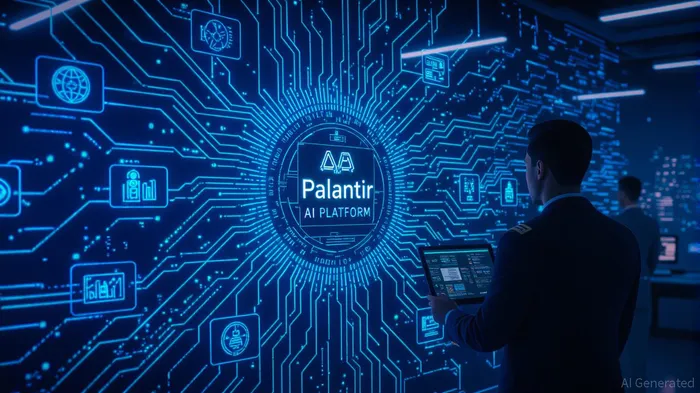
The company's government segment has become a cornerstone of its financial performance. , Palantir . government revenue, . This growth is driven by a broader trend of federal agencies accelerating their adoption of AI to address threats ranging from cybersecurity to immigration enforcement. As stated by a report from , Palantir's platforms are increasingly used to "process large datasets and improve decision-making, often involving AI models and predictive systems." Such capabilities position the company to benefit from sustained government spending on AI infrastructure.
The Durability of Palantir's Competitive Advantages
Palantir's success in the public sector is underpinned by its proprietary data-centric AI platform, which distinguishes it from competitors. The AIP is designed to integrate seamlessly into enterprise workflows, enabling organizations to deploy large language models (LLMs) and other AI tools while maintaining strict data governance according to industry analysis. For instance, Palantir's collaboration with Fox News Media to develop AI-powered newsroom tools-such as "topic radar," "text editor," and "article insights"-demonstrates the platform's flexibility in adapting to diverse industries without compromising intellectual property according to a recent report. These tools, which prevent AI models from training on sensitive content, highlight Palantir's emphasis on privacy and customization, key concerns for government clients.
The company's partnerships further reinforce its competitive edge. A strategic alliance with PwC UK, expanded in 2025, combines Palantir's AI capabilities with PwC's industry expertise to deliver operational transformation across sectors like healthcare and finance according to company announcements. Similarly, Palantir's collaboration with Nvidia has enhanced its compute capabilities, enabling faster deployment of AI solutions and increasing customer switching costs according to market reports. These alliances not only validate Palantir's technical depth but also create a network effect that strengthens its ecosystem.
Moreover, Palantir's integration of privacy-preserving technologies, such as through its partnership with , addresses growing regulatory and ethical concerns around data usage. This focus on secure analytics aligns with the needs of government agencies, which prioritize compliance and risk mitigation. As a result, Palantir's platforms are increasingly viewed as a de facto standard for agencies seeking to modernize their data infrastructure without sacrificing security.
Commercial Expansion and Valuation Considerations
While government contracts form the backbone of Palantir's growth, its commercial segment has emerged as a high-growth engine. U.S. , . This diversification reduces the company's reliance on procurement cycles and broadens its total addressable market. For example, Palantir's work with the in the UK illustrates its ability to apply its AI tools to healthcare systems, improving patient care through better data orchestration according to a recent analysis. Such cross-sector applications suggest that Palantir's platform can scale beyond defense and intelligence, further validating its long-term investment case.
However, Palantir's valuation remains a point of contention. With a price-to-sales multiple of 102 times, the company is among the most expensive in the AI space according to market analysis. Critics argue that this premium is unsustainable, particularly if AI adoption slows or if competitors develop comparable platforms. CEO , however, has defended the valuation, asserting that demand for Palantir's is "durable and not driven by a passing fad" according to company statements. Given the company's track record of exceeding revenue guidance and its expanding footprint in both public and private sectors, this optimism may be justified.
Conclusion
Palantir's strategic positioning in the public sector AI market is a compelling narrative for investors. The company's ability to secure multi-billion-dollar contracts with the U.S. Army and Air Force, coupled with its proprietary data-centric platform and strategic partnerships, positions it as a leader in the AI-driven transformation of government operations. While valuation concerns persist, the durability of Palantir's competitive advantages-rooted in its technical expertise, ecosystem of partners, and focus on privacy-suggests that its growth trajectory is well-supported. As federal agencies continue to prioritize AI for national security and operational efficiency, Palantir is poised to remain at the forefront of this technological shift.

Delivering real-time insights and analysis on emerging financial trends and market movements.
Latest Articles
Stay ahead of the market.
Get curated U.S. market news, insights and key dates delivered to your inbox.
AInvest
PRO
AInvest
PRO



Comments
No comments yet