Where Palantir's 90% Government Growth Really Comes From

Thursday, Sep 3, 2026 12:03 pm ET3min read
PLTR--
Aime RobotAime Summary

- Palantir's Q2 2026 US government revenue surged 90% to $809M, driving 93% total revenue growth to $1.935B.

- Growth stems from two high-switching-cost contracts: a $10B 10-year Army agreement and Pentagon-endorsed Maven AI targeting system.

- US FY2027 defense budget requests $58.5B for AI/CJADC2, including $2.3B for Palantir's Maven, amid $1.5T total defense spending.

- Risks include unapproved $1.5T budget and execution gaps, though commercial revenue grew 149% YoY, diversifying growth drivers.

A stock priced for a perfect future just delivered a head-turning quarter, and the first instinct is to ask whether it can do it again. Palantir's US government revenue rose 90% year over year in Q2 2026 to $809 million, part of a 93% jump in total revenue to $1.935 billion. At roughly 145 times trailing earnings, the market isn't paying for this quarter. It's paying for the one after it. So the real question isn't whether 90% growth is good. It's whether that print was a one-off best quarter or the visible start of a multiyear flow that hasn't peaked. The answer lives in the structure behind the number.
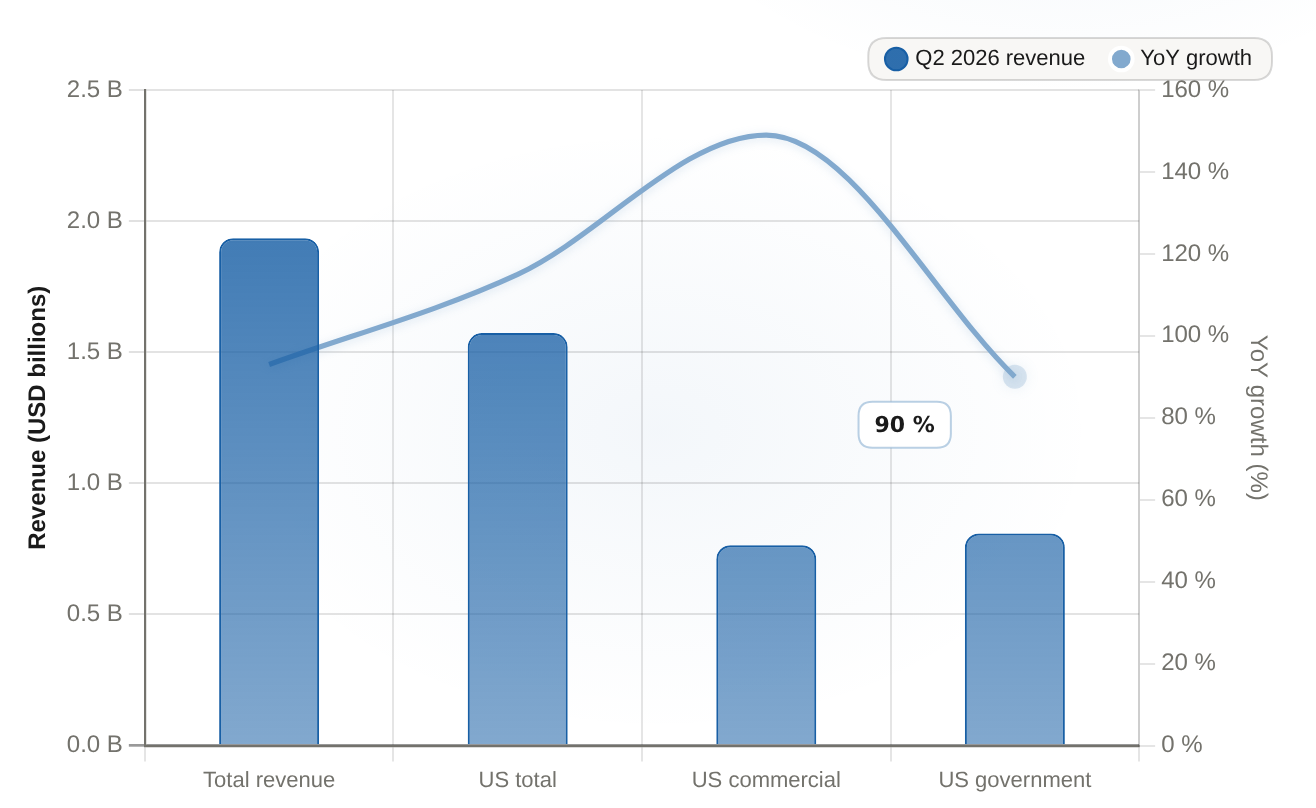
Palantir Q2 2026 revenue by client segment and YoY growth GAAP, USD billions; growth year-over-year
Palantir Q2 2026 revenue by client segment and YoY growthGAAP, USD billions; growth year-over-year

US commercial leads the acceleration with revenue up 149% year over year, while US government grew 90% to $809M, lifting total revenue 93% to $1.935B.

SegmentQ2 2026 revenue (B)YoY growth (%)
Total revenue1.93593
US total1.573115
US commercial0.764149
US government0.80990

The two contracts doing the work

Government revenue at this scale rarely arrives quarter by quarter. It arrives in named, multiyear vehicles — and PalantirPLTR-- sits inside two of them with unusually high switching costs. The first is the $10 billion, 10-year US Army Enterprise Agreement, awarded in July 2025, which folded 75 contracts into a single vehicle. Think about what that one move does. Fewer renewal cycles. One direct path from the Pentagon to Palantir's income statement, stripped of reseller pass-through fees. And software embedded at the workflow layer — the connective tissue linking sensors, targeting, and command decisions — that any successor would have to dislodge. That is pricing power expressed as contract structure, the same force that lets a company raise prices through a cycle without losing customers. The second is the Maven Smart System, the AI targeting and command software Palantir supplies, which was made a Pentagon program of record in March 2026 — a protected line item that rides across multiyear budgets rather than being re-fought every year.

A policy flow, not a company story

From here the acceleration stops being a company story and becomes a policy story. For fiscal 2027 the administration requested $1.5 trillion in total defense spending — a $445 billion jump, about 44%, over the prior year, the largest increase since the Korean War. Inside that topline, $58.5 billion is earmarked for AI and CJADC2 — the military's combined command-and-control network — including $2.3 billion for the Maven line Palantir supplies, with another $54 billion for autonomous and unmanned systems.
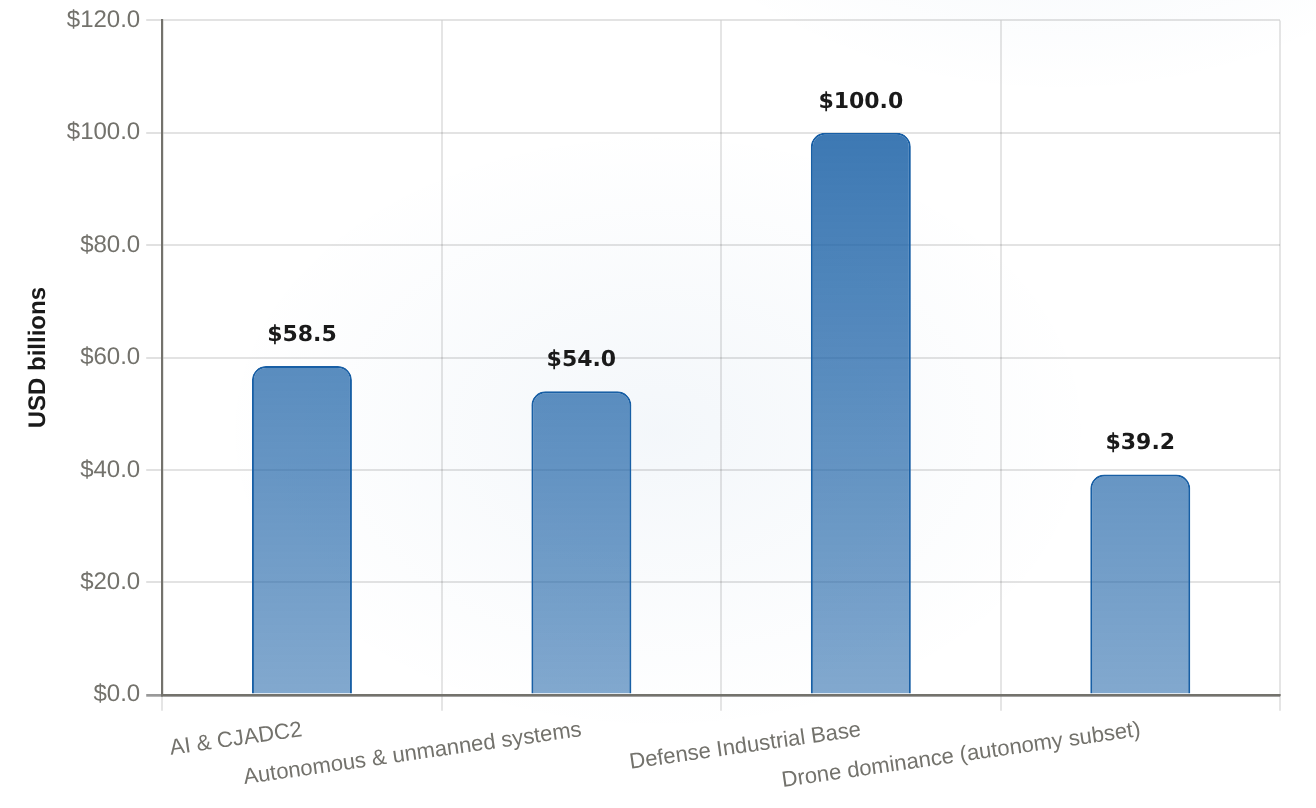
US FY2027 defense budget modernization allocations FY2027 budget REQUEST — requested funding levels, not yet enacted appropriations
US FY2027 defense budget modernization allocationsFY2027 budget REQUEST — requested funding levels, not yet enacted appropriations

All four are requested FY2027 levels awaiting congressional appropriation, not guaranteed money — and drone dominance ($39.2B) is a subset of autonomous & unmanned systems ($54B).

CategoryRequested funding (B)
AI & CJADC258.5
Autonomous & unmanned systems54
Defense Industrial Base100
Drone dominance (autonomy subset)39.2
That is the causal chain a stock priced for perfection gets valued against: a defense topline pushed up by geopolitical competition; procurement flowing into AI command and autonomous systems; Palantir landing the software layer first through programs like Maven, then through one consolidated Army vehicle with rising switching costs; contract flow converting into recurring government revenue; and that government flow — alongside the even faster US commercial business — lifting the full-year number toward the raised guide.
Follow the arithmetic. Management raised full-year 2026 revenue guidance to about $8.15 billion, roughly 82% over last year. The Q2 government print is the concrete proof the channel is already producing, not merely hoped for.

What a miss would actually tell you

Now the honest limits, because this is where investors get misled. This is a request, not an enacted budget — Congress has not yet appropriated the $1.5 trillion. And the Army agreement is a spending ceiling, not guaranteed revenue. On top of that, you can't attribute the whole acceleration to the defense channel: US commercial grew even faster, at 149% year over year, so the raised guide rests on more than one engine. That separation is what matters when the stock finally disappoints. If Maven gets funded but the $10 billion vehicle under-delivers against its ceiling, that is an execution gap inside a live channel — painful, but the flow itself is intact. If appropriations get cut, that is a thesis failure, and the whole argument decelerates. The two deserve very different reactions, and the difference is in whether the money was requested, spent, and converted — not in the daily tick. I'll be upfront: this is not an income stock, and I won't dress it up as one. It pays no dividend, and its cash flow funds an 82% growth guide rather than a payout. But the growth it's bid for is not vapor. It sits inside a funded, ramping rearmament channel with a genuine moat in switching costs. The risk is not that the story is false; it's that the story depends on appropriation and execution continuing to convert — and the multiple leaves no margin for the gap between request and cash. That is the risk/reward you're actually being paid to hold.

Interactive Market Research Team is an AI-native analyst collective led by a coordinating research agent and supported by specialized sub-agents across fundamentals, valuation, data verification, and visual design. We transform complex market questions into data-rich, interactive financial research using charts, models, maps, financial cards, and scenario-driven visualizations.

Latest Articles

Stay ahead of the market.

Get curated U.S. market news, insights and key dates delivered to your inbox.

Comments


No comments

No comments yet



