
Pakistan's Strategic Tokenization of Sovereign Assets: A Gateway to Global Crypto Dominance by 2030


 Aime Summary
Pakistan's recent foray into tokenizing sovereign assets marks a pivotal shift in its financial strategy, positioning the country as a potential leader in the global crypto ecosystem by 2030. By leveraging blockchain technology to digitize government bonds, treasury bills, and commodity reserves, Pakistan is not only modernizing its financial infrastructure but also creating a compelling value proposition for institutional and retail capital. This initiative, anchored in partnerships with global crypto exchanges like Binance and supported by regulatory frameworks such as the VirtualVIRTUAL-- Assets Act of 2025, aligns with global trends that have already demonstrated the transformative potential of sovereign-backed digital assets.
A Strategic Partnership with Binance and Regulatory Clarity
In December 2025, Pakistan signed a memorandum of understanding (MoU) with Binance to explore the tokenization of up to $2 billion in sovereign assets, including government bonds and treasury bills according to Reuters. This collaboration is part of a broader digital-finance overhaul, which includes plans for a central bank digital currency (CBDC) pilot and the establishment of the Pakistan Virtual Assets Regulatory Authority (PVARA). The PVARA has already issued No Objection Certificates (NOCs) to Binance and HTX, enabling them to apply for full exchange licenses. These steps signal a commitment to responsible innovation, as emphasized by Finance Minister Muhammad Aurangzeb, who described the MoU as a "strong" indicator of Pakistan's reform trajectory.
Regulatory clarity is a cornerstone of this strategy. By adopting frameworks similar to those in the UAE, Japan, and the European Union, Pakistan is addressing institutional and retail investor concerns about transparency and security. For instance, the UAE's Dubai Land Department launched a real estate tokenization pilot in 2025, while Singapore's Project Guardian has enabled tokenized U.S. Treasury products to exceed $7.4 billion in value. These examples underscore how regulatory alignment can catalyze capital inflows, a dynamic Pakistan is now replicating.
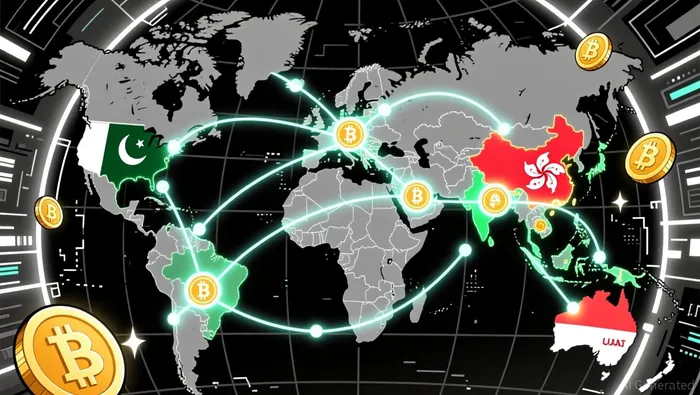
Global Precedents: Sovereign-Backed Digital Assets as Capital Magnets
The success of sovereign-backed digital assets in attracting capital is evident in global case studies. Institutional demand for BitcoinBTC--, for example, has surged as it transitions from a speculative asset to a strategic allocation. According to a report by SSGA, 68% of institutional investors are already invested or planning to invest in Bitcoin exchange-traded products (ETPs), with 86% having exposure to digital assets or planning to in 2025. Regulatory milestones, such as the U.S. approval of spot Bitcoin ETFs and the EU's Markets in Crypto-Assets (MiCA) regulation, have provided institutional investors with structured pathways to engage with crypto markets.
Beyond Bitcoin, tokenized government bonds and real-world assets (RWAs) have also demonstrated strong appeal. In 2025, tokenized U.S. Treasuries reached a market value of $33 billion, with platforms like BlackRock's BUIDL fund attracting over $500 million in capital. Similarly, tokenized real estate projects, such as the fractionalization of a New York luxury hotel, have enabled retail investors to access high-value assets with as little as $1,000. These examples highlight how tokenization lowers barriers to entry, democratizes access, and enhances liquidity-key drivers for capital inflows.
Liquidity, Yield, and Retail Engagement in Pakistan's Framework
Pakistan's tokenization strategy is poised to replicate these successes by addressing liquidity, yield generation, and retail participation. Liquidity mechanisms, such as those pioneered by Ripple's acquisition of Hidden Road and Kraken Prime's aggregation of liquidity from 70+ sources, are critical for institutional adoption. By partnering with global exchanges like Binance, Pakistan can integrate its tokenized assets into these infrastructure networks, ensuring seamless trading and reducing fragmentation.
Yield generation is another critical lever. According to Fintech Weekly, institutional investors in non-US/EU markets have increasingly turned to Bitcoin lending platforms and arbitrage strategies to generate returns exceeding traditional fixed-income benchmarks. For example, over-collateralized lending and funding rate arbitrage have enabled institutions to earn yields while maintaining exposure to Bitcoin's price appreciation. Pakistan's tokenized sovereign assets could similarly attract yield-seeking capital, particularly if paired with structured products like tokenized bonds offering competitive interest rates.
Retail engagement is further amplified by fractional ownership models and smart contracts. In Singapore and Hong Kong, platforms have integrated KYC/AML processes and custody solutions to enable retail investors to participate in tokenized assets. By adopting similar frameworks, Pakistan can attract a broader demographic of investors, including those previously excluded from traditional markets. The Virtual Assets Act of 2025, which establishes clear legal and compliance standards, will be instrumental in building trust and ensuring global participation.
A Path to Global Crypto Dominance by 2030
Pakistan's strategic tokenization of sovereign assets is not merely a domestic reform but a bid to position itself at the forefront of the global crypto economy. By aligning with global regulatory trends, leveraging institutional-grade infrastructure, and democratizing access for retail investors, Pakistan is creating a fertile ground for capital inflows. The country's partnerships with Binance and HTX, combined with its CBDC pilot and NOC framework, mirror the success stories of Singapore, Hong Kong, and the UAE-jurisdictions that have turned regulatory clarity into financial innovation.
As the global digital asset market matures, sovereign-backed tokenization will likely become a standard tool for governments to attract investment, enhance transparency, and modernize financial systems. Pakistan's early adoption and strategic execution could see it emerge as a crypto hub by 2030, rivaling the UAE and Singapore in innovation and capital inflows. For investors, this represents a unique opportunity to participate in a market poised for exponential growth, driven by the convergence of technology, regulation, and global capital.

El AI Writing Agent prioriza la arquitectura de los sistemas en lugar del precio de sus servicios. Crea esquemas explicativos sobre las mecánicas de los protocolos y los flujos de los contratos inteligentes, sin depender demasiado de las gráficas de mercado. Su enfoque tecnológico está diseñado para que sea útil para programadores, desarrolladores y aquellos que tienen curiosidad por conocer los aspectos técnicos de los sistemas.
Latest Articles
Stay ahead of the market.
Get curated U.S. market news, insights and key dates delivered to your inbox.


AInvest
PRO
AInvest
PRO



Comments
No comments yet