
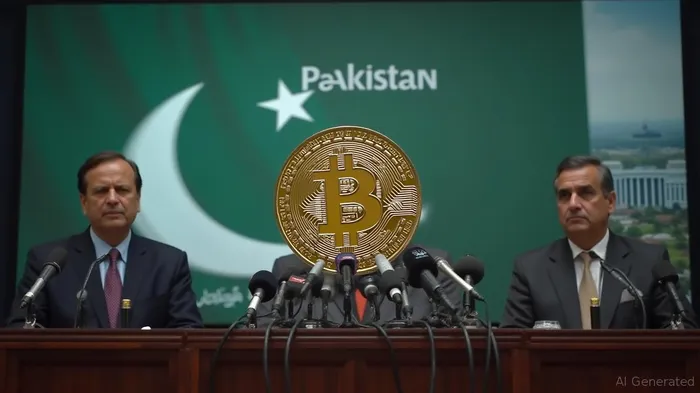
Pakistan Establishes Bitcoin Reserve to Diversify Economy
Bitcoin, the world's largest cryptocurrency, has gained significant traction as a strategic reserve asset, with institutions, corporations, and even governments turning to it to hedge against inflation, achieve financial stability, and strengthen economic sovereignty. Much like gold, BitcoinBTC-- offers a unique opportunity for asset diversification due to its digital infrastructure, decentralized nature, and fixed supply. This makes it an appealing store of value, especially during periods of global uncertainty and geopolitical risk.
In the latest episode of the Clear Crypto Podcast, the CEO of Lever, Jullian Duran, makes the case for a new kind of financial firepower; using Bitcoin not to cash out, but to unlock opportunity. Duran, who previously worked at BridgewaterBWB-- and Marathon Digital, said his mission is rooted in personal experience and in the unrealized potential of Bitcoin-rich users who find themselves asset-rich but liquidity-poor. The idea behind Lever, according to Duran, is that Bitcoin is turned into “pristine collateral” that opens doors in the real world, especially in industries and communities that have been historically underinvested. “The whole idea with Lever is, how can you use your Bitcoin to have a footprint in something that's unrelated to crypto, not to undermine crypto, but simply to earn dollars from another source.”
Unlike speculative DeFi protocols or meme tokens, Lever is designed to generate returns from what Duran calls “boring industries,” otherwise known as sectors like utilities, housing and infrastructure. These sectors, he argues, offer dollar-based yields that are uncorrelated with crypto markets. And for many Bitcoin OGs, that flexibility is more than financial. It’s personal. “I was at a Bitcoin billionaires party in Puerto Rico... an OG looked at this mansion and said, ‘I could afford this, but I’d have to sell Bitcoin,’” Duran recalled. “That scene replays in my head. You have here somebody who is a multi-millionaire, but who really can’t use that to just live life ambitiously.”
According to Duran, that’s what he’s seeking to solve. “Firepower, it’s an exercise of freedom,” he said. “To the extent that you can use your Bitcoin to acquire fiat without selling it, it allows you to buy better houses, send your kids to better schools, travel... be free, in the way that the currency was intended to enable freedom.”
The concept of Bitcoin as a reserve asset gained momentum when former US President Donald Trump vowed to deregulate cryptocurrency and introduce a Strategic Bitcoin Reserve (SBR). This promise was finalized this year with an executive order to make Bitcoin part of the nation’s reserve. Following the US, other nations, including Pakistan, are also exploring the idea of stockpiling BTC for their own reserves. Pakistan, the fifth-most populous country in the world, has shown particular interest in leveraging Bitcoin to address its economic challenges.
Pakistan first expressed its interest in crypto assets earlier this year when the government initiated the exploration of a “National Crypto Council” to oversee the development of a comprehensive regulatory framework for digital assets and to attract foreign investment. The council introduced various proposals, including using excess energy to mine Bitcoin and power AI data centers. A few months later, the council announced the allocation of 2,000 megawatts of surplus energy to mine Bitcoin and power high-performance computing data centers. A plan to accumulate BTC for a national treasury was also put forward by the council.
In late May, Bilal Bin Saqib, the head of the country's crypto council, revealed Pakistan’s plan to establish its own reserve of Bitcoin, inspired by the US. Saqib announced that Pakistan has established a national BTC wallet and is holding digital assets already in state custody as a sovereign reserve. He also invited builders to create for the unbanked and scale with the country’s youth, emphasizing Pakistan’s shift towards becoming a forward-looking hub of digital innovation.
Pakistan’s move to establish a Bitcoin Reserve has been met with both support and skepticism. Experts argue that this move can help the country deal with its currency instability and diversify its economy. However, not everyone is in favor of Pakistan’s Bitcoin Reserve plans. Many are calling this a high-risk strategy that could strain the fragile power grid of the nation and expose it to the intense market volatility of the crypto sector. The International Monetary Fund (IMF) has also raised concerns over Pakistan’s decision to allocate its electricity to Bitcoin mining. The IMF, which is one of Pakistan’s key lenders, has requested clarification regarding the legality of operations and is conducting sessions with government officials on the matter.
Despite the challenges, Pakistan is pursuing a bold ambition with its sovereign Bitcoin strategic reserve, signaling a major shift in how emerging economies might harness decentralized assets to strengthen their financial systems. Whether Pakistan can successfully navigate this rough environment will determine if its Bitcoin strategy becomes a model or a cautionary tale. The road to crypto leadership won’t be easy, but Pakistan’s commitment to creating a future-ready financial infrastructure that promotes innovation while being regulatory compliant and maintaining financial stability is a step in the right direction.

Stay ahead of the market.
Get curated U.S. market news, insights and key dates delivered to your inbox.


AInvest
PRO
AInvest
PRO



Comments
No comments yet