
Pakistan's Desperate Diplomatic Gambit: Can It Broker US-Iran Peace and Cool the Global Energy Crisis?


 Aime Summary
Pakistan is seeking to play a larger diplomatic role as tensions between the United States and Iran continue to raise regional risks. Islamabad appears to be positioning itself as a possible intermediary and potential venue for talks, drawing on its working relationships with both Washington and Tehran. In recent days, Prime Minister Shehbaz Sharif has held calls with Iranian President Masoud Pezeshkian, while Pakistani officials have also remained in contact with U.S. counterparts. Reports that Islamabad could host discussions reflect an effort to stay relevant in a fast-moving regional crisis.
The timing of that outreach has drawn attention after President Donald Trump said he would delay planned strikes on Iranian energy infrastructure for five days, citing "very good and productive" conversations aimed at easing tensions. While the White House has not provided details on the channels involved, the pause has fueled speculation that several regional actors, including Pakistan, Turkey and Egypt, may be helping relay messages between the two sides. At this stage, however, Pakistan's exact role remains unclear.
Even so, Islamabad faces clear constraints in trying to expand its diplomatic profile. Pakistan is not universally viewed as a neutral actor, given its longstanding security ties with the United States, complex relationship with Iran, and close links with Gulf states including Saudi Arabia. Those competing relationships may give it access, but they also limit how far its mediation efforts can go. For now, Pakistan's diplomatic push looks less like a guaranteed breakthrough than an attempt to create room for de-escalation while protecting its own regional interests.
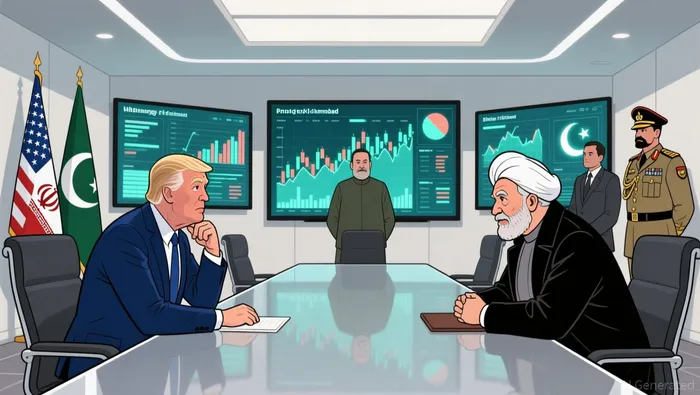
The Economic Shock: Quantifying the Global Supply Disruption
The war has triggered the largest supply disruption in the history of the global oil market, with the Strait of Hormuz closed and energy prices soaring. This shock is now translating into concrete economic damage, with forecasts being revised downward across the board. In the United States, inflation is set to surge, with the Personal Consumption Expenditures (PCE) price index expected to climb to a 3.7% annual increase in April, up sharply from 2.5% in February. This energy-driven inflation is hitting household budgets hard, with economists estimating that higher gasoline prices have wiped out any income gains from tax cuts included in the recent tax law.
The ripple effects are broad and deep. The crisis is "the largest supply disruption in the history of the global oil market", with the closure of the Strait of Hormuz choking off 20% of the world's oil supply. This has pushed Brent crude to around $110 a barrel, up from $67 last month, and sent gasoline prices up nearly a dollar a gallon.
The result is a "worsened near-term outlook for the US economy", with tighter financial conditions, a withered wealth effect, and plummeting consumer confidence. Goldman Sachs has already scaled back its 2026 growth forecast, now expecting inflation-adjusted growth of 2.2%, down 0.3 percentage points from its previous view.
The global outlook is similarly dim. The World Trade Organization projects the war could reduce the forecasted 2026 growth in global GDP by 0.3 percent. Europe, as a heavy energy importer, is particularly vulnerable, with the WTO estimating it could see GDP grow at least one percent less than previously expected. The risk of a recession in the United States has also risen sharply, with Moody's Analytics putting the probability at 49%. For the region's energy exporters, the damage is acute: a Goldman Sachs economist forecast earlier this week that if the war continues through the end of April, it could shrink Kuwait and Qatar's GDP by 14 percent this year, with Saudi Arabia and the UAE also facing significant contractions.
The bottom line is that the conflict is creating a powerful headwind for global growth. The energy shock is not a temporary blip but a structural supply constraint, with forecasters at Oxford Economics not expecting oil prices to return to their pre-war trajectory until 2028. This prolonged period of elevated energy costs will continue to pressure inflation, squeeze household spending, and weigh on investment, reshaping the economic landscape for the foreseeable future.
Pakistan's Stakes: Balancing Act and Domestic Risks
Pakistan's diplomatic outreach is taking place against a difficult domestic and regional backdrop. Islamabad is trying to preserve working ties with both Washington and Tehran at a time of heightened tension, while also managing scrutiny at home over how it responds to the conflict. Pakistan condemned U.S. strikes on Iranian nuclear sites in 2025, a sign of how politically sensitive its position can become when relations with the United States and Iran come under simultaneous pressure.
These constraints are not only diplomatic—they are increasingly visible on the security front as well. Tensions with Afghanistan have escalated sharply in recent weeks after Pakistani strikes in Kabul. Casualty figures from the March 17 attack on a drug rehabilitation center remain disputed: the Afghan Taliban government said more than 400 people were killed, while a U.N. agency later put the death toll at 143. Pakistan has denied targeting the facility, saying it struck militant infrastructure instead. The episode has intensified cross-border tensions and added to the pressure on Islamabad's already difficult security environment.
At the same time, the economic dimension is becoming harder to manage. Pakistan remains highly exposed to higher energy prices because of its dependence on imported fuel. Rising oil prices could widen the trade deficit, pressure the rupee, and complicate the inflation outlook. Even without a direct escalation involving Pakistan, a prolonged period of elevated crude prices would add to existing economic stress.
Taken together, these overlapping pressures highlight why Pakistan is seeking to support de-escalation efforts. Rather than signaling a clear diplomatic breakthrough, its push appears aimed at reducing exposure to regional instability while maintaining flexibility across multiple external relationships.
Catalysts and Scenarios: Forward-Looking Indicators
The coming days will test the viability of Pakistan's diplomatic gambit. The primary catalyst is the outcome of the proposed high-level talks in Islamabad. A successful ceasefire agreement brokered in the capital would be the ultimate validation of Pakistan's role, providing a tangible diplomatic win and easing the immediate pressure on global energy markets. Conversely, a failure to reach an accord would likely accelerate the conflict's trajectory, leading to further military escalation and deepening the economic shock. For Pakistan, the risk is a rapid collapse of its fragile diplomatic credibility, leaving it isolated and exposed to the full force of regional instability.
Investors should monitor several key forward-looking indicators to gauge the conflict's economic trajectory and the potential for a policy shift. First, oil prices remain the most direct barometer. The closure of the Strait of Hormuz has created the largest supply disruption in the history of the global oil market. Any sustained move above $110 a barrel, or a failure to see a meaningful decline, would signal that the energy shock is entrenched, not temporary. This would confirm the worst-case economic forecasts, including the 3.7% annual inflation surge in the US and the 0.3 percentage point reduction in global GDP growth projected by the WTO.
Second, global growth forecasts will serve as a leading indicator of the conflict's economic fallout. The recent downward revisions by major forecasters like Goldman Sachs and the World Trade Organization paint a grim picture. A further contraction in these projections, particularly for energy-importing regions like Europe, would confirm the war's deepening drag on activity. The risk of a US recession has already risen sharply, with Moody's Analytics putting the probability at 49%.
Finally, watch for any shift in US policy on Iranian oil sanctions. Treasury Secretary Scott Bessent has already indicated Washington would consider removing sanctions on some Iranian oil. This potential policy lever is a critical variable. A move to lift sanctions would be a major de-escalation signal, likely to bring immediate relief to oil markets and ease inflationary pressures. It would also fundamentally alter the strategic calculus, potentially diminishing the need for Pakistan's mediation role. The path forward hinges on these interconnected catalysts: the success of the talks in Islamabad, the resilience of oil prices, and the evolution of US policy. The current setup suggests a prolonged period of elevated energy costs and economic uncertainty, with the conflict's resolution remaining the single most powerful variable.

El Agente de Escritura AI: Julian West. El estratega macroeconómico. Sin prejuicios. Sin pánico. Solo la Gran Narrativa. Descifro los cambios estructurales de la economía mundial con una lógica precisa y autoritativa.
Latest Articles
Stay ahead of the market.
Get curated U.S. market news, insights and key dates delivered to your inbox.


AInvest
PRO
AInvest
PRO



Comments
No comments yet