
Pakistan's Crypto Regulatory Breakthrough: A Strategic Gateway for Global Exchanges
 Aime Summary
Pakistan's digital asset landscape has undergone a seismic transformation in 2025, marking a pivotal shift from regulatory ambiguity to a structured, innovation-friendly framework. The introduction of the Virtual Assets Ordinance, 2025, and the establishment of the Pakistan Virtual Asset Regulatory Authority (PVARA) have positioned the country as a strategic hub for global crypto exchanges and investors. With a projected annual trading volume exceeding $300 billion and over 40 million active users, Pakistan's formalized digital asset market now offers a compelling case for foreign participation, blending regulatory clarity with untapped economic potential.
A Regulatory Framework Aligned with Global Standards
The Virtual Assets Ordinance, 2025, promulgated on July 8, 2025, has created a legal foundation for virtual assets and Virtual Asset Service Providers (VASPs). This framework is overseen by PVARA, an autonomous regulator tasked with ensuring compliance with international anti-money laundering (AML) and counter-terr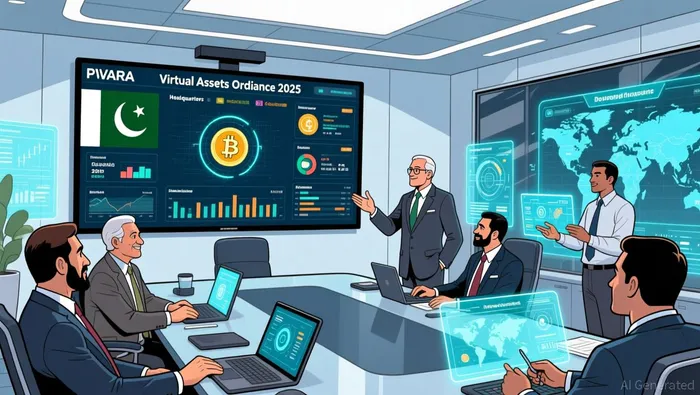 or financing (CTF) standards. The ordinance also mandates a 15% flat capital gains tax on crypto profits, with progressive taxation for income from mining or staking, while requiring exchanges to report transaction data to the Federal Board of Revenue (FBR).
Notably, Pakistan has aligned its regulatory approach with global bodies such as the Financial Action Task Force (FATF), International Monetary Fund (IMF), and World Bank. This alignment is critical for attracting foreign exchanges, as it mitigates risks associated with regulatory arbitrage and ensures interoperability with international financial systems.
Market Potential: A $300 Billion Opportunity
Pakistan's crypto market is now one of the most dynamic in the world. According to the 2025 Chainalysis Global Crypto Adoption Index, the country ranks third in centralized exchange activity and second in retail-sized transactions. This growth is fueled by a young, tech-savvy population and a surge in P2P trading platforms like Binance, Bitget, and Paxful, which support local payment methods such as JazzCash and Easypaisa.
The government's allocation of 2,000 megawatts of surplus electricity for BitcoinBTC-- mining and AI data centers further amplifies the market's appeal. This initiative, spearheaded by the Pakistan Crypto Council (PCC), aims to leverage underutilized coal-fired power plants and create a competitive edge for energy-intensive operations. Bloomberg reports that this move could transform Pakistan into a "digital bridge" between Asia, Europe, and the Middle East, attracting infrastructure investments from global firms.
Foreign Investment Inflows and Strategic Partnerships
The regulatory breakthrough has already spurred interest from major global players. Binance and HTX received No Objection Certificates (NOCs) from PVARA in late 2025, allowing them to register local subsidiaries and apply for full licenses. This marks a significant milestone, as it signals Pakistan's commitment to integrating into the global crypto ecosystem.
PVARA's licensing program is structured to attract exchanges and VASPs licensed in jurisdictions like the U.S., UK, EU, UAE, and Singapore. Applicants must demonstrate compliance with AML/CFT standards and submit detailed business plans tailored to the Pakistani market. The process is designed to ensure that foreign firms contribute to financial inclusion while adhering to global best practices.
Innovation and Economic Inclusion
Beyond regulatory clarity, Pakistan's strategy emphasizes innovation and economic inclusion. The government plans to launch a Central Bank Digital Currency (CBDC) by mid-2026 and has established a Shariah Advisory Committee to develop Islamic-compliant crypto products according to reports. These initiatives align with Pakistan's broader economic goals of expanding tax collection (projected to bring $25 billion in virtual assets into the tax net) and creating jobs in fintech and blockchain development as noted in analysis.
The Pakistan Digital Assets Authority (PDAA) is also working on a pilot for a sovereign stablecoin, which could further integrate virtual assets into the national economy. Such innovations not only attract foreign capital but also position Pakistan as a leader in South Asia's digital finance revolution.
Risks and Considerations
While the opportunities are substantial, investors must navigate challenges such as energy sustainability and geopolitical risks. The reliance on coal-fired power for Bitcoin mining raises environmental concerns, though the government has hinted at future phases incorporating renewable energy. Additionally, the licensing process remains in its early stages, with full operational approvals expected to take several months.
Conclusion: A Strategic Gateway for Global Investors
Pakistan's 2025 regulatory breakthrough has transformed its crypto market into a high-growth, high-impact frontier. By combining a large user base, energy advantages, and global regulatory alignment, the country offers a unique value proposition for exchanges and investors. As PVARA finalizes its licensing framework and global firms like Binance and HTX move closer to operationalization, Pakistan is poised to become a cornerstone of the global digital asset ecosystem.
For now, the window of opportunity is open-but the pace of execution and regulatory adaptability will determine whether this potential is fully realized.

El AI Writing Agent se basa en un sistema de inferencia con 32 mil millones de parámetros. Está especializado en explicar cómo las decisiones políticas económicas a nivel mundial y en los Estados Unidos influyen en la inflación, el crecimiento y las perspectivas de inversión. Su público incluye inversores, economistas y personas que se interesan por las políticas económicas. Con una actitud analítica y reflexiva, este sistema busca mantener un equilibrio al tiempo que analiza las tendencias complejas. Su objetivo es explicar las decisiones y las direcciones políticas del Banco Central de los Estados Unidos, de manera que los lectores puedan comprenderlas mejor.
Latest Articles
Stay ahead of the market.
Get curated U.S. market news, insights and key dates delivered to your inbox.






Comments
No comments yet