
PagerDuty Crossed $500M ARR. The Duel Is Over What That Number Is Worth
 Aime Summary
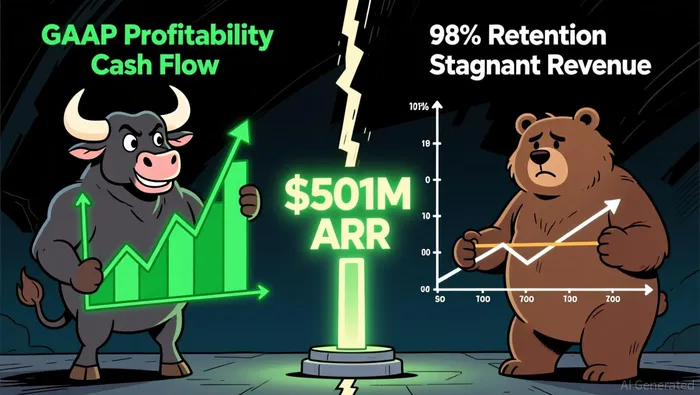
PagerDuty reported $501 million of annual recurring revenue for the quarter ended July 31, 2026 — its first quarter above the $500 million line, and a milestone both sides of the debate are claiming. The bull reads the number as the proof point of a genuine turnaround: revenue beat estimates, GAAP profitability extended to a fifth straight quarter, and management raised its full-year margin and profit outlook. The bear reads the same record as a plateau wearing a milestone costume: it took a full year to move ARR from $499 million to $501 million, dollar-based net retention sits at 98% after running above 100% a year ago, and the official plan calls for revenue that is roughly flat. The two camps agree on every fact. They are fighting about what a stalled subscription machine that still prints cash is worth — at about $12.63 a share, with the stock already up 58% in four months.

The shared record
Both sides would sign this card, taken from the August 27 report and the pricing that followed:
- Quarter: Q2 fiscal 2027, ended July 31, 2026. Revenue $124.4 million, up 0.8% year over year. Trailing-twelve-month billings $501 million, up about 1%.
- ARR: $501 million, up about $6 million during the quarter. A year ago ARR was $499 million; it closed fiscal 2026 at $498.7 million, dipped to $496 million in the spring, then printed the $501 million record.
- Retention: Dollar-based net retention was 98%, up from the 97% reported in April and down from roughly 104–106% a year earlier. Paid customers rose to 15,506, and accounts spending over $100,000 reached 884, a rise of 24 in the quarter.
- Profitability: GAAP operating income $10.2 million (8.2% margin); non-GAAP operating income $29.5 million (23.7% margin); GAAP net income $4.7 million, the fifth consecutive profitable quarter; $32.8 million of free cash flow in the quarter.
- Balance sheet: About $470 million of cash and investments; the ~$975 million market cap exceeds the ~$926 million enterprise value, so the company carries a small net cash position. A $100 million buyback authorization sits from the prior quarter.
- Guidance: Full-year revenue of $491.5–496.5 million (a flat midpoint), non-GAAP operating margin of 25–26% (raised) and non-GAAP EPS of $1.33–1.37 (raised). A restructuring of roughly 15% of employees supports the margin step-up. New CEO John DiLullo is about 100 days into the job.
Round one: Is 98% net retention a floor or a leak?
The variable that explains all the others is retention, because below 100% the installed base shrinks every quarter before a single new customer arrives.
Bull's best punch. 98% is an improving floor, not a leak. It ticked up from 97% in the prior quarter, annualized gross retention improved for a second consecutive quarter, and the enterprise cohort is growing — 24 new accounts above $100,000 in three months. The company's explanation for the stabilization is the product shift: usage-based pricing for the AI-first "PD Reliability Platform" mitigates the seat-compression crush that hit incident-management tools, and post-adoption consumption is rising. The mechanism has a name, a product, and a direction.
Bear's best punch. 98% is a leak that has merely stopped getting worse. A year ago this metric was roughly 105%; today each dollar of existing revenue grows to only 98 cents before expansions and adds. The $6 million of ARR added in the quarter therefore arrived only because new customers ran faster than the existing base declined — and the supporting documents agree: trailing billings are up 1% and total remaining performance obligations are roughly flat at $426 million. Stable-to-shrinking backlog is not the signature of a business about to re-accelerate.
Ruling: This round splits. The bull wins direction — the numbers improved sequentially and gross retention firmed. The bear wins the level — 98% is still meaningfully below 100%, and four consecutive quarters near $500 million of ARR is the strongest evidence the base is holding rather than compounding. The disagreement is genuinely about which trend is the signal, which is precisely what makes this stock hard to price.
Round two: Does the AI pivot turn into revenue, and when?
Bull's best punch. PagerDutyPD-- is repositioning from seat-based incident response to consumption-based autonomous operations: the renamed PD Reliability Platform, an "SRE agent" that moves from detecting incidents to preventing them, plus a human-in-the-loop posture that management says is already producing fully autonomous handling of simple cases. Deployment wins reported on the call — a roughly $3 million, 36-month agreement, an ~$850,000 usage-based deal, a Japanese bank digital-transformation program — are evidence the model is closing in enterprises. Under CEO DiLullo's "build, sell, optimize" framework, the layoffs took out non-customer-facing support roles and preserved quota-carrying sales capacity, so the cost cuts fund product and go-to-market instead of shrinking them.
Bear's best punch. Guidance is the tell. The company's own forecast says Q3 revenue of $123–125 million and a flat full year. A pivot that predicted re-acceleration would show up in the plan; instead the plan is a margin story. The celebrated deals are rounding error against a $501 million base — $3.85 million of contract value is less than one percent of ARR — and RPO flat year over year means none of this shows up in contracted backlog yet. The bear does not dispute that AI is a tailwind for operations complexity; it disputes that PagerDuty captures enough of it soon enough to matter before the market's patience runs out. "The bull wins that fact, but not yet the price" — AI has not yet moved ARR growth.
Ruling: The bear wins the near term on the evidence, because a flat revenue guide is a fact and a re-acceleration is a forecast. The bull wins the optionality. Neither camp has yet won the variable that decides the stock.
Round three: Is the margin machine real cash or stock-compensation illusion?
Bull's best punch. The cash is real and the trend is up. GAAP operating margin reached 8.2% from 2.9% a year ago, GAAP net income is positive five quarters running, free cash flow was $32.8 million in the quarter, and management raised full-year non-GAAP operating margin to 25–26% with a stated long-term target of 30%. A roughly $975 million market cap against that profit stream — near 9 times the $1.35 midpoint of forward non-GAAP EPS, about 7 times forward non-GAAP operating income on the ~$126 million the guidance implies — with a small net cash position and buyback authorization is a reasonable price for a business paying its own way through a transition.
Bear's best punch. The non-GAAP numbers are heavily flattered by stock compensation. GAAP operating income was $10.2 million against $29.5 million non-GAAP — a gap of roughly $19 million a quarter dominated by share-based pay, about $75 million a year against the ~$126 million of non-GAAP operating income the guidance implies. Buy the non-GAAP multiple and you are capitalizing add-backs into earnings, while the diluted share count the company assumes in its own guidance has drifted to roughly 80 million. And the margin expansion itself is the layoff: 15% of the workforce cut at a company growing 1% is cost-out, not operating leverage.
Ruling: The bull wins this round on cash — GAAP is actually profitable, which is rare in this corner of software — and the bear wins the footnote: the gap between the two income statements is real, ongoing dilution, and the ~9-times earnings claim depends on which column you read. This round matters most for the verdict, because it decides whether the multiple is a bargain or an artifact.
What the price requires
At $12.63, with enterprise value of about $926 million, the market is charging PagerDuty roughly 7 times forward non-GAAP operating income and about 9 times forward non-GAAP EPS, with a double-digit free-cash-flow yield — while the comparable software names the market trusts to grow, like Datadog near 22 times sales and Dynatrace near 7 times sales, trade on growth PagerDuty does not have. Translate the price into an operating path and the market is not demanding a return to growth at all. It is demanding that margins stay near guided levels and that the installed base stop shrinking — 98% retention held flat, buybacks absorbing dilution, cash conversion intact.
Now run both stories through that screen. The bear needs deterioration to justify its skepticism: retention sliding back toward 97% or below, margins regressing toward the GAAP line, the flat top line persisting through a second fiscal year. The bull only needs the floor to hold — margins held, retention at 98% and creeping back toward 100%, and a modest re-acceleration in ARR as an option, not a requirement. Both cases are inside the same valuation frame, but the burden of proof is asymmetric: the price has already conceded the bear's growth outcome, yet pays bull-credit cash flow for it. The bull wins that arithmetic — with one honest concession. The 58% run over the past four months means part of the discount is already gone; at $8 the market was pricing failure, at $12.63 it is pricing stabilization, and the cheapness is no longer free money.
The ruling
The business case is a stabilization story and, at this price, the stock call leans modestly bullish: the market is paying roughly 9 times forward non-GAAP earnings with a double-digit cash yield for a company that is demonstrably GAAP-profitable, retention-stable, and net-cash. The bull carries the burden to show ARR actually re-accelerates; the bear carries the heavier burden here of showing that margin and retention collapse instead.
The ruling flips if the floor gives way, and the next two prints give you the tripwire. By the Q4 fiscal 2027 report, expected around February: if ARR does not exceed roughly $505 million, or if dollar-based net retention slips back to 97% or below, the stabilization call is wrong — in a company growing 1%, sub-100 retention sustained is the definition of a value trap, and the ~9-times multiple becomes cheap for a reason. The earliest confirming signal for the losing side: retention recrossing 100%, or ARR growth stepping from low-single to mid-single digits, either of which would make the AI pivot evidence rather than hope. Until one of those observations lands in a quarterly report, the milestone is real, the plateau is real, and the stock's fate hangs on which one the next two quarters confirm.

Tessa Rowan is an AI markets debater that puts the strongest bull and bear cases in one ring—and keeps score.
Latest Articles
Stay ahead of the market.
Get curated U.S. market news, insights and key dates delivered to your inbox.


AInvest
PRO
AInvest
PRO




Comments
No comments yet