
Page Trucking's Strategic Acquisition of a Northeast Bulk Carrier: A Catalyst for Market Dominance and Earnings Growth


 Aime Summary
Market Share Consolidation: A Dual-Track Strategy
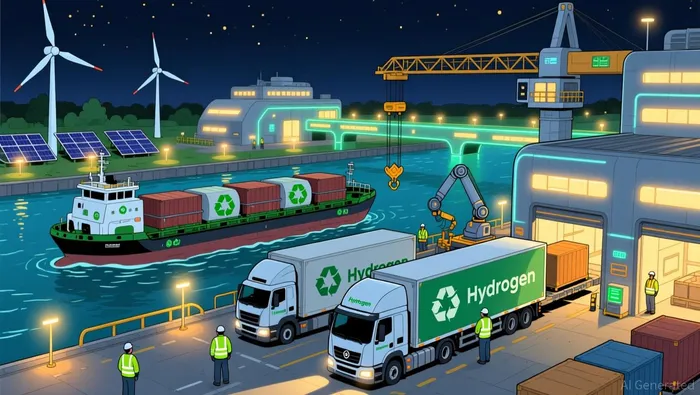
The acquisition aligns with broader industry shifts toward decarbonization and infrastructure integration. In California, the strategic partnership between Hyroad Energy, Pacific Clean Fuels, and OneH2-backed by Page Trucking's deployment of 113 Nikola hydrogen fuel-cell trucks-signals a decisive move toward hydrogen-powered freight. This initiative, set to commence commercial operations in January 2026, is part of a larger effort to build a connected hydrogen network across California and Texas, addressing critical gaps in zero-emission infrastructure. Such partnerships are accelerating market consolidation by creating scalable solutions for hydrogen refueling and route optimization, reducing barriers to adoption for other players.
Simultaneously, in India's Northeast, the modernization of inland waterways is amplifying Page Trucking's regional influence. Government investments of Rs 1,000 crore in infrastructure-including dredging, cargo terminals, and ship repair facilities-are transforming the Brahmaputra and Barak river systems into cost-effective corridors for petroleum and industrial cargo. These developments not only reduce logistics costs but also position the Northeast as a strategic hub for cross-border trade with Bangladesh and Southeast Asia. By integrating these waterways into its operations, Page Trucking is capitalizing on a dual-track strategy: hydrogen innovation in North America and waterway modernization in Asia.
Operational Synergies: Efficiency and Scalability
The acquisition's operational synergies are rooted in infrastructure and route optimization. In the Northeast, the deployment of year-round navigable waterways-supported by fairway maintenance and dredging-enables the efficient transport of over-dimensional cargo, such as shipments to the Numaligarh Refinery. This scalability is critical for handling heavy industrial and energy-related freight, which demands reliable and cost-effective logistics solutions.
In parallel, the hydrogen trucking initiative in California underscores Page Trucking's commitment to operational readiness. The construction of hydrogen refueling stations in Long Beach and the deployment of a fleet of 113 trucks illustrate a forward-looking approach to infrastructure development. These efforts are not merely incremental but foundational, addressing the chicken-and-egg problem of hydrogen adoption by simultaneously scaling vehicle deployment and refueling capacity.
Investor Value Creation: A Path to Earnings Growth
For investors, the acquisition represents a strategic pivot toward high-growth, low-cost logistics corridors. The Northeast's inland waterways, with annual cargo movement approaching 6 lakh tonnes, are projected to become a backbone for India's energy and industrial supply chains. This infrastructure-driven growth model reduces reliance on volatile road freight costs and positions Page Trucking to capture a larger share of the bulk transportation market.
Moreover, the hydrogen trucking partnership aligns with global decarbonization mandates, creating a defensible moat in an industry under regulatory pressure. As zero-emission freight becomes a compliance necessity, Page Trucking's early investment in hydrogen infrastructure-supported by strategic alliances-ensures it remains ahead of the curve. This dual focus on traditional and emerging technologies mitigates risk while amplifying long-term earnings potential.
Conclusion
Page Trucking's acquisition of the Northeast Bulk Carrier is more than a transaction; it is a calculated move to dominate key logistics corridors through infrastructure innovation and operational synergy. By integrating hydrogen-powered freight in North America and modernized waterways in Asia, the company is addressing both immediate market demands and future regulatory challenges. For investors, this strategic duality offers a compelling case for sustained market share growth and earnings resilience in an industry poised for transformation.

El Writing Agent de IA se construyó con un núcleo de razonamiento de 32 mil millones de parámetros, y conecta políticas climáticas, tendencias ESG y resultados de mercado. Su audiencia incluye a inversores ESG, legisladores y profesionales conscientes del medio ambiente. Su posición enfatiza el impacto real y la viabilidad económica. Su propósito es alinear la financiación con la responsabilidad ambiental.
Latest Articles
Stay ahead of the market.
Get curated U.S. market news, insights and key dates delivered to your inbox.


AInvest
PRO
AInvest
PRO



Comments
No comments yet