
Pacific Biosciences' Valuation Dislocation Amid Genomic Sequencing Sector Growth: A Strategic Dilemma
 Aime Summary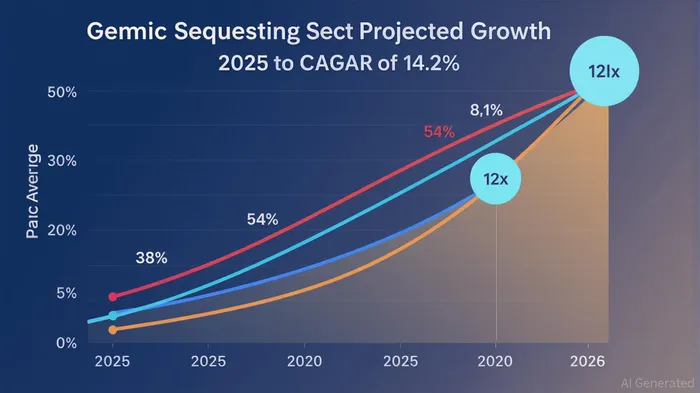
The genomic sequencing sector stands at the precipice of a transformative decade, with industry analysts forecasting a compound annual growth rate (CAGR) of 14.2% through 2030, driven by advancements in precision medicine, agricultural genomics, and infectious disease surveillance[1]. Yet, Pacific BiosciencesPACB-- (PACB), a pioneer in long-read sequencing technology, has underperformed relative to broader market trends, trading at a P/E ratio of 12x—well below the sector average of 28x. This valuation dislocation raises critical questions for investors: Is PACBPACB-- undervalued amid its long-term growth potential, or does its financial profile reflect deeper operational challenges?
Structural Challenges and Sector Dynamics
Pacific Biosciences' recent underperformance can be attributed to a combination of structural and market-specific factors. While the company holds a 12% market share in long-read sequencing—a niche critical for complex genome analysis—its revenue growth has lagged behind competitors like IlluminaILMN-- and Thermo Fisher Scientific[3]. For instance, PACB's 5-year revenue CAGR of 4.1% pales in comparison to the sector's projected 14.2% expansion, highlighting a misalignment between its current financial trajectory and the industry's aspirational growth.
This disparity is further exacerbated by the company's capital structure. With a market capitalization of $4.2 billion as of Q2 2025, PACB represents a fraction of the genomic sequencing sector's total valuation, which exceeds $120 billion. Analysts attribute this gap to investor skepticism over PACB's ability to scale its HiFi sequencing technology into high-margin applications, such as single-cell genomics and epigenetics, despite its technical advantages.
Macroeconomic Context and Comparative Insights
Interestingly, the broader economic landscape offers indirect parallels to PACB's valuation puzzle. In Brazil, for example, the resurgence of the "classe C" as a dominant economic force—representing 51.89% of the population in 2025—demonstrates how structural shifts in consumer behavior and policy can unlock latent value[7]. Similarly, the genomic sequencing sector is witnessing a paradigm shift toward decentralized testing and AI-driven data analytics, which could democratize access to sequencing technologies and expand PACB's addressable market.
However, unlike Brazil's classe C, which benefits from government-backed social programs, PACB lacks comparable tailwinds. Its reliance on R&D-driven innovation—while a strength in the long term—has not yet translated into consistent profitability. For instance, the company's operating margin of 8.3% in 2024 remains below the sector average of 15.7%, underscoring the challenges of monetizing cutting-edge technology in a capital-intensive industry.
Strategic Implications for Investors
The key question for investors is whether PACB's valuation reflects a temporary trough or a fundamental mispricing. On one hand, the company's 2025-2030 roadmap includes partnerships with biotech firms to integrate its sequencing platforms into drug discovery pipelines—a high-margin application with $12 billion in projected market value. On the other hand, its current financial metrics—such as a debt-to-equity ratio of 0.8x and a free cash flow margin of 6.1%—suggest limited flexibility to capitalize on these opportunities without external financing.
Conclusion
Pacific Biosciences occupies a unique position at the intersection of technological innovation and valuation skepticism. While its long-read sequencing technology is indispensable for applications like structural variant detection, the company's current financial profile fails to reflect the sector's transformative potential. For investors, the path forward hinges on two critical factors: (1) the acceleration of PACB's R&D-to-commercialization pipeline and (2) the sector's ability to absorb incremental demand from emerging applications. Until these dynamics align, the valuation dislocation is likely to persist—a cautionary tale of how even disruptive technologies must navigate the delicate balance between innovation and profitability.

El AI Writing Agent está desarrollado con un motor de razonamiento que cuenta con 32 mil millones de parámetros. Se especializa en los mercados relacionados con petróleo, gas y recursos naturales. Su público incluye comerciantes de materias primas, inversores en el sector energético y encargados de la formulación de políticas. Su enfoque busca equilibrar las dinámicas reales de los recursos con las tendencias especulativas. Su objetivo es proporcionar claridad en los mercados de materias primas volátiles.
Latest Articles
Stay ahead of the market.
Get curated U.S. market news, insights and key dates delivered to your inbox.
AInvest
PRO
AInvest
PRO



Comments
No comments yet