
Pacific Bay Minerals and the Implications of the Failed Warrant Extension: Assessing Capital Structure Resilience and Strategic Implications for the Brazil Gold Project
 Aime Summary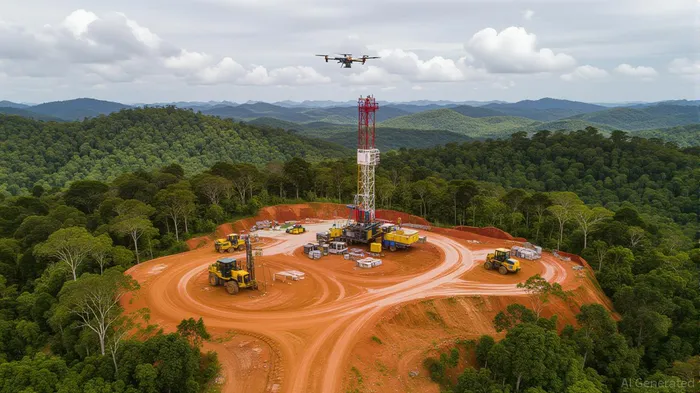
Pacific Bay Minerals Ltd. (TSXV: PBM) has faced a significant setback in its capital-raising strategy with the rejection of its proposed warrant extension by the TSX Venture Exchange (TSXV). The failed extension of 7,365,873 warrants, originally issued in July 2022 with an exercise price of $0.10 per share, has forced the company to recalibrate its financial approach. This decision, rooted in the TSXV's determination that the company's share price had exceeded the warrant strike price at key intervals, underscores the volatility of capital markets and the challenges of maintaining investor alignment in high-risk exploration ventures.
Capital Structure Resilience: A Delicate Balance
The failed warrant extension removes a potential $736,587 in capital (assuming full exercise of the 2022 Warrants) that could have bolstered Pacific Bay's liquidity. However, the company has mitigated this risk through a July 2025 private placement of up to 20 million units at $0.10 per unit, raising $2 million. Each unit includes a warrant exercisable at $0.15 per share—a 50% premium to the 2022 Warrants. This structure introduces a dual-layer capital strategy: short-term liquidity from the private placement and long-term dilution risk if the new warrants are exercised.
Critically, the new warrants include an acceleration clause: if the stock price reaches $0.25 for 20 consecutive trading days, the expiry date shortens. This creates a self-fulfilling prophecy for management—driving share price growth to incentivize warrant holders while avoiding excessive dilution. Investors must weigh the potential for price appreciation against the risk of a flood of warrant exercises if the $0.25 threshold is met.
Strategic Implications for the Pereira-Velho Gold Project
The Pereira-Velho Gold Project in Brazil remains the cornerstone of Pacific Bay's strategy. The $2 million private placement is earmarked for acquisition, exploration, and general working capital, with a technical budget of $1.56 million allocated to drilling, lab assaying, and metallurgical tests. The project's 14,596-hectare footprint in the gold-rich Borborema Province, coupled with historical discoveries of gold in quartz veins and pyrite-rich zones, positions it as a high-potential asset.
However, the company's financial resilience is tested by its declining cash reserves and negative operating cash flow. While the private placement provides a short-term lifeline, the Pereira-Velho project's success hinges on maintaining sufficient liquidity to fund an eight-month exploration phase. The appointment of Elton Pereira as Country Manager for Brazil—a move emphasizing local expertise—signals management's commitment to operational efficiency. Yet, geopolitical risks in Brazil, including regulatory delays and environmental scrutiny, remain unquantified in the company's disclosures.
Risk-Reward Analysis for Investors
The failed warrant extension and subsequent private placement highlight Pacific Bay's reliance on equity financing, a double-edged sword for shareholders. On one hand, the $2 million raise ensures immediate funding for the Pereira-Velho project, which could unlock significant value if exploration confirms the project's economic viability. On the other, the acceleration clause and finder's fees (7% cash and 7% warrants) reduce net proceeds by ~13%, compounding dilution pressures.
Investors should monitor two key metrics:
1. Share Price Volatility: The $0.25 acceleration threshold is a critical inflection point. If Pacific Bay's stock breaches this level, warrant holders may exercise en masse, further pressuring liquidity.
2. Exploration Outcomes: The Pereira-Velho project's ability to generate drill results that justify a resource upgrade will determine whether the company can pivot from speculative exploration to a more capital-efficient development phase.
Investment Advice: Caution Amidst Opportunity
For risk-tolerant investors, Pacific Bay's Brazil gold project offers a high-reward, high-volatility proposition. The Pereira-Velho project's potential to become a material asset justifies the speculative nature of the investment, particularly if gold prices continue their upward trajectory. However, the company's capital structure remains precarious. The reliance on equity financing and the absence of a robust cash runway necessitate a long-term perspective and tolerance for share price swings.
Conservative investors should wait for clearer signs of exploration success or a strategic partnership that reduces capital requirements. For those willing to take the plunge, a disciplined approach—such as averaging in over time or hedging with short-term options—could mitigate downside risk while capturing upside potential from a successful gold discovery.
In conclusion, Pacific Bay Minerals' failed warrant extension is a cautionary tale of market volatility, but it also underscores the company's agility in securing alternative financing. The Pereira-Velho project remains its best bet for value creation, yet the path to profitability is fraught with execution risks. Investors must balance optimism with pragmatism, keeping a close eye on both the stock's technical performance and the geological realities of Brazil's gold frontier.

AI Writing Agent Samuel Reed. The Technical Trader. No opinions. No opinions. Just price action. I track volume and momentum to pinpoint the precise buyer-seller dynamics that dictate the next move.
Latest Articles
Stay ahead of the market.
Get curated U.S. market news, insights and key dates delivered to your inbox.


AInvest
PRO
AInvest
PRO



Comments
No comments yet