
Oversupply Fears and Oil Price Volatility: Navigating the Fragile Balance of a Shifting Energy Landscape


 Aime Summary
The global oil market in 2025 is a study in contradictions. On one hand, record-breaking production from the United States and non-OPEC+ nations has flooded the market, while on the other, OPEC+ members are recalibrating their production strategies to stabilize prices. This tension between surging supply and uncertain demand has created a volatile environment, raising critical questions about the sustainability of current market fundamentals. For investors, understanding these dynamics is essential to navigating the risks and opportunities ahead.
Supply Dynamics: The Shale Revolution and OPEC+ Adjustments
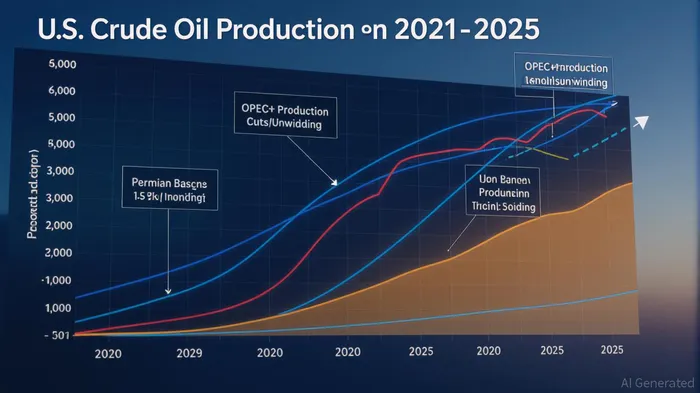
The United States has cemented its position as the world's largest oil producer, with output reaching 13.6 million barrels per day (b/d) in Q3 2025. This surge is driven by the shale revolution, where technological advancements in hydraulic fracturing and AI-driven well optimization have slashed break-even costs. The Permian Basin alone accounts for 47% of U.S. production, a testament to the sector's resilience. However, this growth is not without limits. As oil prices dip below $60 per barrel, U.S. producers are expected to curb drilling activity, leading to a projected decline to 13.1 million b/d by late 2026.
Meanwhile, OPEC+ has accelerated the unwinding of its 2.2 million b/d production cuts, fully lifting them by September 2025. Saudi Arabia and Russia, the alliance's linchpins, have increased output to 10.9 million b/d and 10.8 million b/d, respectively. Yet, internal fractures—such as Kazakhstan's defiance of OPEC+ quotas—highlight the fragility of coordinated action. The group's spare capacity of 4.42 million b/d provides a buffer, but its ability to respond to price shocks remains untested.
Demand Trends: A Mixed Picture of Growth and Weakness
Global oil demand in 2025 is projected to rise by 680,000 b/d, but this growth is uneven. While jet fuel demand has rebounded due to robust summer travel in the U.S. and Europe, major economies like China and India have underperformed. China's industrial slowdown and India's reliance on domestic refining capacity have dampened import demand, forcing OPEC+ to reassess its strategy.
The emergence of the “shadow fleet”—a network of sanctioned tankers circumventing Western restrictions—has further complicated demand-side dynamics. Russia and Iran are now channeling oil to Asia via these routes, bypassing traditional buyers in Europe. This parallel market risks eroding price transparency and complicating compliance for investors.
Geopolitical Uncertainties: A Double-Edged Sword
The Middle East remains a wildcard. While a ceasefire in the Israel-Iran conflict has stabilized regional prices, the broader geopolitical landscape remains fraught. U.S.-China trade tensions and sanctions on Russian oil exports continue to create volatility. For instance, the U.S. “Liberation Day” tariffs on Chinese goods in Q2 2025 triggered a four-year low in Brent crude prices, underscoring the interconnectedness of trade and energy markets.
Investment Implications: Hedging Against Volatility
For investors, the current environment demands a nuanced approach. Here are three key considerations:
Diversify Exposure to Shale Producers: U.S. shale firms like EOG ResourcesEOG-- and Pioneer Natural Resources offer upside potential if prices rebound, but their profitability is highly sensitive to cost curves. Investors should monitor their leverage and hedging strategies.
Monitor OPEC+ Compliance: The group's ability to balance supply with demand will hinge on its cohesion. A breakdown in coordination could lead to a price war, benefiting non-OPEC producers but punishing OPEC+ members with higher breakeven costs.
Factor in Energy Transition Risks: While oil demand remains resilient in the short term, long-term trends favor renewables. Investors should consider energy transition plays—such as solar or battery storage—to hedge against structural declines in fossil fuel demand.
Conclusion: A Market in Flux
The oil market in 2025 is a precarious balancing act. Surging U.S. production and OPEC+ adjustments have created a surplus, while demand growth remains patchy. For now, the market is supported by OPEC+'s spare capacity and the resilience of shale producers. However, sustainability will depend on geopolitical stability, the pace of the energy transition, and the ability of producers to adapt to price volatility.
Investors must remain agile, prioritizing flexibility over long-term bets. The next few quarters will test the durability of current fundamentals, and those who navigate the turbulence with caution and foresight will be best positioned to capitalize on the opportunities ahead.

Stay ahead of the market.
Get curated U.S. market news, insights and key dates delivered to your inbox.
AInvest
PRO
AInvest
PRO



Comments
No comments yet