
The Overestimated Potential of Driverless Taxis: Navigating Reality in Autonomous Mobility
The promise of driverless taxis—convenient, affordable, and transformative—has long fueled investor optimism in autonomous mobility. Yet, as HSBC's recent analyses underscore, the path to widespread adoption is littered with obstacles: delayed timelines, staggering capital demands, fragmented regulations, and operational challenges that could derail returns. For investors, this reality check demands a sharp recalibration: prioritize firms with diversified revenue streams or near-term monetizable technologies over bets on pure-play robotaxis. Here's why.
The Timeline Mirage
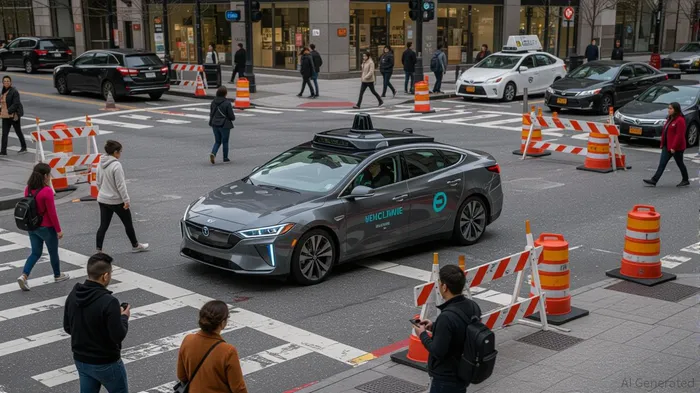
The allure of fully autonomous vehicles (Level 5) hinges on the assumption that technological progress will outpace hurdles. HSBC's skepticism targets this optimism. While Level 3 systems (conditional automation) are slowly gaining regulatory approval in regions like Europe and Japan, Level 4 (high automation) and Level 5 (full autonomy) remain distant. Germany and Japan have permitted consumer use of Level 3 automated lane-keeping systems (ALKS), but even these systems require drivers to intervene instantly in emergencies—a gap in public trust and liability frameworks that delays broader adoption.
 .
.
The reality? Full autonomy requires solving edge cases—snowstorms, sudden roadblocks, or aggressive drivers—that defy easy coding. HSBCHSBC-- notes that even advanced trials in Singapore and China are confined to geofenced zones, far from the open roads needed for mass adoption. The result: timelines for Level 5 deployment keep slipping. A 2023 McKinsey report projected 2030 as a plausible target, but HSBC warns that geopolitical disruptions and regulatory inertia could push it further.
Capital Intensity: A Costly Race to Nowhere
Autonomous vehicle development is a capital black hole. Companies must invest in AI, sensor systems, 5G infrastructure, and massive data centers to process terabytes of real-world driving data. The bill is staggering: Waymo, Alphabet's self-driving unit, has spent over $30 billion since 2009, while Cruise (GM's subsidiary) has raised $8.3 billion since 2019.
.
Even worse, geopolitical tensions exacerbate costs. U.S.-China trade wars have disrupted supply chains for semiconductors and LiDAR sensors. Companies like TeslaTSLA-- and Ford now face dual pressures: diversifying suppliers to mitigate risks and complying with divergent regulations (e.g., EU data privacy laws vs. U.S. state-by-state rules). HSBC argues that these costs could force smaller players out, leaving only giants with deep pockets—or those willing to partner with governments.
Regulatory Quagmire
Regulatory fragmentation is a major headwind. In the U.S., a patchwork of state laws creates operational chaos, while Europe's harmonized approach—driven by UNECE's Regulation No. 157 for Level 3 ALKS—has moved faster. Yet liability remains unresolved: Who is responsible in an accident? The manufacturer, the software provider, or the passenger?
.
Governments also fear economic disruption. Taxi unions and trucking associations have lobbied against rapid adoption, delaying approvals. In the U.S., the National Highway Traffic Safety Administration's (NHTSA) 2024 updates to the Driver-Centric Automation Standards (DCAS) aim to streamline testing, but compliance adds costs and delays.
Operational Challenges: Trust and Data
Public skepticism is a silent killer. Surveys show over 60% of consumers distrust self-driving cars, a sentiment reinforced by high-profile accidents during testing phases. Without trust, companies face a Catch-22: scaling requires public acceptance, but acceptance demands flawless performance.
Meanwhile, data privacy concerns loom large. AVs generate vast amounts of data—from road conditions to passenger behavior—that regulators and activists demand be secured. The EU's General Data Protection Regulation (GDPR) and California's Consumer Privacy Act (CCPA) force companies to invest in cybersecurity, diverting funds from core R&D.
Investment Strategy: Pragmatism Over Hype
HSBC's analysis suggests investors should avoid pure-play robotaxi companies unless they have other revenue streams. Instead, focus on firms with:
- Near-term monetizable tech: Companies like NVIDIANVDA-- (NVDA), which sells AI chips and software to automakers, or Tesla (TSLA), whose Full Self-Driving (FSD) beta generates recurring revenue through subscriptions.
- Diversified revenue models: ToyotaTM-- (TM) and Ford (F) are integrating advanced driver-assistance systems (ADAS) into mainstream vehicles, turning autonomous tech into a profit center today, not a distant dream.
- Strategic partnerships: Companies like AptivAPTV-- (APTV), which supplies autonomous driving systems to multiple automakers, reduce risk through shared investment.
Avoid betting on firms reliant solely on robotaxi networks, such as Waymo or Cruise, unless they can demonstrate a path to profitability within five years.
Conclusion
The autonomous mobility sector is at a crossroads. While HSBC's skepticism highlights risks, it also underscores opportunities for investors who focus on resilience. The road to driverless taxis is long, costly, and fraught with regulatory potholes. Success will favor firms that generate cash today while building for tomorrow—rather than those doubling down on a distant, overhyped vision.
.
In short, investors should prioritize pragmatism over prophecy. The future of autonomous vehicles isn't a straight line—it's a winding route best navigated with a diversified portfolio.

Stay ahead of the market.
Get curated U.S. market news, insights and key dates delivered to your inbox.




Comments
No comments yet