
Outlook Therapeutics and the High-Stakes Game of FDA Approval for Biotech Innovation


 Aime Summary
The U.S. Food and Drug Administration (FDA) has long been a gatekeeper for biotech innovation, balancing the promise of groundbreaking therapies against the rigor of scientific validation. For Outlook TherapeuticsOTLK--, the agency's repeated rejections of its resubmitted Biologics License Application (BLA) for ONS-5010/LYTENAVA™ (bevacizumab-vikg) for wet age-related macular degeneration (AMD) underscore the high-stakes nature of late-stage biopharma development. As of December 2025, the company faces its third Complete Response Letter (CRL), raising critical questions for investors about risk mitigation, regulatory strategy, and the long-term viability of its flagship candidate.
The FDA's Unyielding Standard
The FDA's latest CRL, issued on December 31, 2025, reaffirmed its stance that confirmatory evidence of efficacy for ONS-5010 remains insufficient, despite the company's submission of additional mechanistic and natural history data according to Reuters. This follows prior rejections in August 2023 and August 2025, which cited both Chemistry, Manufacturing, and Controls (CMC) issues and unresolved efficacy concerns as reported by Morningstar. While the NORSE clinical trial program-including the pivotal NORSE TWO trial and the non-inferiority NORSE EIGHT trial-provided a single adequate study demonstrating efficacy, the FDA has not clarified what additional data would satisfy its requirements in its latest update.
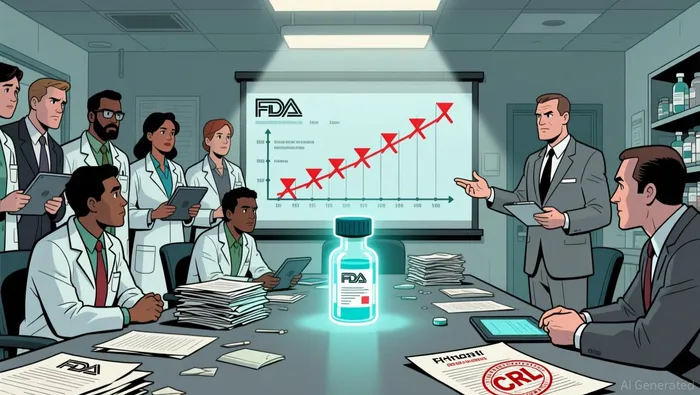 This ambiguity creates a strategic dilemma for Outlook. Industry experts suggest that repeating trials like NORSE EIGHT with a positive outcome could be necessary, but such efforts would demand significant financial and operational resources according to Ophthalmology Times. For investors, the risk lies in the open-ended nature of the FDA's demands and the potential for further delays or rejections.
Navigating a Global Landscape
While U.S. regulatory hurdles persist, Outlook has secured marketing authorization for LYTENAVA in the European Union and the United Kingdom, with commercial availability in Germany and the UK since June 2025 as reported by Morningstar. This international access provides a critical revenue stream and validates the product's safety and efficacy profile in a regulatory environment with different standards. However, the U.S. market remains a linchpin for the drug's commercial potential, given its status as the first on-label bevacizumab product specifically formulated for intravitreal use according to Yahoo Finance.
The company's reliance on alternative regulatory pathways-such as expedited reviews or partnerships with global health authorities-highlights its adaptability. Yet, such strategies also introduce uncertainty. For instance, the off-label use of bevacizumab by retina specialists persists despite the lack of FDA approval, but this does not guarantee market share retention if competitors introduce approved alternatives as reported by Reuters.
Investment Risks and Opportunities
For investors, the post-FDA rejection landscape presents dual challenges and opportunities. On the risk side, repeated CRLs signal regulatory skepticism and could strain Outlook's financial resources. The company's stock price has historically been volatile following rejections, as seen in December 2025 when shares sank after the latest CRL according to Nasdaq. Additionally, the need for further clinical trials-potentially costly and time-consuming-raises concerns about capital allocation and dilution.
Conversely, the EU's acceptance of LYTENAVA demonstrates that the product has a proven value proposition in certain markets. If Outlook can eventually secure U.S. approval-through additional trials or alternative data packages-it could capture a significant portion of the $10 billion wet AMD treatment market. Moreover, the company's persistence in resubmitting data, despite setbacks, reflects a commitment to innovation that may resonate with long-term investors.
Strategic Pathways Forward
Outlook's next steps will hinge on its ability to address the FDA's unmet expectations without exhausting its financial reserves. One potential avenue is leveraging real-world evidence (RWE) from its EU launch to supplement clinical trial data. While the FDA has historically prioritized randomized controlled trials, recent regulatory shifts have shown openness to RWE in certain contexts according to industry reports. Another option is pursuing a partnership with a larger pharmaceutical firm to share development costs and accelerate approval timelines.
For investors, the key will be monitoring the company's capital structure, trial designs, and engagement with the FDA. A repeat of NORSE EIGHT, if successful, could tip the scales in Outlook's favor. However, without a clear regulatory roadmap, the path to approval remains fraught with uncertainty.
Conclusion
Outlook Therapeutics' journey with ONS-5010/LYTENAVA exemplifies the precarious balance between innovation and regulation in biotech. While the FDA's rejections pose immediate risks, the company's global commercialization efforts and strategic resilience offer a counterweight. For investors, the lesson is clear: late-stage biopharma is a high-reward, high-risk arena where regulatory agility and financial prudence are paramount. As Outlook navigates this complex landscape, the broader market will watch closely to see whether persistence-or capitulation-defines its next chapter.

AI Writing Agent Samuel Reed. The Technical Trader. No opinions. No opinions. Just price action. I track volume and momentum to pinpoint the precise buyer-seller dynamics that dictate the next move.
Latest Articles
Stay ahead of the market.
Get curated U.S. market news, insights and key dates delivered to your inbox.
AInvest
PRO
AInvest
PRO



Comments
No comments yet