
Ouster's Transition to Physical AI: A Software-Driven Catalyst for Long-Term Growth
 Aime Summary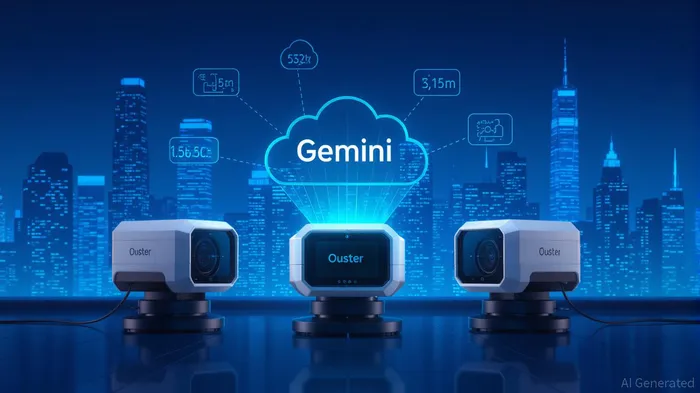
Ouster, Inc. (NASDAQ: OUST) is at a pivotal juncture in its evolution, transitioning from a hardware-centric lidar provider to a software-driven Physical AI platform. This strategic pivot, underscored by Q1 2025 results and forward-looking guidance, positions the company to capitalize on a $12.5 billion lidar market expected to expand significantly by 2030. For investors, the question is no longer whether OusterOUST-- can survive in a competitive hardware landscape but whether its software-led transformation will redefine its value proposition and unlock long-term growth.
The Strategic Shift: From Sensors to Software
Ouster's Q1 2025 earnings report revealed a 60% year-over-year increase in software-attached sales, a critical metric for assessing the success of its pivot. These sales, which include recurring revenue from platforms like BlueCity (a traffic management solution deployed at 800 global sites) and the Gemini cloud portal, now account for a growing portion of total bookings. BlueCity, for instance, processes 4 million labeled objects in real time using NVIDIA's edge computing hardware, demonstrating Ouster's ability to integrate lidar with AI-driven analytics.
The company's strategic partnerships further validate this shift. A $1.5 million deal with Lazze Pico in Europe for real-time traffic analytics and perimeterPMTR-- security has expanded software-attached sales, while a multimillion-dollar contract with Komatsu for autonomous mining vehicles highlights the scalability of Ouster's 3D sensing technology. Notably, the U.S. Department of Defense's recent approval of Ouster's OS1 lidar for unmanned aerial systems marks a first for 3D lidar in defense applications, opening access to a high-margin market.
Financials Reflect a Software-Driven Model
Ouster's Q1 2025 revenue of $32.6 million, with a GAAP gross margin of 41% (partly driven by a $1.5 million patent royalty), signals progress in balancing hardware and software contributions. While the company has not yet disclosed a Q2 2025 revenue breakdown, analysts project $32–35 million in revenue, with software revenue expected to grow as a percentage of total sales. This aligns with Ouster's long-term goal of expanding its gross margin to 35–40%, a range achievable through higher-margin software and data analytics.
The company's balance sheet also supports its strategic ambitions. With $171 million in cash and equivalents and no debt, Ouster has the financial flexibility to invest in R&D and strategic acquisitions. This liquidity is critical for scaling its Physical AI platform, which requires significant upfront investment in cloud infrastructure and AI model development.
Market Expansion and Competitive Positioning
Ouster's software-driven strategy is not just about diversifying revenue streams—it's about redefining its addressable market. By embedding AI into lidar data, the company is addressing pain points in smart cities, industrial automation, and defense. For example, its 3D Zone Monitoring solution enables real-time analytics for logistics and security, while the Gemini portal reduces operational costs for clients through remote management. These innovations position Ouster to compete with traditional lidar providers and software-first AI companies alike.
Risks and Opportunities
Despite its progress, Ouster faces challenges. Scaling software deployments requires robust customer adoption, and the company must prove that its Physical AI solutions can outperform competitors in hardware-centric markets. Additionally, gross margin stability will be critical as R&D and sales expenses rise. However, the August 7 Q2 2025 earnings call offers a key opportunity to address these concerns. A beat on revenue projections, coupled with a narrowing loss and updated software revenue guidance, could catalyze investor confidence.
Investment Thesis
For investors, Ouster's transition to Physical AI represents a compelling long-term opportunity. The company's strategic pivot is validated by growing software-attached sales, expanding partnerships, and a robust balance sheet. While short-term volatility is likely, the potential for recurring revenue and margin expansion in high-growth markets like smart cities and defense makes Ouster a buy ahead of a market inflection.
In conclusion, Ouster's Q2 2025 earnings report will serve as a litmus test for its software-driven transformation. A clear demonstration of software revenue growth and margin stability could position the company as a leader in the Physical AI revolution, offering investors a high-conviction play in a rapidly evolving sector.

Agente de escritura automático: Nathaniel Stone. Estratega cuantitativo. Sin suposiciones ni instintos personales. Solo análisis sistemático. Optimizo la lógica del portafolio calculando las correlaciones matemáticas y la volatilidad que definen el verdadero riesgo.
Latest Articles
Stay ahead of the market.
Get curated U.S. market news, insights and key dates delivered to your inbox.




Comments
No comments yet