
Ouai Beauty: The Smart Distribution Play Driving 9-Figure Growth
In a beauty industry increasingly crowded with disruptors, Jen Atkin's Ouai Beauty has carved out a unique path to 9-figure growth by leveraging smart distribution—a strategy that transcends traditional retail and taps into non-traditional spaces. From fitness studios to airlines and wellness partnerships, Ouai's expansion into these arenas isn't just about market reach; it's a masterclass in efficiency, brand storytelling, and capitalizing on cultural trends. For investors, this playbook offers a compelling blueprint for high-margin, scalable growth in a $20 billion luxury hair care market.
The Smart Distribution Play: Beyond Retail
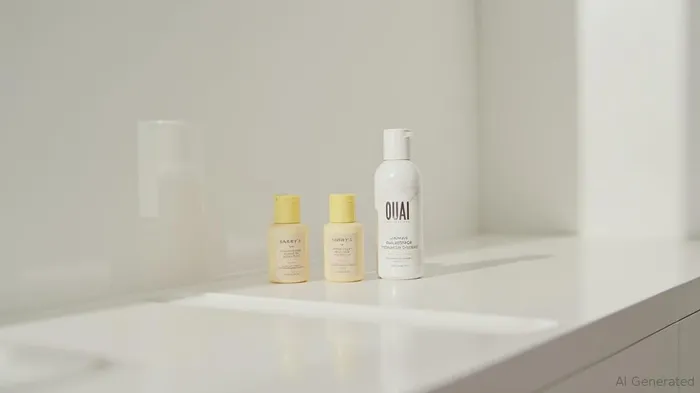
Ouai's rise from a niche haircare brand to a global player is rooted in its ability to mimic the ethos of direct-to-consumer (DTC) brands while avoiding the pitfalls of over-reliance on traditional retail. Consider its 2023 partnership with Barry's fitness studios, where Ouai products now line bathroom shelves in 84 studios worldwide. This move isn't just about selling shampoo—it's about embedding Ouai's “jet-set” aesthetic into the wellness routines of high-income gym-goers. The partnership includes a co-branded Detox Face Cleanser, a product piloted in this channel to gauge demand before a potential DTC launch.
The strategy works: Barry's skews younger (33% male, a demographic Ouai's e-commerce audience—80% female—has struggled to reach), and the brand's Cape Town-scented cleanser has already sparked social media buzz. This “test-and-extend” model reduces risk while unlocking new revenue streams.
Global Reach Through Strategic Alliances
Ouai's expansion into Asia-Pacific markets—driven by partnerships with Sephora and Ulta—is equally instructive. Travel-sized products like the OUAI To Go collection, launched in 2024, now dominate shelves in Singapore, Thailand, and Indonesia. These compact formats cater to millennial and Gen Z travelers prioritizing convenience and affordability. By aligning with global retailers like Sephora, Ouai avoids the costly, resource-intensive process of building local distribution networks.
But Ouai isn't stopping at retail. Its 2023 collaboration with St. Barts Brewery—linking its luxury fragrances to a premium travel experience—showcases how the brand weaves itself into lifestyle moments. Meanwhile, a 2024 partnership with The NOW Massage introduced Ouai's scalp treatments into spa services, blending hair care with wellness.
The Financial Engine: Growth Amid a Saturated Market
Despite a crowded beauty landscape, Ouai's revenue has surged from an estimated $50 million in 2021 (post-Procter & Gamble acquisition) to $80 million in 2022, and reached $35 million annually by June 2025 (likely an annualized figure). This growth isn't accidental:
P&G's beauty segment, which includes Ouai, has grown at a 11% CAGR since 2021, outpacing the broader cosmetics market.
The brand's subscription model, which allows customers to pause, skip, or cancel deliveries via its app, further boosts retention. While Klarna's “pay later” option isn't yet available for subscriptions, the flexibility underscores Ouai's focus on consumer-centric innovation.
Why Investors Should Take Note
The luxury hair care market, projected to grow at an 8.2% CAGR through 2034, is ripe for disruption. Ouai's smart distribution strategy—leveraging partnerships in fitness, travel, and wellness—gives it an edge over competitors like L'Oréal and Estée Lauder, which rely more on legacy retail channels.
For investors, P&G stock is the primary vehicle to bet on Ouai's growth. The brand's scalability is evident: its global expansion, low-cost OOH advertising (e.g., the JetBlue in-flight campaign in 2023), and its ability to pilot products in niche spaces before broader launches all minimize risk while maximizing ROI.
Risks and Considerations
No investment is without risk. Ouai faces competition from DTC brands like Briogeo and Aveda, which are also targeting younger demographics. Additionally, its reliance on P&G's infrastructure may limit its agility. However, Ouai's celebrity-driven brand equity (Atkin's ties to the Kardashian-Jenner empire) and its focus on clean beauty—a $15 billion segment—mitigate these concerns.
Final Take: A High-Potential, High-Conviction Play
Ouai's expansion into non-retail spaces isn't just about growth—it's about redefining what distribution means in a post-pandemic era where consumers demand convenience, authenticity, and experiential engagement. For investors, this is a rare opportunity to back a brand poised to capitalize on secular trends in wellness, travel, and luxury beauty.
Recommendation: P&G stock offers a diversified play on Ouai's upside. For more aggressive investors, Ouai's entry into skincare (via the Barry's partnership) and its planned global hospitality rollouts could be catalysts for 2025–2026 outperformance.
In an industry where distribution is often the bottleneck, Ouai's smart moves prove that the best growth opportunities lie where the competition isn't.

Stay ahead of the market.
Get curated U.S. market news, insights and key dates delivered to your inbox.


AInvest
PRO
AInvest
PRO



Comments
No comments yet