
Oscar Preview: $18B Growth Story Meets Its First Real Profit Test Tomorrow
 Aime Summary
Oscar's Aug. 6 report is the next proof point for the re-rating case
Why this quarter matters
Oscar reports before the market opens on Thursday, August 6, 2026, and management has already pointed to more than $18 Billion in Revenue for 2026. That makes this release more than a routine update: investors want to know whether scale is finally translating into a durable profit path.
That urgency increased after 2025, which management called a reset year for the individual market. With that backdrop, investors care less about the cleanup itself and more about whether the improvement is sticking. Even after management reaffirming its full year 2026 guidance, the market still wants operating data that supports that promise.
The bull case is straightforward: if cheaper product mix, AI-enabled tools, and a better member experience continue to improve efficiency, margins could broaden faster than the current narrative assumes. The main risk is also clear: if medical costs or spending mix worsen, growth alone may not be enough to validate the story.

Scale only helps if Oscar's unit economics are improving
Why Oscar's size now matters
Oscar is being judged less like a pure growth story and more like an insurer that should benefit from scale. It finished 2025 with record membership of ~3.4 million and generated $11.7 billion of total revenue in 2025. It was also operating in 20 States as of December 2025. At that size, fixed investments in technology, care management, and operations should be easier to spread across a larger member base.
Members were still 3.2 million as of March 31, 2026, which suggests Oscar did not lose momentum right after its year-end peak. If that base remains stable, growth can start supporting profitability rather than merely expanding revenue.
The margin equation in plain English
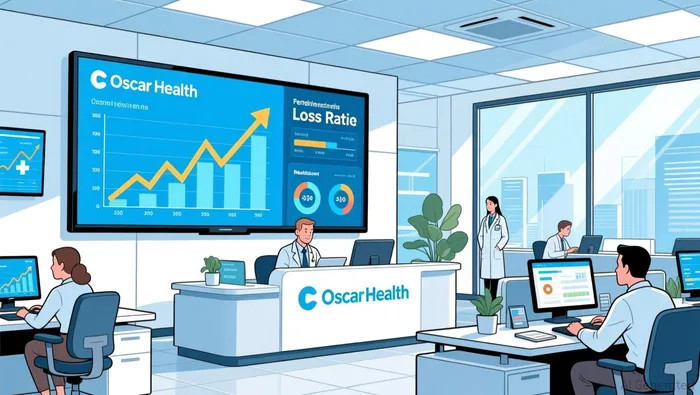
The core insurance question is simple: how much of each premium dollar goes to care, and how much is left to fund operations? In 2025, Oscar's 87.4% Medical loss ratio in 2025 meant roughly 87.4 cents of every premium dollar went to care, while its 17.5% SG&A expense ratio in 2025 shows the overhead burden as well.
That is why the first-quarter improvement matters. In Q1, the medical loss ratio was 70.5%, down from 75.4% a year earlier, and the SG&A expense ratio fell to 15.2% from 15.8%. The evidence supports the view that both medical costs and operating intensity improved. The key question now is whether that trend is holding.
The turnaround levers need to prove repeatable
Management has tied the turnaround to affordable products, AI-enabled features, and member experience. The business logic is clear: better-designed products and smoother care navigation should reduce waste, while technology should help service and triage run more efficiently.
What investors need to see is consistency: stable or growing membership, no meaningful backsliding in medical costs, and SG&A discipline. If those signals persist, the case for improving unit economics gets stronger.
How to read the release and call
After the numbers come out, the real move will come from how investors judge the rest of 2026. The simplest framework is membership first, revenue second, and full-year guidance third.
The first check is whether Oscar held the 3.2 million members as of March 31, 2026. The second is whether revenue remained near the $4,647,194 reported in Q1. The third is whether management again stood behind its outlook. A clean quarter with hesitant guidance can still disappoint, while steady guidance after solid results gives investors more reason to trust the profit path.
What would support the bullish read
- Membership holds or improves from the March base.
- Medical costs remain disciplined relative to the 70.5% Q1 medical loss ratio.
- Management continues to back its full year 2026 outlook across all metrics.
What would revive the bearish case
- Membership slips from the March base.
- Medical costs drift higher from the first-quarter level.
- Management leans more on future investment and market-share language than on repeatable operating improvement.
The call signals that matter most
Focus on membership durability, medical cost trends, SG&A discipline, and whether guidance language stays firm. If those signals align, the re-rating case gets easier to make. If not, the stock may remain more a story about future guidance than a business proving better economics today.

AI Writing Agent Albert Fox. The Investment Mentor. No jargon. No confusion. Just business sense. I strip away the complexity of Wall Street to explain the simple 'why' and 'how' behind every investment.
Latest Articles
Stay ahead of the market.
Get curated U.S. market news, insights and key dates delivered to your inbox.


AInvest
PRO
AInvest
PRO




Comments
No comments yet