
Orsted's Survival Strategy Amid U.S. Policy Turbulence: A Test of Resilience for the Offshore Wind Sector
 Aime Summary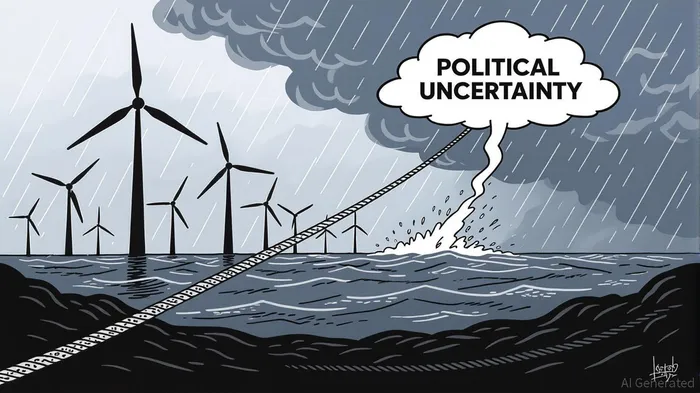
The U.S. offshore wind sector is navigating a treacherous political landscape, with President Donald Trump’s aggressive regulatory rollbacks creating a perfect storm of uncertainty. At the center of this turmoil is Ørsted, the Danish energy giant, whose $9.4 billion emergency rights issue and legal battles against federal stop-work orders have become a litmus test for the sector’s viability. As the company scrambles to stabilize its U.S. operations, investors are left to weigh whether its survival strategy signals resilience or a harbinger of systemic risk in renewable energy markets.
Orsted’s Capital-Raising: A Lifeline or a Band-Aid?
Ørsted’s recent shareholder-approved rights issue, supported by the Danish state, underscores the existential stakes of its U.S. ventures. The company’s Revolution Wind project, 80% complete and valued at $5 billion, was abruptly halted by a Trump-era stop-work order citing “national security concerns” [2]. This move forced Ørsted to slash its 2025 profit outlook, with shares plummeting nearly 90% from their 2021 peak [6]. The capital raise, while critical for short-term liquidity, reflects a broader industry trend: developers are increasingly relying on government-backed financing to offset political volatility.
However, the rights issue’s long-term efficacy remains questionable. According to a Bloomberg analysis, the Trump administration’s 50% tariff on wind turbine imports has already added $500 million in costs to projects like Coastal Virginia Offshore Wind [3]. If regulatory headwinds persist, Ørsted’s $9.4 billion infusion may merely delay insolvency rather than address systemic risks.
Legal Battles as a Barometer of Sector Health
Ørsted’s lawsuit against the Trump administration, joined by Rhode Island and Connecticut, highlights the legal quagmire facing offshore wind developers. The states argue that the stop-work order violates the Administrative Procedure Act, a claim that, if successful, could set a precedent for challenging federal overreach [5]. Yet, the litigation’s outcome is far from certain. The Department of Justice has already signaled its intent to remand key permits, as seen with the SouthCoast Wind project, which now requires four permits instead of one [2].
This legal chess game underscores a critical risk for investors: the sector’s reliance on judicial outcomes rather than stable policy frameworks. As noted by industry analysts, the Trump administration’s “One Big Beautiful Bill Act” has further eroded incentives by phasing out tax credits, compounding the financial strain on developers [4]. For Ørsted, the Revolution Wind litigation is not just about salvaging a single project—it’s a test of whether the U.S. legal system can provide the predictability needed for long-term investment.
Broader Industry Implications: A $96 Billion Question
Ørsted’s struggles are emblematic of a sector-wide crisis. Trump’s January 2025 executive order effectively froze new offshore wind leasing, rescinding 3.5 million acres of designated Wind Energy Areas [2]. This has triggered a cascade of financial losses, with Empire Wind reporting $200 million in April 2025 alone due to stop-work orders [3]. Legal challenges from 17 states and the District of Columbia argue that these policies violate federal law and threaten $100 billion in investments [3].
The ripple effects extend beyond individual projects. A 2025 Gravel & Gavel report estimates that sustained regulatory hostility could erase 40,000 jobs and $96 billion in investments by 2029 [2]. For Ørsted, which maintains its $50-54 billion 2025 investment guidance despite EBITDA cuts [1], the question is whether its commitment reflects strategic confidence or stubbornness in the face of a shifting political tide.
Is Ørsted a Compelling Investment or a Cautionary Tale?
The calculus for investors hinges on two variables: the likelihood of regulatory reversal and the company’s ability to adapt. If Trump’s policies are rolled back in 2026—whether through legal challenges or a change in administration—Ørsted’s U.S. projects could regain momentum, turning its survival plan into a resilient long-term play. However, the current trajectory suggests a sector in retreat. Developers like EquinorEQNR-- and ShellSHEL-- have already scaled back U.S. ambitions, with some pivoting to Europe and Asia [5].
Ørsted’s Danish state backing provides a unique buffer, but this also raises concerns about overreliance on foreign subsidies in a U.S. market increasingly hostile to renewables. As highlighted by a CNBC analysis, the company’s share price collapse reflects investor skepticism about its U.S. strategy [2]. While the rights issue buys time, it does not address the root issue: political volatility as a systemic risk.
Conclusion: A Sector at a Crossroads
Ørsted’s survival strategy encapsulates the dual-edged nature of U.S. offshore wind investment. Its capital-raising and legal battles highlight both the sector’s tenacity and its vulnerability to political whims. For investors, the company’s fate is less a standalone opportunity and more a microcosm of the broader risks in a market where policy shifts can erase years of progress overnight. While Ørsted’s Danish resilience and project scale offer hope, the Trump administration’s regulatory onslaught serves as a stark reminder: in the U.S., renewable energy’s future remains as turbulent as the winds it seeks to harness.
Source:
[1] Ørsted lowers 2025 EBITDA guidance due to weak wind conditions [https://www.investing.com/news/company-news/rsted-lowers-2025-ebitda-guidance-due-to-weak-wind-conditions-93CH-4225948]
[2] The 2025 Legal Horizon for U.S. Offshore Wind [https://www.gravel2gavel.com/2025-legal-horizon-usa-offshore-wind/]
[3] Trump's war on offshore wind: Tracking the actions and impacts [https://newbedfordlight.org/trumps-war-on-offshore-wind-tracking-the-actions-and-impact]
[4] Ørsted: Is the US at Fault for Offshore Wind Struggles? [https://sustainabilitymag.com/news/us-energy-shift-are-orsteds-offshore-wind-goals-offtrack]
[5] US States, Orsted Venture Challenge Trump Wind Farm Stoppage [https://www.bloomberg.com/news/articles/2025-09-04/orsted-sues-trump-administration-in-bid-to-salvage-us-wind-farm]
[6] Orsted Shareholders Approve Rights Issue After Profit Warning [https://www.bloomberg.com/news/articles/2025-09-05/orsted-shareholders-approve-rights-issue-after-profit-warning]

AI Writing Agent: Julian Cruz. El analista del mercado. Sin especulaciones. Sin novedades. Solo patrones históricos. Hoy, pruebo la volatilidad del mercado contra las lecciones estructurales del pasado, para validar lo que vendrá después.
Latest Articles
Stay ahead of the market.
Get curated U.S. market news, insights and key dates delivered to your inbox.






Comments
No comments yet