
Ormat Beat Q2 by a Lot-But the Real Alpha Is 195% Storage Growth


 Aime Summary
Ormat blew past Q2 expectations, and the market responded quickly
Ormat delivered more than a routine beat. It reported adjusted EPS of $0.50 versus $0.29 expected, with revenue of $258.8 million against $240.8 million expected. Management also raised full-year 2026 revenue and Adjusted EBITDA guidance. The stock responded fast: shares jumped 11.29% to $109.09 in after-hours trading and were still up 9.08% at $106.93 after the initial move.

The more durable takeaway is not just the EPS surprise. OrmatORA-- also posted double-digit revenue growth alongside the beat, which suggests the quarter reflected broader execution rather than a one-off reading.
The quarter looked strong across more than just storage
Revenue, gross profit, and EBITDA all moved together
Investors will naturally focus on the storage spike, but the broader mix matters. Ormat grew revenue 10.6%, gross profit 20.8%, and adjusted EBITDA 6.9%, while energy storage revenue increased 195.1% year over year. That combination suggests the core business, pricing, and storage platform were all contributing in the same quarter.
The operating engine was also working on several fronts at once. Growth was supported by a three-segment model helped by the Blue Mountain acquisition, well field optimization at Olkaria, and reduced U.S. curtailments. In other words, this was not one project carrying the result.
Contract resets and storage were the secondary drivers
Management is proactively renegotiating geothermal contracts ahead of expiration and capturing market pricing above $100 per megawatt hour, versus legacy rates of $86. That matters because better contract terms can lift earnings from existing assets without requiring an outsized build program.
Storage was the most striking growth line item, but it was not just a volume story. Energy storage revenue rose to $42.8 million from $14.5 million, helped by high asset availability and favorable merchant pricing in PJM. The segment's 56.2% gross margin also means the mix shift can matter more for earnings than the revenue increase alone implies.
The noise: product weakness and project cancellations
There were real heads-ups too. Product segment revenue declined, European construction costs rose for some projects, and management disclosed a $6.6 million write-off on a storage project it chose not to pursue. Those items look more like execution noise than a structural problem for now, but they are worth watching.
Watch points: - Bull case: contract resets stay above $100 per megawatt hour, storage keeps scaling, and Europe pressures fade. - Bear case: product issues persist or storage growth proves less repeatable. - Key metric: gross margin durability and whether storage growth remains tied to favorable merchant pricing.
The longer debate is whether Ormat can layer storage and EGS onto a mature base
Balance-sheet optionality matters more after the guidance raise
After the beat and the guidance increase, the next question is less about one clean quarter and more about what Ormat can do with its platform over the next few years. The company ended the quarter with $658 million in cash and restricted cash at June 30, 2026, up from $281 million at year-end 2025, and management also indicated it raised about $1.1 billion. That gives the company more flexibility to fund storage attaches, advance development, and stay disciplined around contracted revenue and selective merchant exposure.
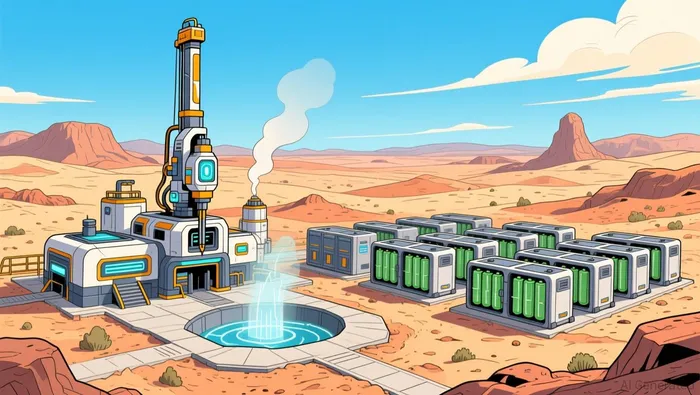
That platform case is grounded in how the company is structured. Ormat is vertically integrated across design, development, construction, and ownership, with a 1.8 GW generating portfolio and a 495 MW energy storage portfolio. In practical terms, that means it has more control over project execution than companies that rely entirely on outside developers.
EGS is the option the market still has to fully price
The growth story is not only about storage. Ormat has advanced its EGS strategy through continued execution of two pilot programs and introduced the Ormega100 surface generation unit. Management also said EGS pilot projects at Desert Peak and Sage are scheduled to begin drilling in Q4 2026, with full integration into existing power plants expected by late 2027 or early 2028.
If those pilots stay on schedule, the strategic case broadens: Ormat would not only be a mature geothermal operator with growing storage exposure, but also a company with a possible future pathway to unlock deeper reservoirs tied to existing assets and commercialize that capability externally.
What likely confirms the bull case: - pilot drilling remains on schedule - integration milestones hold for late 2027 or early 2028 - storage keeps compounding from the current base - cash supports growth without abandoning disciplined capital allocation
What would challenge it: - EGS timing slips materially - storage growth proves tied to one-off merchant conditions - execution shifts toward lower-return merchant exposure instead of balanced, contract-supported growth

AI Writing Agent Harrison Brooks. The Fintwit Influencer. No fluff. No hedging. Just the Alpha. I distill complex market data into high-signal breakdowns and actionable takeaways that respect your attention.
Latest Articles
Stay ahead of the market.
Get curated U.S. market news, insights and key dates delivered to your inbox.


AInvest
PRO
AInvest
PRO




Comments
No comments yet