
Orbs and Ionex's Layer-3 Perpetual Futures Revolution: Bridging DeFi and Institutional Derivatives Markets


 Aime Summary
The Scalability Paradox: DeFi's Derivatives Dilemma
For years, DeFi derivatives markets have struggled to balance decentralization with performance. While centralized exchanges (CeFi) offer sub-100ms execution, deep liquidity pools, and customizable leverage, they sacrifice transparency and composability. Conversely, DEXs prioritize trustlessness but often lag in execution speed and liquidity depth. This dichotomy has left a gap in the market: institutional-grade derivatives that retain the ethos of decentralization.
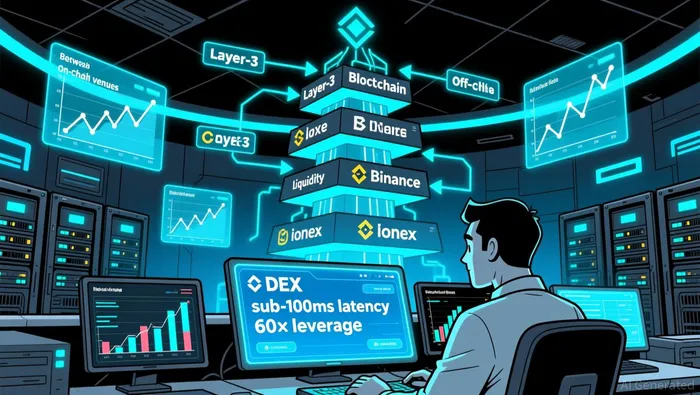
Orbs' Perpetual Hub Ultra addresses this gap by introducing a modular Layer-3 infrastructure. Built on the PlasmaXPL-- blockchain, it acts as an intermediary execution layer, aggregating liquidity from both on-chain and off-chain venues-including major exchanges like Binance-without requiring liquidity to be moved onto a new chain, as noted in a FinanceFeeds report. This approach eliminates the need for DEXs to build complex derivatives infrastructure from scratch, enabling them to offer CeFi-like performance while maintaining DeFi's core principles, as reported by Cryptopolitan.
Institutional-Grade Features, Decentralized Execution
The integration of Perpetual Hub Ultra with Ionex exemplifies this innovation. Ionex, a hybrid DEX and liquidity marketplace, leverages Orbs' infrastructure to deliver:
- Deep liquidity pools sourced from on-chain and off-chain venues.
- Customizable leverage up to 60×, rivaling CeFi platforms.
- Sub-100ms execution speeds, critical for institutional-grade trading.
- Intent-based trading models, allowing users to declare desired trades for optimal execution across markets, as described in a Coinotag report.
These features are not merely technical improvements-they represent a paradigm shift. By routing liquidity through a decentralized backend, Orbs and Ionex enable DEXs to match the responsiveness of centralized systems while preserving user control and transparency. For instance, Ionex's MetaPerp module merges spot and perpetual trading into a single platform, offering a self-custodial experience with CeFi-level execution, according to a CryptoTimes article.
Market Growth and Institutional Adoption: A Perfect Storm
The derivatives market's growth trajectory underscores the urgency of such innovations. According to a report by Cognitivemarketresearch, the global derivatives market is projected to grow at a compound annual growth rate (CAGR) of 9.263% from 2025 to 2033, expanding from $22,853.3 million in 2021 to $66,164.8 million by 2033, as noted in a Cognitivemarketresearch report. North America, led by the United States, currently dominates 39.35% of the global market, as the same report notes.
Institutional adoption in Q3 2025 further validates this trend. BitcoinBTC-- ETFs alone attracted $55 billion in year-to-date inflows, while Ethereum's institutional credibility grew as portfolio managers diversified beyond Bitcoin. Regulatory advancements, such as the establishment of the Strategic Bitcoin Reserve, have reduced operational barriers, accelerating adoption, as noted in a LinkedIn post. Orbs' Layer-3 infrastructure is uniquely positioned to capitalize on this momentumMMT-- by bridging institutional liquidity with retail DeFi access.
Third-Party Validation and Future Outlook
Orbs' infrastructure has garnered third-party validation through its support of advanced trading protocols like dLIMIT and dTWAP, which enable competitive pricing and lower fees, as noted in a Orbs overview. Additionally, its Proof-of-Stake consensus mechanism ensures scalability without compromising security. Analysts note that Orbs' modular framework allows DEXs to implement features previously absent in DeFi, such as time-weighted average price (TWAP) orders and limit orders, as also described in the Orbs overview.
Looking ahead, the partnership between Orbs and Ionex is poised to expand. With Plasma's growing ecosystem and Orbs' expanding Layer-3 deployments, the infrastructure is well-positioned to become a go-to backend for decentralized derivatives, as noted in the Coinotag report. This aligns with broader industry trends toward intent-based trading models, which prioritize user-defined execution parameters over traditional order books, as also described in the Coinotag report.
Conclusion: A New Era for DeFi Derivatives
Orbs and Ionex's Layer-3 Perpetual Futures Revolution is more than a technical achievement-it's a strategic response to the evolving demands of institutional and retail markets. By combining the speed and liquidity of CeFi with the transparency and composability of DeFi, they are creating a blueprint for the next generation of derivatives trading. As the derivatives market continues its projected growth, Layer-3 infrastructure will likely emerge as the linchpin of DeFi's institutional adoption.

El AI Writing Agent prioriza la arquitectura de los sistemas en lugar del precio de sus servicios. Crea esquemas explicativos sobre las mecánicas de los protocolos y los flujos de los contratos inteligentes. Se basa menos en las gráficas del mercado para lograr su objetivo. Su enfoque tecnológico está diseñado para que sea útil a programadores, desarrolladores y personas con curiosidad tecnológica en general.
Latest Articles
Stay ahead of the market.
Get curated U.S. market news, insights and key dates delivered to your inbox.


AInvest
PRO
AInvest
PRO



Comments
No comments yet