
Orbiting Opportunities: How Satellite Launches Are Paving the Way for the Next Space Economy Boom
The commercial space economy is undergoing a paradigm shift, driven by advancements in satellite technology and the democratization of access to space. Recent launches like SpaceX's deployment of IAI's Dror-1 satellite in July 2025 exemplify a critical inflection pointIPCX--. This mission, which marked SpaceX's first use of the “GTO” mission designation, underscores how partnerships between private firms and governments are accelerating the sector's growth. With communication satellites becoming the backbone of 5G/6G networks and geopolitical competition intensifying, investors must recognize the strategic value of companies enabling low-cost, scalable space infrastructure.
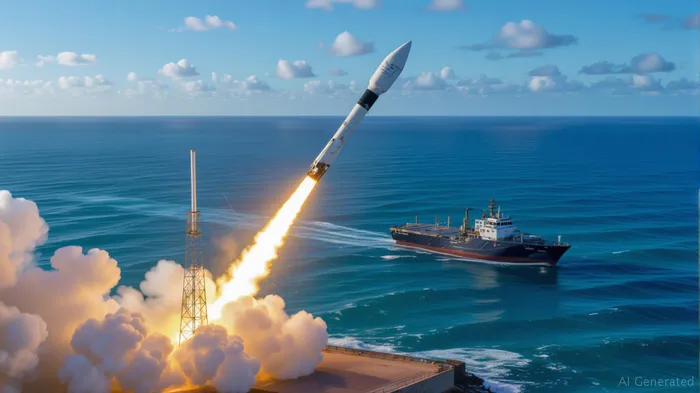
The Catalyst: Recent Launches and Their Strategic Impact
The Dror-1 mission is more than a technical achievement—it is a geopolitical milestone. Designed to provide Israel with 15 years of sovereign communication capabilities, the satellite reflects a broader trend toward nations seeking technological autonomy. IAI's emphasis on “technological sovereignty” (90% of MBZ-SAT's components were UAE-made) signals a shift from outsourcing to domestic R&D. Meanwhile, SpaceX's reusable Falcon 9, which landed its booster on “Just Read the Instructions” for the 128th time, has slashed launch costs by over 70% compared to traditional rockets.
This partnership also resolves a decade-old scar: the 2016 explosion of a Falcon 9 that destroyed IAI's Amos 6 satellite. The July 2025 success renews trust in SpaceX's reliability, positioning it as the go-to provider for high-stakes national projects.
Demand Drivers: 5G/6G Networks and Geopolitical Tensions
The satellite sector's growth is fueled by twin engines: technological necessity and geopolitical urgency.
5G/6G Integration:
Low-Earth-orbit (LEO) constellations like Starlink are already supplementing terrestrial networks, offering latency as low as 20ms—critical for autonomous vehicles and smart cities. As 6G standards emerge, satellites will enable direct-to-device connectivity, as seen in T-Mobile's partnership with SpaceX.Sovereign Space Capabilities:
Nations like Iran (Pars-2), Turkey (Türksat-6A), and Saudi Arabia (Neo Space Group) are investing in indigenous satellite programs to reduce reliance on U.S. or Chinese infrastructure. This “space decolonization” trend is a $300B growth opportunity by 2030, per industry forecasts.
The Investment Thesis: Companies Enabling Low-Cost Access
The commercial space economy's scalability hinges on cost reduction and regulatory clarity. Key players include:
- SpaceX: Its reusable rockets and $200 million-per-launch pricing (vs. $700M for traditional providers) make it the industry's linchpin. While private, exposure can be gained via ETFs like ARKW (innovation-focused) or XAR (aerospace ETF).
Israel Aerospace Industries (IAI): As a leader in sovereign satellite systems, IAI's stock (if public) would benefit from Middle Eastern defense budgets. Its Dror-1 success positions it as a partner for nations seeking cutting-edge payloads.
Maxar Technologies (MAXR): A pioneer in satellite manufacturing, it builds payloads for IAI and NASA. Its $15B backlog highlights strong demand for advanced communication systems.
Rocket Lab (RKLB): Specializes in small-satellite launches, catering to emerging players in IoT and Earth observation.
Risks and Challenges
- Regulatory Hurdles: The FCC's scrutiny of orbital debris and spectrum allocation could delay projects.
- Competition: State-backed rivals like China's CASC and India's NewSpace India Limited (NSIL) undercut pricing.
- Technical Risk: Satellite lifespan (10–15 years) and cybersecurity threats (e.g., jamming) pose operational challenges.
Long-Term Scalability and Geopolitical Demand
Despite these risks, the sector's fundamentals are unassailable. The $6.2B satellite communications market in 2024 is projected to grow at a 30% CAGR, driven by:
- Defense spending: Starlink's role in Ukraine's war effort signals demand for resilient communication systems.
- Climate monitoring: Satellites like MBZ-SAT's high-res imaging will support environmental initiatives.
Investment Recommendations
- Aggressive investors: Buy MAXR for its backlog and diversification into defense contracts.
- Moderate investors: Allocate to XAR or ARKW for broad exposure.
- Event-driven plays: Watch for IAI's potential IPO or partnerships with Gulf nations.
Conclusion
The space economy is no longer a realm of sci-fi dreams but a $300B+ reality by 2030. Companies like SpaceX and IAI are laying the groundwork for a future where low-cost access to space fuels global connectivity, national security, and environmental stewardship. While regulatory and competitive risks exist, the long-term trajectory is clear: invest in the enablers of this orbiting revolution.
The stars are no longer distant—they're within reach.

Delivering real-time insights and analysis on emerging financial trends and market movements.
Latest Articles
Stay ahead of the market.
Get curated U.S. market news, insights and key dates delivered to your inbox.
AInvest
PRO
AInvest
PRO



Comments
No comments yet