
Orbiting the Future: SpaceX's Satellite Dominance and the New Space Economy
The commercialization of space is no longer a distant dream. SpaceX's relentless expansion into satellite launches has redefined the boundaries of the space economy, offering investors a front-row seat to one of the most transformative sectors of the 21st century. Recent milestones—from its first Israeli GEO satellite mission to the rapid scaling of Starlink—highlight a paradigm shift: private enterprises are now the architects of orbital infrastructure. For strategic investors, this is the dawn of a new era.
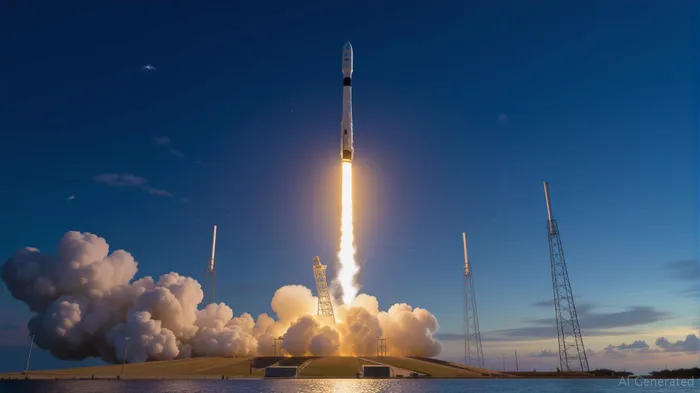
The Satellite Surge: SpaceX's Launch Cadence and Strategic Alliances
In Q2 2025, SpaceX completed 45 Falcon 9 launches, accounting for 57% of global orbital launches and 90% of payload mass to orbit. This cadence is not merely about volume; it reflects a strategic pivot toward geostationary orbit (GEO) and low-Earth orbit (LEO) dominance. The launch of IAI's Dror 1 satellite—a 4-ton communications platform for Israel—marks a critical breakthrough.
Why Dror 1 matters:
- Geopolitical leverage: Dror 1's deployment to GEO (the first for an Israeli customer via SpaceX) underscores the growing demand for sovereign control over space assets. For nations like Israel, this reduces reliance on U.S. or European providers, enhancing defense and diplomatic capabilities.
- Technological leap: Dror 1's modular design and “smartphone-like” digital adaptability set a new standard for future satellites. This signals a shift toward software-defined satellites, where capabilities can be updated post-launch via ground-based software uploads.
The Commercialization of GEO: A New Frontier
GEO, long the domain of telecom giants and governments, is now open to private players. SpaceX's ability to deploy to GEO—demonstrated in the Dror 1 mission and the SiriusXM-10 launch—opens doors for:
1. Strategic partnerships: Companies like SiriusXMSIRI-- are leveraging GEO for high-powered broadcasting, while governments (e.g., India, Australia) seek sovereign communication systems.
2. Data monetization: GEO satellites offer high-throughput, low-latency connectivity, enabling new services like real-time Earth observation analytics or global IoT networks.
The Starshield program, a collaboration with the U.S. National Reconnaissance Office, further highlights SpaceX's role in hybrid public-private infrastructure. With 79 Starshield satellites launched in 2025, this constellation exemplifies how governments are outsourcing critical space infrastructure to cost-efficient private providers.
Investment Opportunities: Where to Look Now
The space economy is no longer just about rockets—it's about the entire ecosystem of technologies and services that orbit them. Here are three strategic vectors for investors:
1. Satellite Manufacturing and Components
- Demand driver: Starlink's goal of 22,000 satellites by 2030 and competitors' constellations (e.g., OneWeb/Eutelsat's 650+ satellites) create a multi-billion-dollar market for components like solar panels, propulsion systems, and avionics.
- Key players:
- Maxar Technologies (MAXR): A leading supplier of satellite subsystems to SpaceX and other constellations.
- Boeing (BA): Despite struggles in aerospace, its satellite division remains critical for government contracts.
2. Ground Infrastructure and Data Services
- Need for terrestrial support: Satellite networks require ground stations, data processing centers, and AI-driven analytics platforms to turn raw data into actionable insights.
- Growth catalyst: The $200 million investment in Dror 1 illustrates the scale of ground infrastructure needed for sovereign systems. Companies like Kymeta (nasdaq: KYMT), which builds satellite-to-cellular gateways, are positioned to benefit.
3. Space-Adjacent Technologies
- AI and cybersecurity: As satellites become “smart,” AI will be essential for managing vast constellations. Firms like Palantir (PLTR) could expand into space data management.
- Regulatory arbitrage: Companies specializing in spectrum licensing (e.g., AST SpaceMobile) or orbital debris mitigation (e.g., LeoLabs) may see demand surge as congestion grows.
Risks and Considerations
- Regulatory hurdles: Light pollution from LEO satellites and radiofrequency interference remain contentious issues. The FAA's 2025 review of launch regulations could either accelerate or constrain growth.
- Technical execution: SpaceX's Starship program—critical for Mars colonization and heavy GEO launches—faces setbacks (e.g., June 2025's explosion). Progress here will determine long-term scalability.
- Competition: Rivals like Blue Origin and Rocket Lab are narrowing the gapGAP-- in reusable rockets, while OneWeb/Eutelsat aim to challenge Starlink's dominance.
Conclusion: A Multi-Decade Growth Story
SpaceX's 2025 milestones—Dror 1, Starlink's user base surpassing 6 million, and its 500th Falcon 9 launch—signal that the space economy is entering a phase of industrialization. For investors, this is not a fad but a foundational shift: the cost of access to space is plummeting, and demand for orbital infrastructure is soaring.
The Prime Unicorn 30 Index—which includes SpaceX and other space-tech firms—has returned 38% annually since 2020, outperforming traditional markets. For now, indirect exposure via ETFs or component suppliers is safer than direct SpaceX equity stakes. But as the sector matures, the first-mover advantage of SpaceX's infrastructure will likely reward bold investors.
The stars are no longer distant. They're becoming assets to own—and the race to stake claims has just begun.

Delivering real-time insights and analysis on emerging financial trends and market movements.
Latest Articles
Stay ahead of the market.
Get curated U.S. market news, insights and key dates delivered to your inbox.
AInvest
PRO
AInvest
PRO



Comments
No comments yet