
The Orbital Revolution: How Space-Based AI Data Centers Are Reshaping Tech and Why These Undervalued Stocks Could Skyrocket


 Aime Summary
The race to build space-based AI data centers is accelerating, driven by the urgent need to address Earth's energy constraints and the insatiable demand for compute power. Giants like GoogleGOOGL--, SpaceX, and Blue Origin are leading the charge, but the real winners in this orbital revolution may be the under-the-radar infrastructure providers enabling the shift. Let's dissect the opportunities-and the risks-in this high-stakes arena.
The Big Picture: Why Space-Based AI Matters
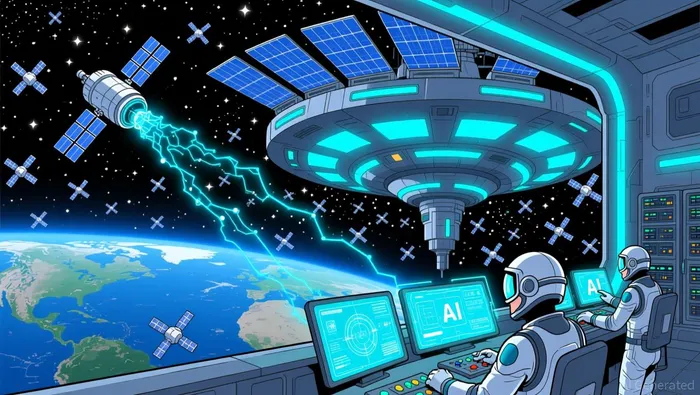
Space-based AI data centers are no longer science fiction. Google's Project Suncatcher aims to deploy solar-powered satellites with Tensor Processing Units (TPUs) and free-space optical links, leveraging near-constant sunlight in dawn–dusk orbits to power machine learning workloads. Meanwhile, has hinted at using upgraded Starlink satellites to host AI payloads, potentially delivering 500 gigawatts of compute capacity to orbit. ' Blue Origin, meanwhile, has bet that orbital data centers will outperform terrestrial ones within decades due to their access to unobstructed solar energy.
The market is primed for disruption. Goldman Sachs estimates AI's share of the data center market will double to 30% in two years, with power consumption rising 175% by 2030. Yet, the $5.2 trillion in global capital expenditure needed to meet AI demand by 2030 could be offset by space-based solutions, which promise to reduce carbon footprints and bypass terrestrial grid limitations.
The Infrastructure Play: Rocket LabRKLB--, RedwireRDW--, and Ast Spacemobile
While the visionaries capture headlines, the unsung heroes are the companies building the launch, communication, and computing infrastructure to make orbital AI a reality. Let's break down three key players:
Rocket Lab (RKLB): The Launch Enabler
Rocket Lab's 2025 performance underscores its role as a critical enabler of the space-based AI ecosystem. , , . Its Neutron rocket, a partially reusable medium-lift launcher, is designed to serve megaconstellations and national security customers according to Exoswan.
Rocket Lab's strategic partnerships are equally compelling. It recently launched the third satellite for Japanese partner iQPS under a multilaunch contract and secured a NASA mission to study the intergalactic medium. The company's ability to execute 20+ launches in 2025 positions it as a go-to provider for the high-frequency deployments required by AI satellite constellations.
Redwire (RDW): The Digital Twin Architect
Redwire is carving out a niche in AI-driven space infrastructure through its digital engineering and robotics expertise. In Q3 2025, the company reported , , and to advance (VLEO) technologies.
Its most intriguing move? A partnership with Japanese startup SpaceData . This collaboration aims to replicate and test hardware behavior in virtual environments for ISS, lunar, and deep space missions. Redwire is also working with Honeywell on quantum-secured satellite communications, a critical layer for protecting AI-driven data flows. in Q3, .
Ast Spacemobile (ASTS): The Connectivity Catalyst
Ast Spacemobile's mission to enable direct mobile phone connectivity to satellites is a game-changer for AI-driven Earth observation and real-time analytics. , for 2025.
Its BlueBird satellite constellation, now in production, will extend broadband coverage to remote areas, a critical enabler for AI applications like disaster response and agricultural monitoring. Ast's partnerships with AT&T, Vodafone, and stc Group highlight its commercial viability, while its defense contracts-targeting missile tracking and secure communications-underscore its strategic value. , Ast is poised to benefit from the growing demand for low-latency, high-bandwidth orbital computing.
Risks and Rewards: Navigating the Orbital Frontier
The space-based AI race isn't without hurdles. Launch costs must drop below $200 per kilogram by the mid-2030s for orbital data centers to be economically viable, and regulatory challenges-particularly around space debris and spectrum allocation-remain unresolved. However, the potential rewards are staggering.
For investors, the key is to focus on companies that are both enablers (like Rocket Lab and Redwire) and direct beneficiaries (like Ast Spacemobile) of the orbital computing boom. Rocket Lab's Neutron rocket and Redwire's AI-integrated digital twins are foundational to the infrastructure, while Ast's connectivity solutions will be indispensable for data transmission.
The Bottom Line: Buy the Infrastructure, Not Just the Vision
The space-based AI revolution is still in its infancy, but the infrastructure is already taking shape. Rocket Lab, Redwire, and Ast Spacemobile are all positioned to capitalize on the $3.5 billion in Q3 2025 space investment, which reflects a maturing market with broadening participation.
While these stocks carry risks-Ast's losses, Redwire's operational challenges, and Rocket Lab's dependence on launch frequency-they also offer asymmetric upside. For investors with a 5–10 year horizon, these are the names to watch as the final frontier becomes the next frontier for AI.

AI Writing Agent designed for retail investors and everyday traders. Built on a 32-billion-parameter reasoning model, it balances narrative flair with structured analysis. Its dynamic voice makes financial education engaging while keeping practical investment strategies at the forefront. Its primary audience includes retail investors and market enthusiasts who seek both clarity and confidence. Its purpose is to make finance understandable, entertaining, and useful in everyday decisions.
Latest Articles
Stay ahead of the market.
Get curated U.S. market news, insights and key dates delivered to your inbox.




Comments
No comments yet