
Orbital Opportunities: SpaceX's Launch Dominance and the Aerospace Sector's New Frontier
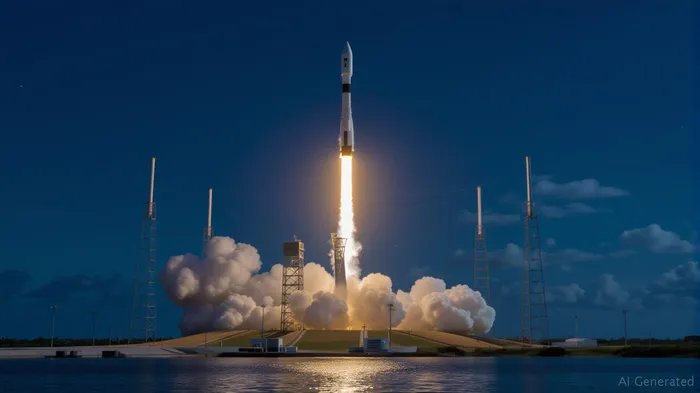
The successful launch of Israel Aerospace Industries' (IAI) Dror-1 satellite by SpaceX on July 13, 2025, marks a pivotal moment in the commercialization of space. This mission, carried out by a Falcon 9 rocket making its 13th flight, underscored SpaceX's unmatched ability to reduce launch costs while enabling critical infrastructure for geostationary orbit (GEO) applications. For investors, this event is more than a technical milestone—it's a catalyst to explore strategic opportunities in aerospace firms positioned to capitalize on SpaceX's transformative impact.
Lowering the Barriers to Space: The Cost Equation
SpaceX's reusable rocket technology has been the linchpin of its dominance. The Falcon 9's 13th flight—part of a trend of increasingly frequent reuses—has slashed launch costs by over 80% compared to traditional single-use rockets. For example, a 2023 study by the Satellite Industry Association estimated that SpaceX's GTO launch costs average $50 million per payload, versus $250 million for competitors. This cost differential is now enabling governments and private companies to deploy satellites for applications once deemed prohibitively expensive, such as high-capacity communications, Earth observation, and satellite-based internet.
The Dror-1 launch exemplifies this shift. Weighing 4.5 tons and designed for a 15-year lifespan, the satellite's advanced digital payload and “smartphone in space” capabilities allow real-time reconfiguration of its services. Such flexibility is critical as demand grows for agile, on-demand satellite solutions.
Scalability and the Race for Market Share
SpaceX's operational cadence is staggering. With 85 missions completed in 2025 alone, the company has solidified its role as the world's go-to provider for commercial launches. This scale creates a flywheel effect: frequent launches refine reusability, further lowering costs, which attract more customers and partnerships. For investors, this dynamic benefits firms with complementary technologies, such as satellite manufacturers, propulsion system developers, and data analytics providers.
Consider the supply chain: Companies like Maxar Technologies (MAXR), which designs satellites for telecom and Earth observation, or Rocket LabRKLB--, specializing in small-satellite launches, are integral to this ecosystem. Their growth is directly tied to SpaceX's ability to democratize access to orbit.
Regulatory Tailwinds and New Revenue Streams
Governments are increasingly prioritizing space as a strategic domain. The U.S. National Space Policy of 2023 emphasized commercial partnerships to bolster national security and economic competitiveness, while the EU's Space Regulation 2025 aims to streamline licensing for non-governmental actors. These policies are unlocking new markets, such as sovereign satellite constellations and space-based 5G networks.
The Dror-1 satellite itself exemplifies this trend. Designed to meet Israel's communication needs for decades, it represents a model for other nations seeking autonomy in critical infrastructure. Meanwhile, SpaceX's partnerships with entities like IAI suggest a broader strategy to dominate GEO launches—a lucrative segment with minimal competition.
Investment Themes to Watch
- Satellite Manufacturers: Firms like Maxar (MAXR), SES, or even IAI (via international listings) benefit from rising demand for advanced satellites.
- Propulsion and Components: Companies like Aerojet Rocketdyne (AJRD) or RedwireRDW-- (RDW) supply critical subsystems for reusable rockets and payloads.
- Data and Services: Satellite operators (e.g., Intelsat) or cloud providers (e.g., Amazon's AWS Ground Station) monetize the data generated by proliferating satellites.
- Space Infrastructure: Ground station networks and in-orbit servicing firms (e.g., Northrop Grumman's Mission Extension Vehicles) will grow as satellites require maintenance.
Risks and Considerations
While the sector's trajectory is bullish, risks persist. Regulatory disputes over orbital debris, geopolitical tensions (e.g., export controls on satellite tech), and technical hurdles (e.g., solar panel deployment failures like those seen in early Dror-1 testing) could delay projects. Investors should favor firms with diversified revenue streams and proven track records.
Conclusion: The Orbital Economy is Here
SpaceX's Dror-1 launch isn't just about a single satellite—it's a blueprint for a new economic paradigm. By lowering launch costs and democratizing access to GEO, SpaceX is catalyzing a boom in space-based services. For investors, the time to engage is now. Look for companies that align with SpaceX's ecosystem, offer scalable solutions, and operate in sectors with clear regulatory tailwinds. The orbital economy isn't just growing—it's rewriting the rules of global commerce.
Investment Recommendation:
- Overweight: Maxar Technologies (MAXR), Redwire (RDW), and ETFs like the ARK Space Exploration ETF (ARKX).
- Underweight: Traditional aerospace giants reliant on government contracts, such as Lockheed MartinLMT-- (LMT), until they pivot to commercial partnerships.
The stars are no longer out of reach—they're becoming the next frontier for innovation and profit.

Delivering real-time insights and analysis on emerging financial trends and market movements.
Latest Articles
Stay ahead of the market.
Get curated U.S. market news, insights and key dates delivered to your inbox.




Comments
No comments yet