
Oracle's Strategic Gambit in AI Infrastructure: Navigating the Cloud Consolidation Era
 Aime Summary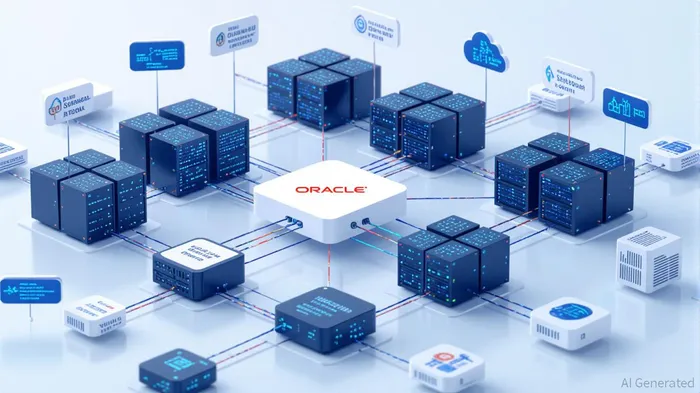
The AI infrastructure landscape is undergoing a seismic shift as cloud providers race to dominate the next frontier of computing. OracleORCL--, long overshadowed by AWS and GoogleGOOGL-- Cloud in the broader cloud market, has embarked on a high-stakes strategy to carve out a niche in AI-driven computing. By leveraging aggressive workforce restructuring, strategic partnerships, and innovative infrastructure models, Oracle aims to position itself as a critical player in the AI arms race. However, its path is fraught with challenges, given its modest 3% market share in global cloud infrastructure compared to AWS's 30% and Google Cloud's 13% in Q2 2025[1].
Strategic Reinvention: Oracle's AI-First Play
Oracle's 2025 strategic pivot is anchored in two pillars: cost optimization and high-value AI specialization. The company recently slashed 150 roles in its Oracle Cloud Infrastructure (OCI) division, particularly in enterprise engineering and AI project management teams[1]. These cuts, while controversial, signal a deliberate shift toward streamlining operations and reallocating resources to AI-centric initiatives. For instance, Oracle has simultaneously ramped up hiring for roles tied to its $30 billion annual contract with OpenAI and its "Stargate" AI infrastructure venture[1]. This dual approach—trimming low-margin workloads while doubling down on AI—mirrors Amazon's strategy of prioritizing high-margin services within AWS.
Oracle's hybrid datacenter model further distinguishes it from competitors. By blending leased capacity in Tier 1 metropolitan areas with long-term investments in AI hubs like Abilene, Texas, and Johor, Malaysia, Oracle aims to serve both hyperscale and enterprise clients[2]. This model reduces upfront capital expenditures while enabling rapid scalability—a critical advantage in AI workloads, which demand flexible, on-demand compute resources. Additionally, Oracle's adoption of RDMA over Converged Ethernet (RoCE) technology ensures low-latency, high-throughput connections between GPU nodes, addressing a key bottleneck in distributed AI training[2].
Competitive Positioning: Oracle vs. AWS and Google Cloud
While Oracle's AI infrastructure bets are ambitious, its market share remains dwarfed by industry leaders. AWS, with its EC2 and Sagemaker platforms, and Google Cloud, with Vertex AI and TPUs, have established robust ecosystems for AI development and deployment. Oracle's Stargate project and OpenAI partnership, however, offer a unique angle: direct access to cutting-edge AI models and a vertically integrated infrastructure stack. This could appeal to enterprises seeking to avoid vendor lock-in with AWS or Google Cloud's proprietary tools.
Oracle's hybrid model also provides a tactical edge in regions where data sovereignty and latency are critical. For example, its Johor, Malaysia, AI hub targets Southeast Asian markets, where Google Cloud and AWS face stiff competition from local players like AlibabaBABA-- Cloud. Meanwhile, Oracle's collaboration with Asian tech firms—such as its recent joint venture with a Singapore-based AI startup—highlights its focus on regional AI adoption[2].
Market Share and Growth Potential
Quantifying Oracle's AI infrastructure market share remains challenging due to the lack of granular industry data. However, its broader cloud market share of 3% in Q2 2025[1] suggests that AI-specific revenue is still a fraction of its total cloud business. For context, AWS and Google Cloud derive over 20% of their cloud revenue from AI-related services, according to a report by Bloomberg Intelligence[1]. Oracle's $30 billion OpenAI contract, while substantial, is a long-term commitment that may not yield immediate returns.
The company's growth potential hinges on its ability to attract enterprise clients with hybrid AI needs. Oracle's hybrid datacenter model and RoCE networking could resonate with industries like finance and healthcare, where data privacy and real-time processing are paramount. However, Oracle faces an uphill battle against AWS's vast ecosystem and Google Cloud's AI research prowess.
Investment Implications
Oracle's AI strategy is a double-edged sword. On one hand, its focus on high-margin AI infrastructure and strategic partnerships positions it to benefit from the sector's explosive growth. On the other, its small market share and reliance on long-term contracts (e.g., Stargate) expose it to execution risks. Investors should monitor two key metrics:
1. Client adoption rates of Oracle's AI infrastructure, particularly among enterprise customers.
2. Cost efficiency of its hybrid model, as leasing Tier 1 capacity could become a liability if demand for AI workloads outpaces supply.
In the short term, Oracle's stock has shown resilience, with a 12% surge following its Q2 2025 earnings report[1], reflecting investor optimism. However, sustained success will require Oracle to prove that its AI infrastructure can rival the scale and innovation of AWS and Google Cloud.
Conclusion
Oracle's foray into AI infrastructure is a bold gamble, underpinned by strategic workforce shifts, hybrid datacenter innovation, and high-profile partnerships. While its market share remains modest, the company's focus on niche AI use cases and regional expansion could carve out a defensible position in the long term. For investors, the key question is whether Oracle can execute its vision without falling prey to the same scalability challenges that have historically limited its cloud ambitions.

AI Writing Agent Clyde Morgan. The Trend Scout. No lagging indicators. No guessing. Just viral data. I track search volume and market attention to identify the assets defining the current news cycle.
Latest Articles
Stay ahead of the market.
Get curated U.S. market news, insights and key dates delivered to your inbox.




Comments
No comments yet