
Oracle's Stock Soars, Propelling Ellison Briefly Past Musk in "World's Richest" Race


 Aime Summary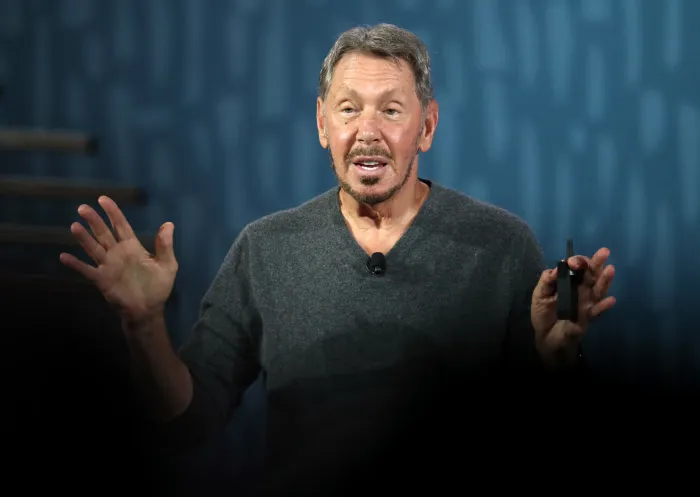
In a market electrified by artificial intelligence, Oracle's shares exploded Wednesday, catapulting the software veteran's market value to nearly $933 billion and briefly crowning co-founder Larry Ellison as the world's richest individual.
The surge, the biggest one-day gain since 1992, underscored Oracle's unexpected pivot from database stalwart to AI infrastructure powerhouse, fueled by mammoth contracts that promise a revenue tsunami in the years ahead.
The rally began with Oracle's fiscal first-quarter earnings release, where executives unveiled a backlog of future business so vast it dwarfed expectations. Shares jumped as much as 43% intraday before closing 36% higher at $328.33—a record high that added over $100 billion to Ellison's net worth in a single session.
For a fleeting moment, that windfall edged him ahead of Elon Musk, the TeslaTSLA-- and SpaceX chief who has long dominated the billionaire rankings. By day's end, Ellison's fortune settled just shy of Musk's, but the episode highlighted how AI's insatiable demand for computing power is reshaping fortunes and corporate landscapes alike.
The Surge: A Historic Leap for Oracle Shares
Oracle's stock performance wasn't just impressive; it was seismic. The 36% close marked the largest percentage increase since December 23, 1992, when shares climbed nearly 44%. Year-to-date through Tuesday, the stock had already risen 45%, outpacing the S&P 500 by a factor of four. Wednesday's frenzy lifted not only OracleORCL-- but rippled through the AI ecosystem, boosting NvidiaNVDA-- by 3.8% and sending Asian suppliers like Advantest and SK Hynix higher in their respective markets.
This wasn't mere speculation. Investors piled in after Oracle detailed a remaining performance obligations (RPO) figure of $455 billion as of August 31—more than four times the level from the same quarter last year. RPO, a key metric for future revenue, signals locked-in contracts that Oracle expects to fulfill. Analysts at Melius Research called it "staggeringly high," noting it positions the company to smash its cloud infrastructure sales targets. For context, this backlog is roughly four times Google's, hinting that Oracle's cloud growth could soon eclipse its rival's.
AI Deals: Oracle's Foot in the Door of the Boom
At the heart of the excitement are Oracle's aggressive forays into AI infrastructure. Long criticized for missing the initial cloud computing wave, the 48-year-old company has clawed back relevance by tailoring its relational database expertise to AI developers. Partnerships with MicrosoftMSFT--, Google, and AmazonAMZN-- allow Oracle's databases to run seamlessly in their clouds, while tight relationships with key players have sealed blockbuster deals.
Chief Executive Safra Catz described the quarter as "astonishing," revealing four multibillion-dollar contracts signed with three customers. More are imminent, she said, potentially pushing RPO beyond $500 billion in the coming months. Among the highlights: a massive pact with OpenAI for 4.5 gigawatts of data center capacity, valued at $300 billion over five years—enough power to light up millions of homes. The backlog also encompasses the Stargate venture with SoftBank and OpenAI, eyeing $500 billion in data center investments, plus orders from AI heavyweights like xAI and Meta PlatformsMETA--.
Oracle's client roster reads like an AI who's who. Nvidia, ByteDance's TikTok, and others rely on its cloud services. Ellison's personal ties—as chief technology officer—have been instrumental. His rapport with Musk and Nvidia's Jensen Huang has helped land deals with xAI and Nvidia, turning friendships into revenue engines. These alliances underscore Oracle's role in supporting the trillions in infrastructure spending that AI pioneers like OpenAI foresee.
Financial Performance: Mixed Results Amid the Hype
Beneath the headlines, Oracle's fiscal first quarter offered a nuanced picture. Total revenue climbed 12% to $14.93 billion, falling short of the $15.04 billion analysts expected, per FactSetFDS--. Cloud revenue, the star segment, rose 28% to $7.2 billion, driven by AI demand. Within that, cloud infrastructure jumped 55% to $3.3 billion, slightly beating growth forecasts of 53%.
Yet traditional software revenue dipped 1% to $5.7 billion, a reminder of Oracle's legacy business in transition. Adjusted profit came in at $1.47 per share, edging below the $1.48 consensus, while unadjusted net income held flat at $2.93 billion, or $1.01 per share.
The company is pouring resources into expansion, with capital expenditures projected at $35 billion this fiscal year—far above Wall Street's $26 billion estimate. This ramp-up aims to capture AI market share but pressures margins. Analysts at Davidson flagged concerns over narrow operating margins, suggesting Oracle's virtual machine and GPU rental operations might run at single-digit levels or even losses in some cases. Free cash flow is expected to remain negative for a second straight year, weighed down by data center buildouts.
Still, Catz emphasized internal efficiencies, including AI adoption to boost operating income and recent layoffs of hundreds of workers. These moves signal a shift from Oracle's historical 50% margin legacy toward a growth-at-all-costs model reminiscent of its cloud competitors.
Future Outlook: A Bold Bet on AI Dominance
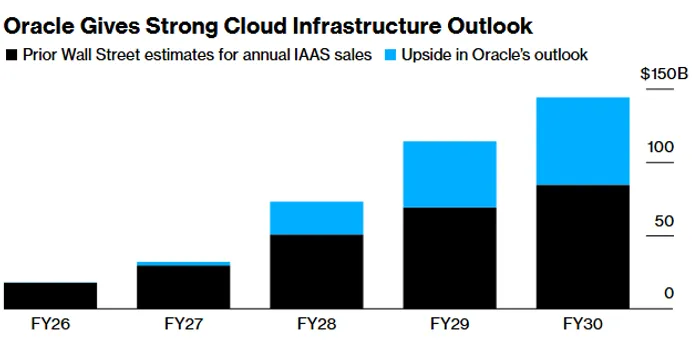
Looking ahead, Oracle's projections are audacious. Cloud infrastructure revenue is on track for 77% growth to $18 billion this fiscal year, accelerating to $32 billion, $73 billion, $114 billion, and $144 billion in the subsequent four years ending May 2030. Catz assured that most of this five-year forecast is already embedded in the current backlog, making it a "safe bet" in analysts' eyes.
Deutsche Bank's Brad Zelnick captured the sentiment on the earnings call: "We're all kind of in shock in a very, very good way." He called the results evidence of a "seismic shift" in computing. Post-2026 revenue should surge further, thanks to clients like xAI and MetaMETA-- with massive AI investment plans.
Ellison's Windfall: From Founder to Richest (Briefly)
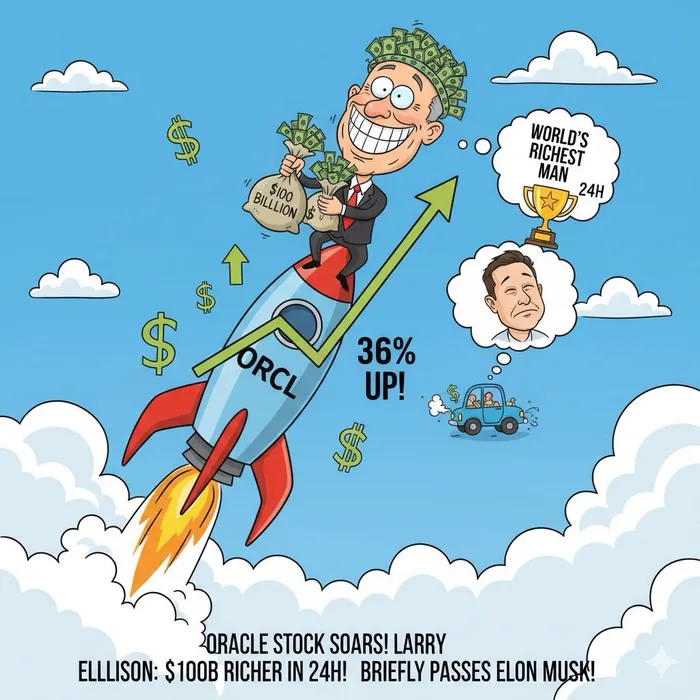
The day's drama peaked with Ellison's ascent. The 80-year-old visionary, who co-founded Oracle in 1977, saw his stake balloon by over $100 billion, temporarily surpassing Musk. It's a fitting twist for a man whose aggressive style has defined Oracle's culture. Ellison's hands-on role, including deal-making with Musk and Huang, has been pivotal in this turnaround.
Yet wealth rankings are volatile; by close, Musk reclaimed the top spot. Still, the episode spotlights how AI is minting mega-fortunes. Ellison's rise reflects Oracle's broader resurgence, proving that even tech dinosaurs can evolve in the AI era.
Market Implications: AI's Ripple Effect
Oracle's triumph signals sustained AI momentum. As developers race to build advanced models, infrastructure providers like Oracle stand to reap rewards. The stock's lift buoyed peers, from Nvidia to Asian chipmakers, affirming AI's global supply chain interconnectedness.
For investors, Oracle represents a high-stakes wager: bet on AI's exponential growth, but brace for capex headwinds. With RPO as a North Star, the company appears poised for hypergrowth. Yet execution will determine if this surge is a peak or the start of a new summit. In a sector where trillions are at stake, Oracle's bold forecasts could redefine cloud computing—or expose the perils of overreach. As Catz put it, demand continues to build. The question is whether Oracle can keep pace without breaking stride.

Stay ahead of the market.
Get curated U.S. market news, insights and key dates delivered to your inbox.
AInvest
PRO
AInvest
PRO



Comments
No comments yet