
Oracle Stock Faces Headwinds: What Recent Earnings Reveal About Software Growth and AI Investments


 Aime Summary
Oracle's Earnings Report: A Tale of Two Revenues
Oracle stock, long a staple of the tech sector, has been in the spotlight this week as the company released its latest earnings report. Investors are now grappling with a mixed bag of news: while Oracle's cloud infrastructure revenue is surging, software revenue missed expectations, and the company's free cash flow turned deeply negative. With Oracle's balance sheet showing signs of strain from aggressive AI-driven capital spending, the question on many investors' minds is whether the company can sustain its growth story while managing its financial risks.
A Tale of Two Revenues
Oracle reported fiscal second-quarter revenue of $16.06 billion, below the $16.21 billion that analysts had expected. Software revenue, a key part of the company's business, came in at $5.88 billion, . That shortfall may signal a slowdown in demand for traditional software solutions, or it could reflect a shift in customer preferences toward cloud services.
On the brighter side, Oracle's cloud business remains robust. , . Application services also saw modest gains, . These figures highlight the company's pivot toward cloud computing, especially as it invests heavily in AI infrastructure.
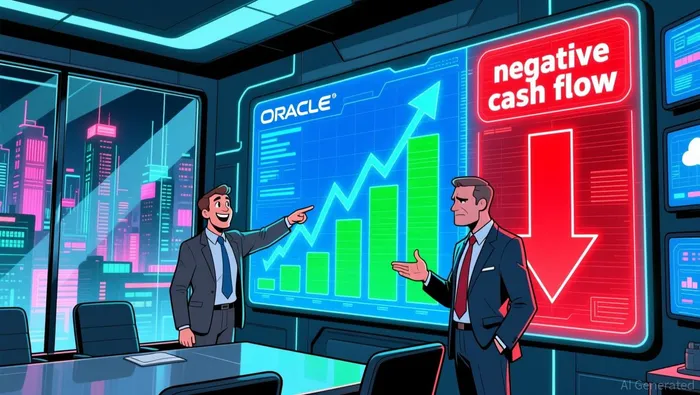
Still, the numbers aren't all positive. Free cash flow turned negative by $10 billion in the quarter, . This was driven by a massive $12 billion in capital expenditures, as Oracle continues to build out its AI and cloud infrastructure. Analysts are watching closely to see whether these investments will pay off in the form of recurring revenue or whether they'll become a drag on profitability.
A Balancing Act Between Growth and Cash Flow
The biggest concern for investors is Oracle's ability to convert its massive backlog—$523 billion in remaining performance obligations—into actual revenue. , suggesting strong long-term demand. However, the company's recent results raise questions about how quickly it can turn that into cash. Free cash flow is now deeply negative, and with capital spending increasing sharply, Oracle's debt load is also growing. , .
Analysts from Morgan Stanley, Bank of America, and others have already begun to revise their price targets and forecasts, expressing uncertainty about Oracle's ability to manage its cash flow. Some, like those at Citizens, remain optimistic, , . Others are more cautious, warning that Oracle's aggressive capital spending could become a balance sheet time bomb if returns don't materialize soon.
What This Means for Retail Investors
For now, , . This sharp decline reflects the market's unease over Oracle's near-term financial outlook. The company is investing heavily in AI, which is a promising but risky bet. While this could pay off in the long run, investors may be wary of over-leveraging to fund growth without clear, near-term returns.
That said, Oracle's core cloud infrastructure business is clearly on an upward trajectory. , and Oracle's leadership has emphasized its focus on expanding its AI capabilities. The company's non-GAAP earnings also beat expectations, . These figures suggest that OracleORCL-- is still generating strong profits, even as it invests for the future.
Still, the risk is real. If Oracle's AI investments don't translate into meaningful revenue growth in the next 12 to 18 months, investors may start to question whether the company is simply burning cash rather than building long-term value. That's especially true in a market where AI valuations are already under scrutiny. Oracle's debt load and capex plans are drawing comparisons to other tech companies that have overinvested in infrastructure without matching returns.
Looking Ahead: A Balancing Act
At the end of the day, Oracle is walking a tightrope. On one hand, it's doubling down on AI and cloud infrastructure, which are two of the most important trends in tech. On the other hand, it's running into headwinds related to cash flow and capital efficiency. The company's management team will need to reassure investors that it can convert its massive RPOs into revenue while maintaining profitability.
For now, the focus will be on Oracle's ability to deliver consistent results in the coming quarters. If cloud revenue continues to grow at a rapid pace and software demand stabilizes, the company may be able to justify its current valuation. But if free cash flow remains negative and capital spending outpaces revenue growth, investors may lose confidence.
Oracle's next earnings report, due later this year, will be a key moment. In the meantime, investors should keep a close eye on Oracle's balance sheet and cash flow trends, as well as the broader market's reaction to AI-driven expansion. For those willing to take a long-term view, Oracle could still offer compelling upside—if it can navigate the near-term challenges.

Delivering real-time insights and analysis on emerging financial trends and market movements.
Latest Articles
Stay ahead of the market.
Get curated U.S. market news, insights and key dates delivered to your inbox.
AInvest
PRO
AInvest
PRO



Comments
No comments yet