
Oracle Leads Market with $4.45 Billion Turnover as AI Backlog and Gemini Integration Spark Trading Surge
 Aime Summary
Market Snapshot
Oracle Corporation (NYSE: ORCL) closed the trading session on July 31, 2026, with a modest gain of 1.81%, reflecting continued investor interest despite a broader year-to-date decline of 34.8%. The stock demonstrated significant liquidity and trading activity, recording a total turnover of $4.45 billion, which ranked as the highest volume in the entire market for the day. This surge in trading volume underscores the heightened attention surrounding the company’s strategic developments. While the stock has experienced substantial volatility over the past month, showing a 13.0% decline, it has managed to recover slightly over the last week with a 6.3% increase. The closing price of $127.56 sits well below its 52-week high of $345.72, yet the robust trading activity suggests that market participants are actively reassessing the company’s valuation in light of recent partnership announcements and broader sector trends in artificial intelligence infrastructure.
Key Drivers
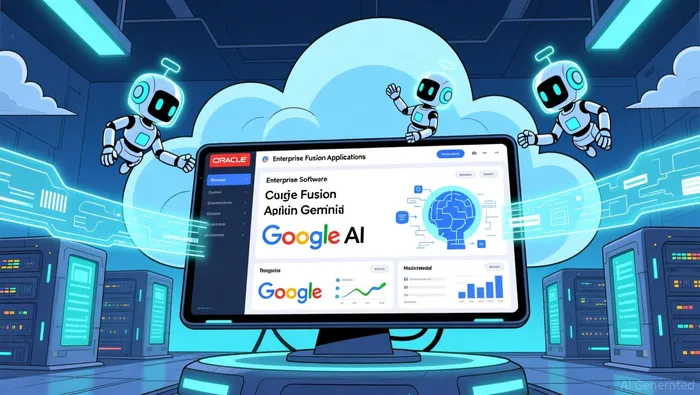
The primary catalyst for Oracle’s recent price movement and elevated trading volume is the strategic expansion of its partnership with GoogleGOOGL-- Cloud. OracleORCL-- announced that it will integrate Google’s advanced Gemini AI models directly into its core enterprise software ecosystem, specifically targeting Oracle Fusion Applications and Oracle NetSuite. This move marks a significant shift in Oracle’s strategy, transitioning from merely providing AI infrastructure to embedding sophisticated, application-level AI workflows. By incorporating Gemini models into the Oracle AI Agent Studio, the company is enabling enterprise clients to build, customize, and deploy autonomous AI agents. This integration aims to bring advanced automation, agentic workflows, and multi-modal capabilities directly into the software that financial, HR, and supply chain teams use daily, thereby strengthening Oracle’s value proposition against competitors like Microsoft, SAP, and Salesforce.
A critical component of this partnership is the introduction of specific Gemini models tailored for different enterprise needs. Oracle will make available Gemini 3.1 Flash Lite, which is engineered for high-efficiency, cost-optimized tasks, and Gemini 3.5 Flash, designed for more complex reasoning and specialized tasks such as video and presentation creation. This multi-model approach allows customers to select the AI model best suited for their specific operational requirements, balancing price-performance with computational power. The integration is not limited to a single platform; it extends to Oracle NetSuite, potentially reaching more than 43,000 global business customers. This broad accessibility is expected to accelerate automated decision-making and improve operational transparency, driving adoption of Oracle’s cloud-based enterprise solutions.
Beyond the immediate partnership news, market sentiment is being influenced by broader discussions regarding Oracle’s financial health and growth prospects. Analysts are increasingly focusing on Oracle’s reported $630 billion AI backlog, which includes potential long-term compute commitments from OpenAI. Some Wall Street analysts argue that the market is currently assigning little to no value to this massive backlog, suggesting that if these contracts convert into revenue, Oracle’s growth outlook and valuation could see significant upward revision. This perspective is supported by recent quarterly results, which showed a 20.6% year-over-year revenue growth and an earnings beat, indicating that the company’s cloud infrastructure investments are beginning to yield tangible financial returns.
However, the positive sentiment is tempered by ongoing concerns regarding Oracle’s leverage and capital expenditure strategy. The company has been investing heavily in data centers to meet surging AI demand, which has increased its debt levels. Critics point to elevated credit-default-swap costs and heavy borrowing as potential risks, questioning whether future AI returns will justify the substantial infrastructure spending. Additionally, governance concerns have arisen regarding CEO Larry Ellison’s personal guarantee on a large Warner Bros. Discovery transaction, prompting some investors to reassess their exposure. These factors contribute to the stock’s current trading range, with some analysts maintaining cautious "hold" ratings while others see substantial upside, leading to the high volatility and trading volume observed in recent sessions.
The convergence of these factors—strategic AI integration, potential backlog monetization, and financial risk assessment—has created a complex trading environment for Oracle shares. The high trading volume of $4.45 billion indicates that institutional investors and market makers are actively adjusting positions in response to these developments. While the integration of Gemini models provides a clear competitive advantage in the enterprise software market, the long-term impact on Oracle’s bottom line remains a subject of intense debate. Investors are closely monitoring how quickly customers will adopt these new Gemini-driven features and whether this adoption will translate into sustained cloud revenue growth sufficient to offset the company’s high capital expenditures and debt obligations.

Stay ahead of the market.
Get curated U.S. market news, insights and key dates delivered to your inbox.


AInvest
PRO
AInvest
PRO




Comments
No comments yet