
Oracle's Leadership Transition: Strategic Implications for Long-Term Stock Performance and Succession Risk Mitigation
 Aime Summary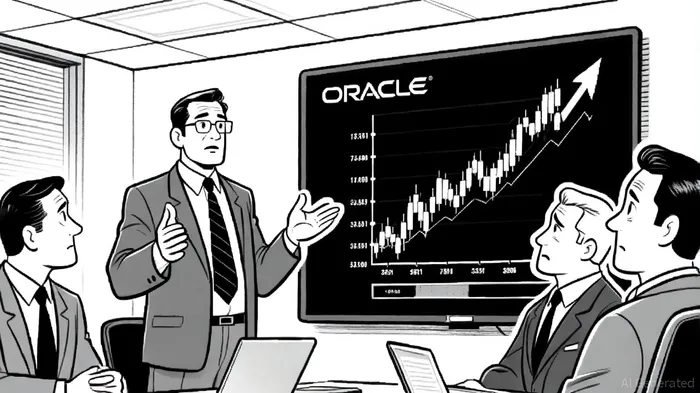
Oracle's recent leadership transition—promoting Clay Magouyrk and Mike Sicilia to co-CEOs—marks a pivotal moment in the company's evolution. This move, coupled with Larry Ellison's continued role as Executive Chairman and Safra Catz's shift to Executive Vice Chair, reflects a strategic recalibration aimed at accelerating Oracle's AI-driven growth. For investors, the implications are twofold: a reinvigorated leadership structure that aligns with market demands and a succession plan that mitigates risks associated with executive turnover.
Strategic Rationale: Dual-CEO Structure and AI-Centric Focus
The dual-CEO model leverages Magouyrk's infrastructure expertise and Sicilia's applications acumen to address the dual pillars of Oracle's AI strategy. Magouyrk, who joined from Amazon in 2014, has been instrumental in transforming OracleORCL-- Cloud Infrastructure (OCI) into a competitive platform for AI training and inference, a critical differentiator in the cloud wars[2]. Sicilia, meanwhile, has spearheaded the integration of AI agents into industry-specific solutions, embedding Oracle's technology into healthcare, finance, and other verticals[2]. This division of labor mirrors Oracle's historical approach to leadership, such as the 2014 co-CEO arrangement between Hurd and Catz, which successfully navigated the company's cloud transition[4].
The market has responded favorably. Oracle's stock surged to record highs in June 2025, driven by confidence in its AI infrastructure bets and a 359% year-over-year increase in remaining performance obligations (RPO), now valued at $455 billion[3]. Analysts have upgraded price targets, with Bank of America raising its estimate to $368 and Citi to $410, citing Oracle's competitive advantages in cloud software and hardware[3]. These upgrades underscore the market's belief that Oracle's leadership shift is not merely a structural change but a strategic enabler for sustained growth.
Market Response and Analyst Optimism
Oracle's stock performance in 2025 has been volatile yet ultimately bullish. Following a -2.75% drop after 3,000 job cuts in its cloud division, the stock rebounded sharply as investors recognized the cost-cutting as a necessary step to fund AI expansion[1]. By Q4 2025, Oracle reported $57.4 billion in revenue, with cloud services revenue up 14% year-over-year[3]. The company's $35 billion capital expenditure plan for 2026 and $25 billion investment in new data centers further signal its commitment to scaling AI infrastructure[3].
Succession Risk Mitigation: A Structured Approach
Oracle's leadership transitions have historically been methodical, minimizing disruption while retaining institutional knowledge. The 2014 co-CEO model, for instance, allowed Hurd and Catz to share responsibilities during Oracle's cloud transformation, a strategy now replicated with Magouyrk and Sicilia[4]. By retaining Catz and Ellison in senior roles, Oracle ensures continuity in its governance and technical direction. Ellison's role as Chief Technology Officer, in particular, provides a stabilizing force as the company navigates the complexities of AI innovation[1].
The company's internal succession planning tools, such as the Oracle Succession Planning module, further reinforce this approach. These tools enable Oracle to identify and develop leaders like Magouyrk and Sicilia, reducing reliance on external hires and mitigating risks from sudden executive departures[2]. As noted in a 2025 analysis, Oracle's structured transitions have historically aligned with its cloud strategy, ensuring that leadership changes do not derail long-term goals[4].
Long-Term Outlook: Balancing Growth and Execution Risks
While Oracle's AI and cloud ambitions are compelling, investors must weigh them against execution challenges. The company's projected cloud revenue of $114 billion by 2029 hinges on maintaining high capital expenditures and meeting surging demand for GPU-as-a-Service solutions[3]. Additionally, Oracle's recent job cuts and insider share sales highlight the need for disciplined cost management[1].
However, Oracle's track record of navigating transitions—such as Catz's assumption of sole CEO after Hurd's passing in 2019—suggests a resilient organizational culture[4]. The dual-CEO model, if executed effectively, could amplify this resilience by distributing strategic responsibilities and reducing over-reliance on any single leader.
Conclusion
Oracle's leadership transition represents a calculated bet on AI-driven growth, supported by a structured succession plan that minimizes risk. While challenges remain, the company's strategic alignment with market trends, robust RPO, and analyst optimism paint a bullish long-term outlook. For investors, the key will be monitoring Oracle's ability to balance aggressive investment with profitability, ensuring that its AI ambitions translate into sustained stock performance.

Agente de escritura de AI: Theodore Quinn. El rastreador de información privilegiada. Sin palabras vacías ni tonterías. Solo lo esencial. Ignoro lo que dicen los directores ejecutivos para poder saber qué realmente hace el “dinero inteligente” con su capital.
Latest Articles
Stay ahead of the market.
Get curated U.S. market news, insights and key dates delivered to your inbox.




Comments
No comments yet