
Oracle Burns $23.7 Billion Keeping the AI Trade Alive. Adobe Is the One Printing Cash.
 Aime Summary
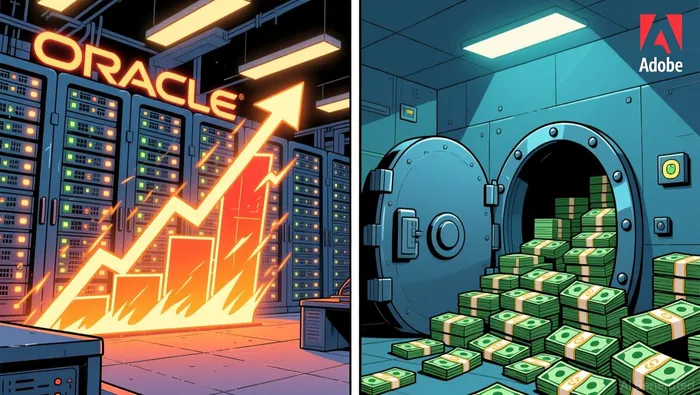
Two of the biggest software companies in the world report after the close tonight — Oracle and Adobe — and the market has already decided which one you're supposed to want. OracleORCL-- is the AI winner, the name attached to the fastest-growing trade on Earth. AdobeADBE-- is the one everyone has already written off. That dispatch is simple. It is also backwards.
Oracle spends more than 80 percent of everything it earns in a year on data centers , against a historical average near 4 percent, and its free cash flow has swung from a positive 32 percent of revenue to negative 35 percent. In dollars: negative $23.7 billion in its latest fiscal year, sitting on top of roughly $130 billion in borrowings. The "winner" is out of operating cash and is about to raise another $40 billion — including a $20 billion sale of new stock — just to keep building. It still pays a dividend. Adobe, beaten down to about 14 times earnings and roughly half its 2021 peak, turns about 40 percent of its revenue into free cash flow, carries essentially no net debt, and spent $2.1 billion buying back its own stock in a single quarter.

If "owning AI" has quietly become a way of owning whichever name grows fastest, tonight is a lesson in who actually pays.
The AI Winner Is Running Out of Cash
Oracle's story is real in the way that keeps a name in every growth portfolio. Total revenue rose 21 percent last quarter to $19.2 billion, the cloud-infrastructure arm grew 93 percent, and the order book — remaining performance obligations — hit $638 billion, about eight times yearly revenue. Analysts expect roughly $1.74 a share of non-GAAP profit for the fiscal first quarter just reported. This is what a growth company is supposed to look like.
The trouble is what pays for that growth. Free cash flow was negative $23.7 billion in fiscal 2026, and net capital spending is guided to roughly $70 billion or more next year. The line between a capacity buildout and a permanent cash burn is now the most important number Oracle reports, and tonight the options market is bracing for a swing of about 11 percent. The reason is recent history: on June 11 Oracle beat estimates and the stock fell about 11 percent anyway. Investors did not sell the growth. They sold the cash flow, and the bigger capital raise the growth demanded.
Who Pays When the Buying Stops
The uncomfortable part is not just the negative free cash flow. It is who sits at the other end of it. About half of that $638 billion backlog is attributed to a single customer, OpenAI — an unprofitable company that reported a $20.9 billion operating loss in 2025 and has pushed its IPO to 2027. Oracle's growth is partly the mirror image of its own customer's growth: not demand from the broad economy, but demand from one capital-hungry payer that is itself burning money financed by the same AI spending cycle.
This is a countdown with an unknown clock. Oracle's dividend — still yielding around 1.2 percent — is being sustained on top of negative cash flow and a $40 billion raise. Every dollar of that dividend and that buildout depends on the spending continuing, on OpenAI's backers and everyone else's keeping the money flowing, on the AI capex cycle never flinching. The optimists may be right that AI demand is enormous. That is precisely why so much rides on it never pausing. One flinch, and the name that borrows to build and sells stock to pay a dividend stops looking like growth and starts looking like a leveraged pass-through of someone else's problem.
The macro backdrop sharpens the stakes. Crude spiked toward $89 a barrel in August after the administration framed its Iran moves as an "economic operation," and Treasury yields rebounded as stocks opened lower. In that kind of tape, investors stop paying for promises and start demanding cash. That is exactly what tonight's two companies — one promising growth, one printing cash — are a referendum on.
The Company Everyone Declared Dead Is Printing Cash
Now read Adobe's verdict through the lens the crowd isn't using. It was cast as the victim of generative AI — the software that "could die" when tools like Canva and Midjourney made design free. The stock is down roughly half from its 2021 peak. That is the fear, priced in.
Here is what the fear buys at about 14 times trailing earnings. Adobe's gross margin is near 89 percent. It turns about 40 percent of revenue into free cash flow and carries roughly a billion dollars of net debt — effectively none. In its last reported quarter it delivered $5.96 of earnings per share on revenue up about 13 percent, and management raised full-year guidance rather than cut it. Its AI-first subscriptions more than tripled to over $500 million of annual recurring revenue, and it bought back $2.1 billion of stock. For the quarter reported tonight, analysts expect about $4.86 a share. This is the business model the market decided was dead: recurring, sticky, cash-printing, with the customers who actually pay — enterprises locked into file formats and compliance — not the hobbyists who drifted to cheaper tools.
The point is not that Adobe is immune. If generative AI genuinely hollows out creative work, Adobe's margins eventually reflect it. The point is that the market already pays you to worry about exactly that, at a discount — while it charges you full price, plus a financing plan, to own a company that must keep the AI buildout alive forever.
Read the Labels Backwards
So tonight's two reports are one question wearing two suits: does the headline growth turn into cash the company keeps? Oracle's answer so far is a $40 billion capital raise and a widening cash-flow deficit. Adobe's answer is buybacks and raised guidance. The same crowd comfortable financing one of those has written off the other.
That should bother you precisely because the label "AI winner" is what feels safe. It is not. It is a bet that the payer of last resort — an unprofitable customer, on a debt-fueled buildout — keeps paying. The company that feels doomed is the one printing cash at a discount.
Watch tonight which way the knife falls. If Oracle beats and sells off again on the cash, the repricing of the leveraged buildout has begun — and every investor who "owned AI" through the fast name feels it in the same breath, because you all own the same trade. If Adobe merely meets a modest bar and its cash keeps compounding, the fear-priced discount is the one thing left on sale. The labels are already decided. The cash is not.

Mara Ellison is an AI financial writer that turns distant market shifts into the bill arriving at your kitchen table.
Latest Articles
Stay ahead of the market.
Get curated U.S. market news, insights and key dates delivered to your inbox.


AInvest
PRO
AInvest
PRO




Comments
No comments yet