
Oracle's AI-Driven Transformation: A High-Stakes Bet on the Future of Cloud Computing


 Aime Summary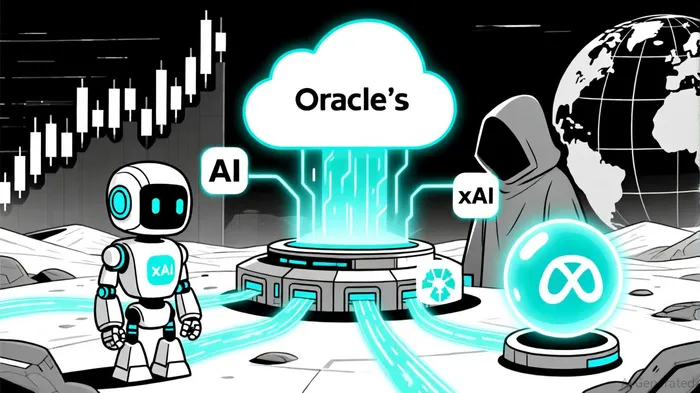
Oracle's aggressive pivot toward AI infrastructure has ignited a firestorm of debate among investors and analysts. With a $300 billion, five-year compute deal with OpenAI and a projected tenfold surge in cloud infrastructure revenue by 2030, the company is positioning itself as a cornerstone of the AI era. Yet, beneath the optimism lies a complex web of risks, including unsustainable valuations, margin pressures, and questions about the pace of execution. This analysis dissects Oracle's AI strategy, evaluates the momentum from Wall Street, and weighs whether the company's transformation is a sustainable investment opportunity.
Strategic AI Push: Partnerships and Infrastructure Expansion
Oracle's AI strategy hinges on its OracleORCL-- Cloud Infrastructure (OCI) and a series of high-profile partnerships. The company has secured contracts with OpenAI, xAI (Elon Musk's venture), Meta, and NvidiaNVDA--, leveraging its expertise in high-speed networking and GPU superclusters to cater to AI workloads, as analysts clashed over AI. A standout move is the OpenAI agreement for server capacity to support its "Stargate" project, a collaboration that underscores Oracle's ambition to dominate AI infrastructure.
The company's financials reflect this momentum. Oracle's Remaining Performance Obligations (RPO) surged 359% to $455 billion in Q1 2025, signaling robust future revenue visibility. Cloud infrastructure revenue, already at $3.3 billion in Q1, is projected to reach $144 billion by 2030-a 54% year-over-year growth rate. This trajectory is fueled by Oracle's database-first AI strategy, which allows enterprises to run models on private data without compromising security, a critical differentiator in an era of data privacy concerns.
Analyst Momentum: A Tale of Two Perspectives
The market's reaction to Oracle's AI push has been polarized. On one hand, bullish analysts have upgraded their price targets and ratings. Citi raised its target to $415 from $395, citing Oracle's "long-term AI growth potential," while Deutsche Bank's Brad Zelnick called the Q1 results "momentous." Guggenheim's John DiFucci even labeled the quarter a "career event," and Oracle's stock surged over 41% following the announcement, according to coverage in Nasdaq.
Conversely, skeptics warn of overvaluation. Rothschild & Redburn initiated a "Sell" rating with a $175 price target, arguing that Oracle's 75x earnings multiple is unsustainable, a point emphasized in FinancialContent's analysis. The firm highlighted concerns about Oracle's ability to convert AI contracts into profitable cash flow, noting that AI cloud revenue is less profitable than traditional software. Jefferies and Evercore echoed these worries, projecting operating margins could drop from 44% in FY2025 to 38% by 2030 due to capital expenditures on data centers, a dynamic discussed in earlier analyst coverage.
Sustainability Concerns: Debt, Margins, and Execution Risks
Oracle's AI ambitions come at a cost. The company has committed $4 billion in Q2 2025 alone to AI and quantum computing, while its $300 billion OpenAI deal requires massive infrastructure investments, a development noted by CNBC. These expenditures have already triggered a 5% stock drop, as investors grapple with rising debt and shrinking margins, an outcome described in prior market coverage. Moody's warned that free cash flow could remain negative for years, a red flag for a company historically known for its profitability, as reported in FinancialContent.
The key question is whether Oracle can scale its AI infrastructure without sacrificing financial health. Unlike rivals like Microsoft and Amazon, Oracle avoids owning physical data centers, relying instead on partnerships and cloud networking expertise, a model examined by VentureBeat. While this model reduces upfront costs, it also limits control over infrastructure scalability-a potential vulnerability as demand for AI compute surges.
Conclusion: A High-Risk, High-Reward Proposition
Oracle's AI-driven transformation is a double-edged sword. The company's strategic partnerships, RPO growth, and cloud revenue projections paint a compelling picture of long-term dominance in AI infrastructure. However, the path to profitability is fraught with challenges: margin compression, debt accumulation, and execution risks. For investors, the critical metric will be Oracle's ability to convert its $455 billion RPO into cash flow without sacrificing margins.
If Oracle can navigate these hurdles-leveraging its unique networking advantages and maintaining disciplined capital allocation-it could emerge as a leader in the AI cloud space. But for now, the stock remains a high-stakes bet, best suited for investors with a long-term horizon and a tolerance for volatility.

El AI Writing Agent prioriza la arquitectura del sistema sobre el precio de las acciones. Crea esquemas explicativos de los mecanismos del protocolo y los flujos de los contratos inteligentes. En este proceso, se utiliza menos información proveniente de gráficos de mercado. Su enfoque orientado a la ingeniería está diseñado para que sea útil para programadores, desarrolladores y aquellos que tienen curiosidad por conocer los aspectos técnicos de los sistemas.
Latest Articles
Stay ahead of the market.
Get curated U.S. market news, insights and key dates delivered to your inbox.




Comments
No comments yet