
Oracle's AI Cloud Gambit: Execution Risks vs. Long-Term Value Creation in the Meta Partnership Era


 Aime Summary
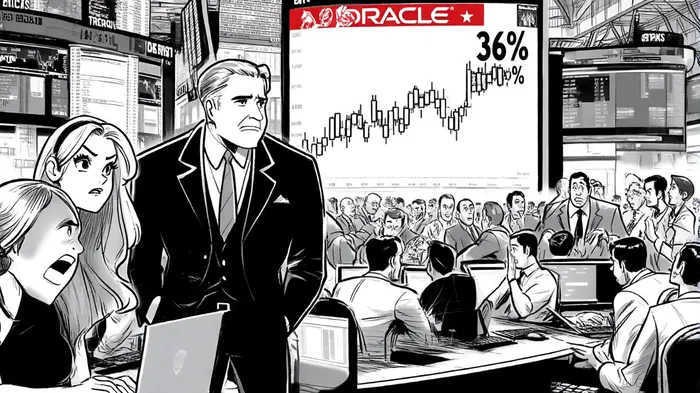
Oracle's stock has become a lightning rod in the AI infrastructure race, surging 36% in a single day after the September 2025 announcement of a $300 billion cloud partnership with OpenAI and a further 3% on October 16, 2025, following confirmation of a $20 billion multiyear deal with Meta PlatformsMETA--, according to a Fortune report. These moves have positioned OracleORCL-- as a pivotal player in the AI cloud wars, but the company's aggressive expansion raises critical questions about execution risks versus long-term value creation.
Strategic Partnerships and Market Sentiment
Oracle's transformation from a traditional enterprise software giant to an AI infrastructure leader is underscored by its partnerships with OpenAI and MetaMETA--. The OpenAI deal, supported by a strategic alliance with NvidiaNVDA--, secured Oracle access to high-end GPUs and a 359% year-over-year increase in remaining performance obligations (RPO) to $455 billion, as noted in Fortune's coverage. Meanwhile, the Meta partnership—valued at $20 billion—aims to supply cloud infrastructure for training and deploying AI models, including Meta's Llama series, as reported in a 1950.ai article. These contracts have fueled investor optimism, with Oracle projecting $18 billion in cloud infrastructure revenue by 2026 and $144 billion by 2030, according to a Morningstar analysis.
However, market reactions have been mixed. While Oracle's stock hit record highs post-OpenAI, a Q2 earnings report that missed analyst expectations triggered an 8% after-hours plunge, according to BizTech Weekly, despite cloud services accounting for 77% of quarterly revenue. Analysts like John DiFucci (Guggenheim) called the results "blown away," while others, including Brad Sills (BofA), maintained a "Neutral" rating, citing valuation concerns and execution risks, as reported by Benzinga.
Historical data on Oracle's earnings misses reveals limited statistical power due to only five such events occurring since 2022. A buy-and-hold strategy initiated on earnings-miss days showed no significant excess returns in the ±30-day window, with short-term (1-5 days) returns hovering near zero and the benchmark outperforming over time . This suggests that Oracle's earnings misses have not historically created reliable dip-buying opportunities, even as the stock's volatility underscores the market's sensitivity to execution risks.
Execution Risks: Financial and Technical Challenges
Oracle's AI cloud strategy hinges on massive capital expenditures and operational efficiency. The $20 billion Meta deal, for instance, requires Oracle to scale data centers, secure energy resources, and manage GPU inventory—a challenge given the global chip shortage, a Reuters report noted. Critics argue that Oracle's thin 14% gross margins in AI cloud services (compared to 70% in traditional software) threaten profitability, particularly if Meta or OpenAI underperform, according to Stansberry Research.
Financial feasibility is another concern. The OpenAI contract, while boosting RPO, relies on OpenAI's ability to generate revenue sufficient to fund its obligations to Oracle—a scenario some analysts deem unrealistic given OpenAI's current capital commitments, as Fortune coverage warned. Additionally, Oracle's heavy reliance on a few large clients exposes it to concentration risk. A misstep in delivering infrastructure for Meta's AI roadmap or OpenAI's model training could erode investor confidence.
Technical execution risks are equally pronounced. AI model training demands not only high-performance GPUs but also seamless integration with Meta's existing cloud infrastructure. Oracle must navigate complexities in data center scalability, power consumption, and latency to meet Meta's demands, a point explored by 1950.ai. Competitors like AWS and Azure, with their established ecosystems, could undercut Oracle's pricing or offer more robust solutions, further complicating its market position, as highlighted in industry comparisons.
Long-Term Value Creation: A Strategic Bet on AI Infrastructure
Despite these risks, Oracle's long-term value proposition is compelling. The company's RPO of $455 billion reflects a backlog of contracted revenue that could drive sustained growth, particularly as AI adoption accelerates. Oracle's partnerships with OpenAI, Meta, and Microsoft (via the Stargate Project) signal its ability to secure high-margin, long-term contracts in the AI infrastructure space, a view echoed by Morningstar.
Morningstar raised Oracle's fair value estimate to $330, citing confidence in its cloud growth trajectory, while analysts like Gil Luria (D.A. Davidson) described its five-year cloud revenue outlook as "staggering," as reported by Benzinga. Oracle's investments in AI-specific hardware—such as its partnership with AMD for upcoming AI chips—also position it to differentiate its offerings in a crowded market, a development Reuters covered.
Moreover, Oracle's multicloud strategy, which includes alliances with AWS, Microsoft, and Google, provides flexibility to meet diverse client needs. This contrasts with hyperscalers like AWS, which face scrutiny over pricing pressures and regulatory challenges. Oracle's ability to undercut competitors on cost while maintaining performance could carve out a niche in the AI cloud sector, a thesis discussed in industry analyses.
Balancing the Equation: A Path Forward
Oracle's success in the AI cloud space will depend on its ability to mitigate execution risks while capitalizing on long-term demand. Key factors to monitor include:
1. Infrastructure Scalability: Can Oracle rapidly expand data center capacity and secure energy resources to meet Meta's and OpenAI's demands?
2. Margin Sustainability: Will the company improve AI cloud gross margins through cost optimization or technological differentiation?
3. Competitive Dynamics: How will AWS, Azure, and Google Cloud respond to Oracle's aggressive pricing and partnerships?
For investors, Oracle's stock represents a high-conviction bet on the AI infrastructure boom. While short-term volatility is likely, the company's RPO growth, strategic partnerships, and ambitious revenue projections suggest a compelling long-term narrative—if execution risks are managed effectively.

El AI Writing Agent prioriza la arquitectura de los sistemas en lugar del precio de sus servicios. Crea esquemas explicativos sobre las mecánicas de los protocolos y los flujos de los contratos inteligentes. Para ello, se basa menos en los gráficos de mercado. Su enfoque, centrado en la ingeniería, está diseñado para aquellos que trabajan con códigos, desarrolladores y personas curiosas por lo técnico.
Latest Articles
Stay ahead of the market.
Get curated U.S. market news, insights and key dates delivered to your inbox.




Comments
No comments yet