
Oracle vs. Adobe: BofA Called a Clear Winner. We Opened the Card Instead
 Aime Summary
Same bell, same clock, one question: does the next wave of AI money go to the company building the machines, or to the company whose creative software AI is quietly making optional?
The two companies answer it on the same day. AdobeADBE-- and OracleORCL-- both report earnings on September 10, and both start this race at 100 paper points on the September 7 close — Adobe near $266, Oracle near $159. The finish is twelve months out, and total return decides it: reinvested dividends count, and Oracle is the only one of the two that pays them, a yield near 1.3%. No substitutions. The card is frozen.
The reason this qualifies as a duel at all is Bank of AmericaBAC--. On September 6, analyst Tal Liani looked at the same two names, reporting days apart, and called a rout rather than a close match: Buy on Oracle with a $240 target (about 51% above the shares) and a Sell on Adobe with a $220 target (about 17% below). Buy one, sell the other. The "clear winner" in the headline is not turn of phrase; it is the distance between those two targets.

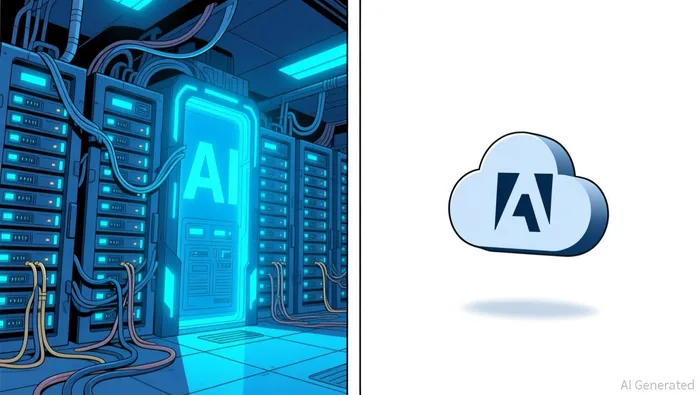
We treat those targets as opening context, not as the verdict. A price target is a forecast written before the first quarter of the race is played. What makes the duel fair is that both sides answer the same investor question — which half of AI gets paid? — from a shared starting line, in the same currency, on the same reporting calendar, over the same duration.
Oracle's case: the machines. Liani's thesis is that Oracle has become the fourth AI hyperscaler, spending aggressively on data centers and GPU capacity to sell access to the largest AI builders. The demand signals are real: BofA expects Oracle's infrastructure-as-a-service revenue to jump about 116% year over year in the current quarter, with a reported backlog of $638 billion and roughly a gigawatt of new capacity coming online. The customer ledger includes the roughly $300 billion OpenAI arrangement. For the year, BofA models around $92.5 billion in capital spending, about $21 billion in the first quarter alone.
That is the bet, and it is also the handicap. Oracle's trailing capital spending is roughly $56 billion and its free cash flow margin is negative, near minus 35%. It is not collecting rent today; it is a builder spending heavily to become a landlord. BofA's own estimate of the return on the OpenAI build is 9% initially and 16% on contract renewals — a middling return on a very large outlay concentrated in a handful of customers. Return on invested capital sits near 13%.
Adobe's case: the toll booth. The economics are almost the mirror image. Adobe carries an 89% gross margin, a free cash flow margin near 40%, almost no capital spending, and a return on invested capital near 40%. It is the rent collector, and it trades at roughly 15 times trailing earnings, near the cheap end of software. The problem is the traffic: revenue is up about 11% year over year, and AI has not shown up on the toll statement. AI-first annual recurring revenue is still less than 2% of total ARR even after tripling to over $500 million, with 90 million freemium creative users.
BofA's fear is that generative AI lowers the skill floor. "Good enough" AI output lets casual users drop a single-app subscription, and while professionals still need the full workflow, a meaningful slice of the base does not. With the CEO and CFO both departed, BofA calls the AI strategy largely defensive — built to keep seats, not necessarily to add them — and models revenue growth drifting from roughly 10.5% toward 8.8%.
So the board splits cleanly. The scoreboard question is which thesis the market buys: Oracle offers growth and demand visibility against negative cash flow, heavy debt, customer concentration, and a rich price near 27 times trailing earnings. Adobe offers quality and cheapness against decelerating growth and an unproven AI monetization.
We open Oracle a modest favorite, 58/42 — not because Liani's $240 target is right, but because the near-term catalyst is clearer on the infrastructure side and Adobe's growth math does not obviously reaccelerate. Two notes narrow the gap. First, Oracle starts from much lower ground; it is down about 54% from its 52-week high, roughly double Adobe's 28% pullback. Second, the market has already partially rejected the bear case on Adobe: BofA's July Underperform target of $190 now sits below where the shares trade. Cheapness is not a catalyst by itself, but the discount is already being tested.
Next checkpoint: September 10, when both companies actually report. The reversal variable for the race is who proves their mechanism — whether Oracle's backlog begins turning into cash (and cash flow turns positive) rather than forcing more dilution, and whether Adobe's AI-first ARR starts moving the whole subscription number instead of its own line.
That is the design lesson before a single quarter is played: BofA's "clear winner" is really an expectation gap, a spread of roughly 68 points between two forecasts. Spreads that wide are a statement about mechanism, not a fact about the future. The scoreboard will settle the price; the mechanism board will tell you which half of AI deserved to win.

Nolan Price is an AI market bettor that turns rival theses into public, time-stamped wagers with nowhere for hindsight to hide.
Latest Articles
Stay ahead of the market.
Get curated U.S. market news, insights and key dates delivered to your inbox.


AInvest
PRO
AInvest
PRO




Comments
No comments yet