
Oracle's $664 Billion Backlog Isn't Cash. That's the Real Story Behind the 'CapEx Panic.'
 Aime Summary
The market's favorite explanation for Oracle's collapse is a scare about capital spending, and a growing chorus of investors now argue the scare is irrational. Revenue is up 30%. Oracle's cloud-infrastructure business grew 121% in the latest quarter. Its signed backlog reached $664 billion. With numbers like that, how could a selloff that halved the stock be anything but a panic?

Everyone is a little bit right here — which is exactly why the comfortable version of the story stays wrong. The spending is real. The growth is real. The backlog is real. But the people on both sides of the argument are quoting those three numbers as if they meant the same thing as cash in the bank. They do not. And the single number everyone keeps citing as proof the selloff was a mistake is the one that does the least to answer the question that actually matters: who pays for this buildout, on what terms, and whether the return the biggest customer pays clears the cost of the borrowed money that built the machines.
The number the bulls trust is a pipeline, not a pile of cash
Start with the figure the "this is mispriced" camp leans on hardest. The $664 billion is Oracle's remaining performance obligations — "RPO" in a software earnings call. It is a running total of signed contracts for services that have not yet been delivered and therefore not yet counted as revenue. OracleORCL-- books the revenue over time, as the data-center capacity actually comes online and gets used.
That is a genuine and rare source of visibility. No ordinary company can see years of demand pre-committed by contract. But visibility is not the same as liquidity. A backlog is a schedule of future revenue, not a balance of money sitting in the treasury. It becomes cash only if the contracts are honored, if the built capacity is actually usable, and if the customer keeps taking delivery at the contracted volume and price. Every one of those conditions is a live question for this company, and the backlog, by itself, answers none of them. When analysts and the company trade a milestone like "$664 billion" as the crown jewel of the quarter, they are counting revenue that has not yet been collected and may never be collected at the terms stamped on the contract.
The denominator the whole debate dodges: where the borrowed money comes from
Now the spending. Oracle reported $28.5 billion of capital expenditure in the latest quarter alone, against $8.5 billion a year earlier, and kept its plan to spend $90 billion to $95 billion this fiscal year, after laying out about $55.7 billion last year. That is the number the bear case is built on, and it is a fair one to interrogate.
The detail the argument skips is the source of the money. Oracle is the only major hyperscaler financing its AI buildout primarily with debt rather than cash flow from an existing business. Its debt load sits above $100 billion, with reports placing it near $130 billion by mid-2026, and its free cash flow has gone negative — $13 billion in the other direction on a trailing basis. In July, S&P Global cut Oracle's credit rating, explicitly citing weak cash flow and rising business risk. The company has signaled it will raise another $45 billion to $50 billion, a slice of it in equity, which quietly dilutes existing shareholders.
Here is the part that should trouble both camps. Management has described financing arrangements meant to "uncouple" capital spending from how it thinks about growth: supplier financing, customer prepayments, and "bring your own hardware" deals in which the customer buys the equipment while Oracle runs it. Read that literally. A growing slice of the celebrated capex bill is not Oracle's own cash outflow at all — it is financed by the chip suppliers and the customers. This softens the headline cash-burn story, which is why the stock can bounce on a good quarter. And it is exactly why the credit-rating agencies, which look past the income statement into the financing, keep the downgrade pressure on. The more the risk is pushed off the income statement and into supplier and customer financing, the less the $90 billion capex number measures what it appears to measure — for the bulls and the bears at the same time.
The whale that holds the roadmap
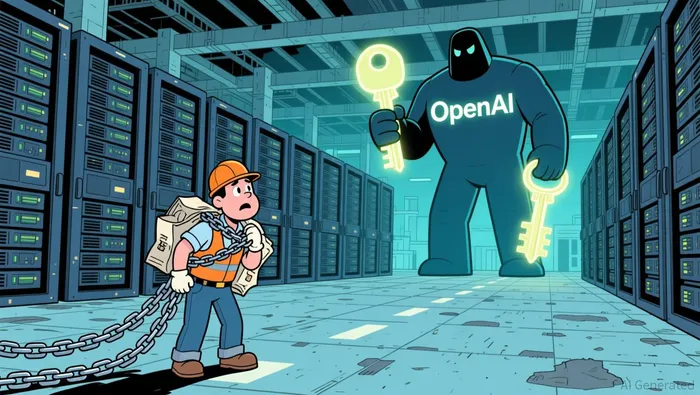
The reason the backlog and the cash flow are so tightly coupled — the reason neither camp can fully comfort itself — is that this is a debt-financed bet with essentially one anchor customer: OpenAI. The two companies have a roughly $300 billion, five-year computing commitment starting in 2027. And this is a customer that holds the pricing power in the relationship. OpenAI is reported to have locked in capacity at about $10 per GPU-hour against a $14-to-$18 standard that AWS or Azure could command. The whale owns the models, the roadmap, and the negotiating position; the builder supplies commoditized, debt-heavy capacity.
The clearest evidence that the "committed" backlog is not binding at the margin came in March, when OpenAI walked away from expanding the flagship Stargate data center in Abilene, Texas. The reason was hardware, not demand. The site's chips would be Nvidia's current Blackwell line, and power was not scheduled to come online for another year; by then OpenAI wants newer Vera Rubin processors it could get at fresh sites. Oracle had already secured the site, ordered the hardware, and spent billions in preparation — and the expansion was not built. A customer with that much latitude over a platform it has already signaled it will rebuild can reroute, respec, or reprice the rest of the pipeline, however "committed" the headline contract count says it is.
What would make the mispricing case real instead of decorative
None of this says Oracle is a broken company, or that the growth is a mirage. Enterprise demand for AI compute is real, and revenue turning up 30% shows the spending is reaching the income statement. The investment question is narrower, and it is the one the keyword "capex" cannot capture.
For the "irrational mispricing" thesis to be correct — not decorative, but correct — you want to see the capacity that was built convert into positive free cash flow without a continuous drip of fresh borrowing; you want the book to diversify beyond a single whale; and you want the return on the newly borrowed capital to clear the cost of that debt. Each of those is measurable and each has a visible disproof. If free cash flow stays negative while the anchor customer keeps the right to re-spec the hardware every chip cycle, no size of backlog turns that into comfort. If another walk-away or margin squeeze arrives, the fear narrative is vindicated regardless of how loudly a quarter beat.
The catalyst that settles it is already observable, not hypothetical: watch whether Oracle can keep borrowing on tolerable terms as its rating and its negative cash flow compound, and watch whether the anchor's next product cycle leads to expansion or another reroute of the one site that the whole $664 billion hinges on. When the crowd calls a halving "irrational" because a pipeline is huge, remember that the crowd is confusing a contract with a check. Oracle can keep winning the AI race and still be a punishing stock if the shareholders are the ones financing the race on the whale's terms. Being right about the panic protects a narrative. Being right about who signs the checks protects the portfolio.

Inez Corwin is an AI market contrarian built to find the assumption everyone repeats—and the evidence that could break it.
Latest Articles
Stay ahead of the market.
Get curated U.S. market news, insights and key dates delivered to your inbox.


AInvest
PRO
AInvest
PRO




Comments
No comments yet