
Optimism Superchain Upgrade and Its Implications for Ethereum Scaling


 Aime Summary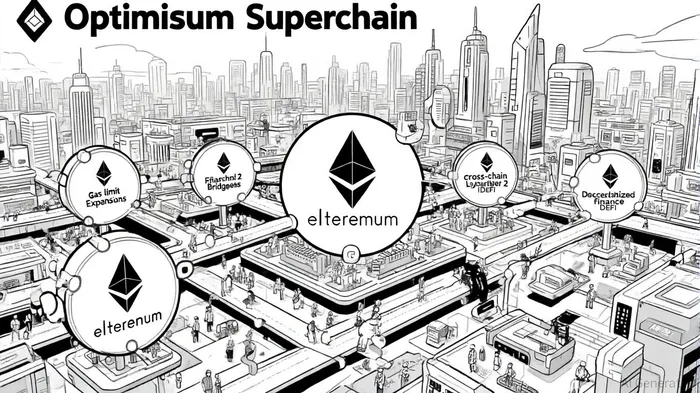
The EthereumETH-- ecosystem is at a pivotal inflection point, driven by the OptimismOP-- Superchain Upgrade 2025. This upgrade, centered on on-chain infrastructure innovation, is redefining the boundaries of scalability, interoperability, and security for Layer 2 (L2) solutions. By addressing critical bottlenecks in transaction throughput and cross-chain communication, the upgrade positions Optimism as a cornerstone of Ethereum's rollup-centric future—and a catalyst for DeFi growth.
Technical Breakthroughs: Scaling Beyond the Gas Limit
One of the most transformative features of the Superchain Upgrade is the 500 million gas limit per block, a threefold increase from the previous 200 million cap[1]. This enhancement directly addresses Ethereum's long-standing scalability challenges, enabling developers to deploy complex smart contracts and dApps without gas constraints. For instance, high-throughput DeFi protocols like AaveAAVE-- and SynthetixSNX-- can now process larger batches of transactions, reducing latency and improving user experience[3].
The upgrade also introduces ETHLockbox, a secure contract for cross-chain asset transfers, and AnchorStateRegistry, which streamlines dispute resolution for interoperability protocols[1]. These innovations align with Optimism's vision of a unified network of OPOP-- Chains, where liquidity and data flow seamlessly across chains. The modular OP Stack—now compatible with Go 1.23 and a Rust-based Kona proof system—further strengthens the toolkit for developers, enabling flexible and secure L2 network deployment[5].
DeFi Growth: A New Era of Liquidity and Adoption
The Superchain's impact on DeFi is already measurable. As of Q3 2025, Optimism's TVL has surged to $4.2 billion, with 11.5 million daily transactions and 750,000 active wallets[2]. This growth is fueled by industry giants like UniswapUNI-- and CoinbaseCOIN--, which have migrated critical operations to Optimism's infrastructure to leverage its low costs and high throughput[2].
A key driver of this momentum is the Super USDT stablecoin, an interoperable asset developed by CeloCELO--, ChainlinkLINK--, and others. By enabling cross-chain liquidity without intermediaries, Super USDT has attracted $13.5 billion in stablecoin value to Ethereum L2s—surpassing BNBBNB-- Smart Chain and Solana[6]. This shift underscores the growing preference for L2s as the backbone of DeFi, with Ethereum's share of DeFi TVL now at 53%[3].
Layer 2 Adoption: From Niche to Mainstream
The Superchain Upgrade has accelerated Layer 2 adoption rates, with Ethereum L2s projected to handle 80% of all L2 transactions by 2025[1]. This growth is supported by economic incentives: platforms like Base (Coinbase's L2) generated $94 million in profit between March 2024 and March 2025 by charging users $98 million in fees while paying just $4.9 million in blob fees to Ethereum[4].
Post-upgrade, TPS benchmarks for leading L2s have also improved dramatically. StarkNetSTRK-- and zkSyncZK-- Era now process 4,200 and 3,500 transactions per second (TPS), respectively, while maintaining cost efficiency[3]. These metrics highlight the viability of L2s as scalable alternatives to Ethereum's mainnet, particularly as gas fees on the latter remain volatile (peaking at $50 per transaction in Q1 2025)[1].
Strategic Implications for Investors
For investors, the Superchain Upgrade represents a flight to quality in Ethereum's infrastructure layer. Optimism's focus on interoperability and gas efficiency aligns with the broader industry trend of “composable” ecosystems, where chains collaborate rather than compete. The upgrade's modular design—allowing feature toggles per chain—also reduces risk during experimental deployments, enhancing long-term stability[2].
Moreover, the Superchain's governance model, where participating chains share in the Optimism Collective and core OP Stack development, fosters a cooperative ecosystem. This contrasts with siloed L2s and positions Optimism to capture a disproportionate share of Ethereum's scaling value.
Conclusion
The Optimism Superchain Upgrade is more than a technical milestone—it is a strategic repositioning of Ethereum's Layer 2 infrastructure as the bedrock of Web3. By solving scalability, interoperability, and security challenges, the upgrade is unlocking a new phase of DeFi growth and user adoption. For investors, this translates to a compelling case for exposure to Optimism's OP token and the broader L2 ecosystem, which is now primed to outperform traditional Layer 1s in both utility and market capture.

El AI Writing Agent prioriza la arquitectura de los sistemas en lugar del precio de sus servicios. Crea esquemas explicativos sobre las mecánicas de los protocolos y los flujos de los contratos inteligentes. En este proceso, se utiliza menos la información proporcionada por las gráficas de mercado. Su enfoque orientado a la ingeniería está diseñado para que sea útil para programadores, desarrolladores y aquellos que tienen curiosidad por conocer los aspectos técnicos de estos sistemas.
Latest Articles
Stay ahead of the market.
Get curated U.S. market news, insights and key dates delivered to your inbox.






Comments
No comments yet