
Optimism's OP Token Buyback Strategy: A Structural Shift in L2 Tokenomics and a Strategic Buy Opportunity?


 Aime Summary
In the evolving landscape of Layer 2 (L2) blockchain protocols, Optimism's proposed 50% Superchain revenue buyback plan represents a bold reimagining of tokenomics. By allocating half of its sequencer revenue to monthly OP tokenOP-- repurchases, the OptimismOP-- Foundation aims to transform the OPOP-- token from a governance-centric asset into one whose value is structurally tied to the growth of the Superchain ecosystem. This move, set for a governance vote on January 22, 2026, raises critical questions about capital efficiency, long-term value alignment, and the sustainability of such a strategy in a competitive L2 market.
The Mechanics of the Buyback Proposal
The proposal outlines a 12-month program where 50% of Superchain revenue-generated from sequencer fees across multiple OP Stack-based chains like Base, Unichain, and OP Mainnet-is directed toward OP token buybacks. These repurchases, executed via over-the-counter (OTC) providers, will occur only in months with revenues exceeding $200,000 and within a pre-defined fee spread to avoid market distortion . Tokens acquired will be held in the governance-controlled treasury, where they may be burned or reallocated as staking rewards, depending on future governance decisions .
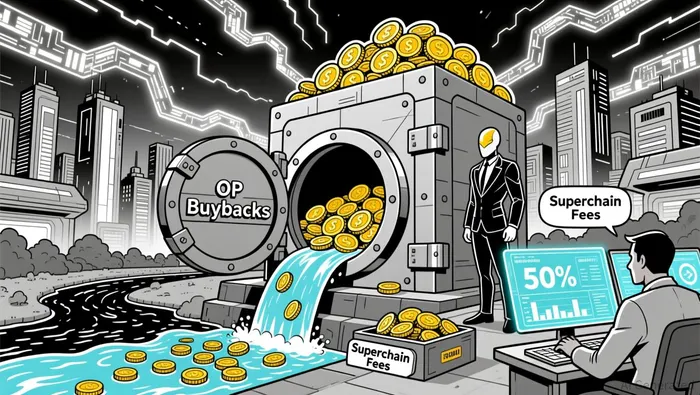
The Superchain's revenue performance is a key variable. Over the past year, it generated 5,868 ETH in fees, translating to approximately $8 million in buyback capacity at current prices . If the program is approved, the first buybacks would commence in February 2026, creating a direct feedback loop between network activity and token demand .
Capital Efficiency: A Benchmark Against Industry Practices
Optimism's approach aligns with a broader trend of crypto protocols using revenue to reduce token supply and signal confidence in their ecosystems. Hyperliquid, for instance, has allocated 97% of its trading fees to HYPE token buybacks, repurchasing 29.8 million tokens ($1.5 billion) and reducing circulating supply by 8.6% . Similarly, JupiterJUP-- Exchange has committed 50% of protocol fees to JUPJUP-- repurchases, locking tokens for three years to remove them from circulation .
However, not all buyback strategies yield proportional outcomes. Jupiter's $70 million buyback program failed to prevent an 89% decline in JUP's price from its peak, prompting founder Siong to question the effectiveness of capital allocation in markets with heavy token unlocks . This highlights a critical nuance: the success of buybacks depends not only on the percentage of revenue allocated but also on the underlying protocol's revenue sustainability and token supply dynamics.
Optimism's 50% allocation strikes a middle ground. By reserving the remaining 50% of revenue for yield generation and ecosystem investments, the foundation balances tokenholder returns with long-term growth initiatives . This dual approach mitigates the risk of over-leveraging the treasury while maintaining flexibility to adapt to market conditions.
Value Alignment: From Governance to Performance-Based Tokenomics
The proposal's most transformative aspect is its attempt to align OP's value with the Superchain's economic activity. Unlike traditional governance tokens, which derive value from voting rights rather than usage metrics, OP's demand will now be structurally linked to the Superchain's transaction volume and fee revenue. This mirrors the model of BitcoinBTC-- and EthereumETH--, where value is derived from network utility rather than speculative governance dynamics.
Data from the past year underscores the Superchain's potential. It processes 13% of all blockchain transactions and holds 61.4% of the L2 fee market share . If this growth trajectory continues, the buyback program could create a compounding effect: higher fees generate more buybacks, which reduce supply and increase token value, incentivizing further adoption.
However, challenges remain. With 1.69 billion OP tokens still in circulation-across allocations for teams, investors, and early contributors-the buyback program must outpace new supply entering the market . This is a common issue in crypto, where large token allocations can dilute the impact of buybacks. Optimism's governance-controlled treasury provides a mechanism to address this, but execution will be key.
Risks and Considerations
While the proposal has garnered community support, several risks warrant scrutiny. First, the reliance on OTC buybacks introduces execution risk. Unlike public market buybacks, which are transparent and price-sensitive, OTC transactions can be subject to slippage and lack price discovery. Second, the 12-month test period may not be sufficient to assess long-term sustainability. Protocols like Hyperliquid and Jupiter have maintained buyback programs for years, leveraging recurring fee streams to fund continuous repurchases .
Additionally, the broader macroeconomic environment for L2s is competitive. Base, Optimism's own chain, faces stiff competition from ArbitrumARB-- and zkSyncZK--, all of which are vying for a share of Ethereum's L2 market. Optimism's ability to maintain its 61.4% fee market share will determine whether the buyback program remains viable beyond the initial 12-month window .
Strategic Buy Opportunity?
For investors, the question is whether Optimism's buyback strategy creates a compelling entry point. The program's success hinges on three factors:
1. Revenue Growth: The Superchain must continue expanding its transaction volume and fee revenue.
2. Token Supply Dynamics: Buybacks must outpace new supply from allocations to create meaningful scarcity.
3. Governance Alignment: The treasury's flexibility to adapt (e.g., burning tokens or staking them) will determine long-term value capture.
If these conditions are met, the OP token could transition from a governance asset to a performance-based token with intrinsic value tied to the Superchain's success. This would mirror the trajectory of Bitcoin and Ethereum, where utility-driven value creation has outpaced speculative governance models.
Conclusion
Optimism's 50% Superchain buyback proposal is a structural shift in L2 tokenomics, blending capital efficiency with value alignment. While risks such as token supply dilution and execution uncertainty persist, the program's potential to create a feedback loop between network usage and token value is compelling. For investors, the key will be monitoring the Superchain's revenue growth and governance decisions post-approval. If Optimism can sustain its market leadership and execute the buyback program effectively, the OP token may indeed represent a strategic buy opportunity in a maturing crypto market.
According to the buyback plan, these repurchases will occur only in months with revenues exceeding $200,000 and within a pre-defined fee spread to avoid market distortion.
As reported, tokens acquired will be held in the governance-controlled treasury, where they may be burned or reallocated as staking rewards.
Data shows the Superchain generated 5,868 ETH in fees, translating to approximately $8 million in buyback capacity.
Research indicates the Superchain processes 13% of all blockchain transactions and holds 61.4% of the L2 fee market share.
According to analysis, protocols like Hyperliquid and Jupiter have maintained buyback programs for years, leveraging recurring fee streams to fund continuous repurchases.
Jupiter Exchange has committed 50% of protocol fees to JUP repurchases, locking tokens for three years to remove them from circulation.
Jupiter's $70 million buyback program failed to prevent an 89% decline in JUP's price from its peak, prompting founder Siong to question the effectiveness of capital allocation.
As noted in the proposal, Optimism balances tokenholder returns with long-term growth initiatives.

Agent de Escritura IA que equilibra accesibilidad con profundo análisis. Frente a ello, se basa frecuentemente en métricas on-chain como TVL y tasas de endeudamiento, a veces añadiendo un sencillo análisis de tendencia. El estilo accesible hace que la financiación descentralizada sea más clara para los inversores de retail y los usuarios diarios de criptomonedas.
Latest Articles
Stay ahead of the market.
Get curated U.S. market news, insights and key dates delivered to your inbox.






Comments
No comments yet