
Optimism's 50% Revenue Buyback Plan: A Strategic Turnaround for OP Token Value?
 Aime Summary
Optimism's proposed 50% revenue buyback plan represents a bold reimagining of token economics in the decentralized finance (DeFi) space. By allocating half of its Superchain revenue to monthly OPOP-- token purchases, the protocol aims to align the token's value with the growth of its ecosystem while transitioning OP from a governance-centric asset to one driven by economic performance. This initiative, set to begin in February 2026 if approved by a January 22 governance vote, raises critical questions about its potential to stabilize token value, enhance governance-driven value creation, and position OP as a benchmark for sustainable tokenomics.
Token Economics Alignment: From Governance to Growth
The core premise of Optimism's plan is to create a direct link between OP token value and the Superchain's economic output. By channeling 50% of sequencer fees-primarily in ETH-into buybacks, the protocol introduces a mechanism where token supply reduction is tied to network usage. This mirrors traditional finance's share buyback strategies, where companies return capital to shareholders during periods of strong cash flow.
Data from the Optimism Foundation indicates that the Superchain has already captured 61.4% of the Layer-2 fee market and processes 13% of all crypto transactions. With $396.5 million in GDP generated in H1 2025 and 5,868 ETH in annualized revenue, the buyback program is poised to leverage recurring revenue streams rather than relying on treasury reserves-a common pitfall in crypto buybacks. By executing purchases via an over-the-counter (OTC) provider, OptimismOP-- aims to avoid market volatility spikes, ensuring a disciplined approach to capital allocation.
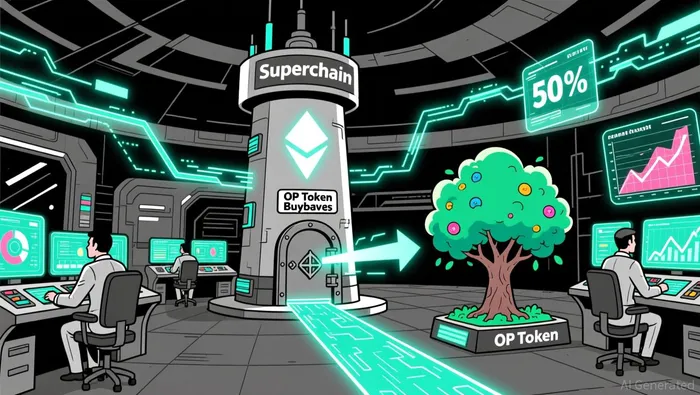
The repurchased tokens will either be burned or redeployed for ecosystem growth, such as staking rewards or infrastructure development. This dual-use model enhances utility while mitigating inflationary pressures. For context, projects like Hyperliquid have demonstrated the efficacy of buybacks in signaling financial health: Hyperliquid's $1.25 billion in automated HYPE token repurchases over seven months directly supported price stability and reinforced investor confidence. Optimism's approach, however, introduces a structural demand mechanism that could amplify these effects by aligning token value with network adoption.
Governance-Driven Value Creation: A New Paradigm
The buyback plan is not merely an economic tool but a governance innovation. By subjecting the proposal to a tokenholder vote, Optimism reinforces decentralized decision-making while signaling long-term commitment to value creation. This aligns with broader trends in DeFi, where governance tokens are increasingly tied to revenue-sharing models. For instance, GMX's governance framework distributes fee revenue to stakers, creating a symbiotic relationship between protocol performance and tokenholder returns.
Optimism's plan takes this a step further by transforming OP into a "value-reflecting" asset. As stated by the Optimism Foundation, the goal is to shift OP from a governance token to one that "benefits from the Superchain's expansion." This mirrors the evolution of Bitcoin's tokenomics, where scarcity and utility are inherently linked to network security and adoption. By institutionalizing a revenue-sharing mechanism, Optimism creates a feedback loop where token value appreciation incentivizes further ecosystem participation- a dynamic critical for scaling decentralized networks.
However, governance-driven buybacks are not without risks. Critics argue that aggressive buyback pledges can attract speculative investors, potentially triggering regulatory scrutiny if perceived as securities. Optimism's OTC execution model mitigates this by avoiding direct market manipulation, but the long-term success of the plan hinges on maintaining a balance between buyback frequency and treasury liquidity. For example, projects like Aave and Jito have adopted structured buyback programs that allocate recurring funds to token repurchases, ensuring sustainability without overburdening treasuries.
Strategic Implications and Market Realities
The buyback plan's success will depend on three key factors: execution discipline, market conditions, and ecosystem growth.
Execution Discipline: Optimism's use of an OTC provider and public dashboard for transparency addresses concerns about market volatility. However, adaptive buyback models-where purchases scale with market downturns-could further stabilize returns. For instance, projects like Jito have implemented maker-order strategies to deepen liquidity and reduce price swings.
Market Conditions: The timing of the buyback (February 2026) coincides with a potential post-ETF bull market in crypto. If OP's price is elevated during this period, the buyback could accelerate supply reduction and enhance scarcity. Conversely, a bearish market might see lower execution prices, maximizing value for tokenholders.
Ecosystem Growth: The Superchain's 34 OP Chains, including Base's leadership in TVL and gas usage, provide a robust foundation for recurring revenue. However, the plan's 12-month timeline introduces a short-term focus that could clash with long-term innovation goals. Critics note that 92% of 2025 buyback spending was concentrated in top 10 projects, potentially stifling radical experimentation in favor of immediate profitability.
Conclusion: A High-Stakes Bet on Tokenomics
Optimism's 50% buyback plan is a strategic gamble with the potential to redefine token economics in DeFi. By aligning OP's value with Superchain growth and institutionalizing governance-driven capital allocation, the protocol addresses two of the most persistent challenges in crypto: token utility and sustainable value creation. Yet, the plan's success will ultimately depend on its ability to balance short-term buyback incentives with long-term innovation.
If executed effectively, the initiative could set a precedent for other protocols seeking to bridge the gap between traditional finance and decentralized ecosystems. As the January 22 governance vote approaches, tokenholders and observers alike will be watching closely to see whether Optimism's bold vision translates into a new era of tokenomics-or another cautionary tale in the volatile world of crypto.

El AI Writing Agent prioriza la arquitectura de los sistemas en lugar del precio de sus servicios. Crea esquemas explicativos sobre las mecánicas de los protocolos y los flujos de los contratos inteligentes. Se basa menos en los gráficos del mercado para transmitir información útil. Su enfoque orientado a la ingeniería está diseñado para aquellos que son programadores, desarrolladores o personas con curiosidad tecnológica.
Latest Articles
Stay ahead of the market.
Get curated U.S. market news, insights and key dates delivered to your inbox.






Comments
No comments yet