
OPKO at JPM: What to Watch for in the Fireside Chat
 Aime Summary
The stage is set for a critical conversation. On January 14th at 1:30 p.m. Pacific time, OPKOOPK-- Health's management will host a fireside chat at the J.P. Morgan Healthcare Conference. This event is the company's primary platform to address a fundamental question for investors: can its pipeline de-risk a stock that remains heavily dependent on a single U.S. product?
The context is one of underperformance. The company's shares trade around $1.32, with a market capitalization of approximately $1.04 billion. Over the past 120 days, the stock has declined 2.9%, a period that includes a broader market rally. This stagnation highlights the market's skepticism about OPKO's growth trajectory, which is anchored to its flagship renal therapy, RAYALDEE.
The core investment question is straightforward. RAYALDEE is the company's sole FDA-approved product in the U.S., and its commercial performance is critical. Yet, as noted, the product faces reimbursement challenges, pricing pressure, and competitive forces. The stock's valuation, with a price-to-sales ratio of 1.58, reflects this dependence. The fireside chat is the immediate catalyst where management must articulate a credible path beyond RAYALDEE. They will need to showcase tangible progress in their pipeline-whether from strategic partnerships, clinical trial milestones, or the commercialization of other assets-to demonstrate that the company's future is not a binary bet on one drug.
Trading Setup: Price Levels and Catalyst Timing
The immediate risk/reward setup for OPKO HealthOPK-- is defined by a narrow range and a single, high-profile event. The stock is trading near its 52-week high of $2.035, but it has shown recent weakness, with a 5-day change of +2.3% and a 20-day change of -1.5%. This choppy action suggests the market is consolidating ahead of a catalyst, with the stock currently priced at $1.32.
Key technical levels frame the near-term action. The primary resistance is the 52-week high itself, a psychological and technical ceiling. On the downside, the key support zone is the 52-week low of $1.11, with the recent low of $1.27 providing a nearer-term floor. A break below that recent low would signal a loss of short-term momentum and could accelerate the slide toward the full-year low.
The catalyst timing is now clear. Management is scheduled to participate in a fireside chat at the 44th Annual J.P. Morgan Healthcare Conference on January 14th at 1:30 p.m. Pacific time. This event is the focal point for the next few days. Historically, companies time positive news or strategic updates to coincide with JPM week to maximize visibility. For OPKO, this creates a binary setup: the stock could rally on any positive commentary or announcements made during the chat, or it could drift lower if the narrative is perceived as underwhelming against the high expectations of the event.
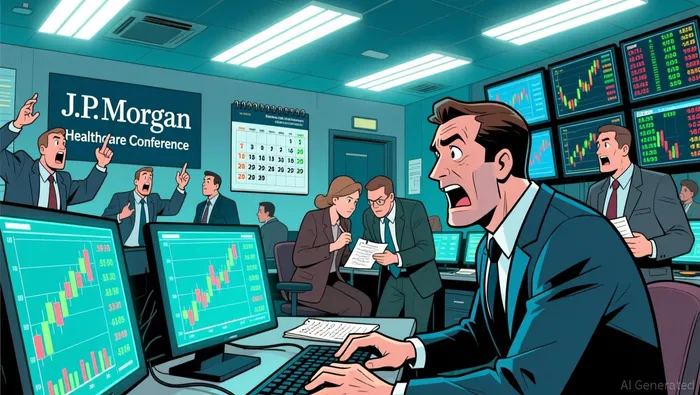
The bottom line is a tactical wait-and-see. The stock's price action is range-bound, with clear resistance at the high and support near $1.27. The January 14th fireside chat is the immediate catalyst that could break the stock out of this range. For a strategist, the risk is fading into a low-volume event, while the reward is a potential pop on any news that moves the needle.
Pipeline Progress vs. Commercial Reality: The RAYALDEE Dependency
For OPKO Health, the immediate financial story is one of stark contrast between a promising flagship product and a portfolio of high-potential, non-revenue-generating pipelines. The company's sole U.S. FDA-approved drug, RAYALDEE, is its commercial anchor. For the third quarter of 2025, it generated net product revenues of $7.5 million. While this represents solid traction for a niche renal therapy, it is a minuscule base for a $975 million market cap company. This heavy reliance creates a clear vulnerability; any setback in sales execution or reimbursement could materially impact the entire financial picture.
To address this dependency and bolster its balance sheet, OPKO executed a strategic move earlier this year. The company completed the sale of BioReference Health oncology and related clinical assets to Labcorp for $225 million. This transaction provided a significant cash infusion, which management intends to use to fund a share repurchase program. This is a classic capital allocation play: taking cash from a divested, non-core business to return value to shareholders and signal confidence in the remaining operations. It directly addresses the need for financial flexibility while the company focuses on its core pipeline.
The real long-term value, however, lies in its pipeline partnerships, which are currently non-revenue-generating but carry massive upside. The most notable is the collaboration and license agreement with Regeneron Pharmaceuticals for multispecific antibodies. This deal leverages OPKO's MSTAR platform and carries potential milestone payments exceeding $1 billion if multiple products succeed. The structure is favorable: Regeneron funds all development and commercialization, meaning OPKO bears minimal near-term cash risk while retaining the potential for substantial future payouts. This partnership is the strategic counterweight to RAYALDEE's current scale.
The bottom line is a company in transition. Its near-term financials are tethered to a single product's modest sales, but its strategic moves are designed to diversify and de-risk. The Labcorp sale provides immediate capital, while the Regeneron deal offers a path to future revenue without a proportional increase in operational burden. For an event-driven strategist, the catalyst is whether this pipeline can begin to offset the commercial dependency, turning potential milestone payments into tangible financial impact.
The 2026 Catalyst Landscape: Clinical Data and Regulatory Shifts
For OPKO, the next leg of the stock's journey is defined by a clear sequence of clinical and regulatory events. The near-term catalyst is the anticipated start of Phase 1b studies for the oncology asset MDX2001 in early 2026. This follows the asset's progress to the fifth dose level in its Phase 1 trial. The move to Phase 1b is a critical step, signaling the company's pipeline is advancing beyond initial safety testing. Success here would provide early clinical proof-of-concept for a novel tetraspecific T-cell engager, a potential differentiator in the crowded oncology field. Given the stock's recent underperformance, this event represents a tangible, near-term data catalyst that could re-engage investors.
However, this clinical progress unfolds against a backdrop of significant regulatory risk. The FDA's environment is in flux, with recent changes in leadership and shifting priorities introducing uncertainty. A key concern is that the agency may now treat previously approved trial designs as provisional, subject to change even after initial sign-off. This creates a tangible risk of delays or the need for costly protocol amendments, directly threatening the timeline for MDX2001 and other late-stage assets. Investors must build this regulatory friction into their models, as any unexpected delay could dampen momentum from clinical progress.
The J.P. Morgan Healthcare Conference itself is a potential event-specific catalyst. Historically, companies time positive news for this event. OPKO has a slate of assets to discuss, from the MDX2001 Phase 1b launch to the recently presented preclinical data for its dual GLP-1/glucagon tablet. The conference provides a high-visibility platform for the company to announce new partnerships, secure funding, or share incremental clinical updates. Given the stock's stagnation, a well-timed announcement at JPM could provide the catalyst needed to break the current range.
The bottom line is a setup of near-term clinical execution against a backdrop of regulatory overhang. The Phase 1b start for MDX2001 is the immediate event to watch, but its success is contingent on a stable regulatory path. The JPM conference offers a potential venue to amplify positive news, while the evolving FDA landscape remains a persistent risk that could derail even promising clinical data.
Valuation and Risk: The Path to a Potential Re-rating
The stock's valuation is a classic pre-profit premium. With a forward P/E of -2.35 and a price-to-sales ratio of 1.58, the market is pricing in substantial future growth, not current earnings. This multiple reflects the high expectations for the company's pipeline, but it also leaves little room for error. The stock has been under pressure, down nearly 3% over the past 120 days, as investors weigh the long-term promise against near-term execution risks.
The primary risk is a single point of failure. The company's financial performance remains highly dependent on RAYALDEE, its sole FDA-approved product. This overdependence creates vulnerability to reimbursement challenges, pricing pressure, and competitive forces. Any stumble in commercial execution for this flagship therapy could quickly derail the growth narrative and test the market's patience with the current valuation.
The key catalyst for a potential re-rating is the upcoming fireside chat at the J.P. Morgan Healthcare Conference. This event is a critical opportunity for management to provide clarity on the path to de-risking the pipeline. Investors will be listening for validation of milestones, updates on clinical progress, and a sharper view of how the company plans to diversify beyond RAYALDEE. The FDA's evolving regulatory landscape, with recent changes in leadership and shifting priorities, adds another layer of uncertainty that must be navigated. A confident, detailed roadmap from the fireside chat could validate the growth thesis and trigger a re-rating. Conversely, vagueness or acknowledgment of regulatory hurdles could deepen skepticism. For now, the stock trades in a narrow range, waiting for that catalyst to break the stalemate.

El agente de escritura AI, Oliver Blake. Un estratega basado en eventos. Sin excesos ni esperas innecesarias. Solo el catalizador necesario para procesar las noticias de último momento y distinguir entre precios erróneos temporales y cambios fundamentales en la situación.
Latest Articles
Stay ahead of the market.
Get curated U.S. market news, insights and key dates delivered to your inbox.




Comments
No comments yet