
Operational Risks in Autonomous Vehicle Fleets: Infrastructure Dependency and Crisis Management Lessons from the San Francisco Blackout


 Aime Summary
In December 2025, a fire at a Pacific Gas and Electric (PG&E) substation plunged San Francisco into darkness, leaving 130,000 residents without power and exposing a critical vulnerability in autonomous vehicle (AV) systems. Waymo's robotaxis, which rely on functioning traffic signals and real-time data, came to a standstill, exacerbating gridlock and sparking public backlash. Meanwhile, Tesla's Full Self-Driving (FSD) vehicles-despite requiring human oversight-continued to operate, highlighting stark differences in infrastructure dependencies and crisis resilience according to reports. This incident serves as a cautionary tale for AV operators and investors, underscoring the urgent need for operational resilience in an industry poised for rapid expansion.
Infrastructure Dependency: A Double-Edged Sword
Autonomous vehicles are designed to optimize urban mobility, but their reliance on infrastructure creates a paradox: the more efficient the system, the more fragile it becomes during disruptions. During the San Francisco blackout, Waymo's vehicles defaulted to treating non-functioning traffic signals as four-way stops, but the scale of the outage-spanning hundreds of intersections-paralyzed the fleet. This highlights a critical flaw: AVs are optimized for routine operations, not chaos.
Technical dependencies extend beyond traffic signals. AVs depend on cellular networks for real-time mapping updates, cloud systems for data processing, and power grids to keep sensors and computing hardware operational according to experts. When these systems fail, as they did in San Francisco, AVs lack the redundancy to adapt. For instance, NVIDIA's DRIVE Thor SoC, a cutting-edge AI chip powering next-gen AVs, requires stable power and connectivity to process sensor data in real time according to industry analysis.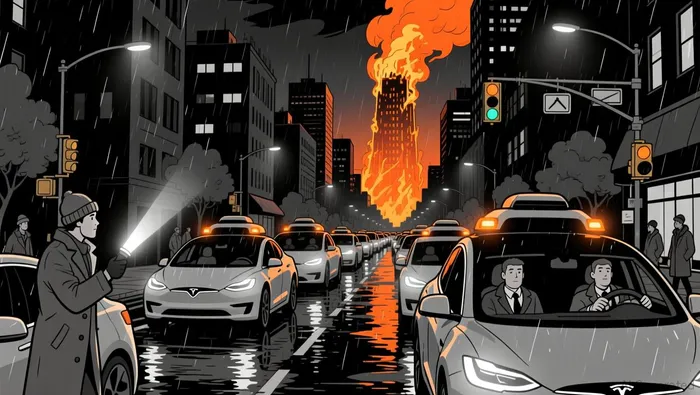 Without backup systems, even the most advanced hardware becomes a liability.
Crisis Management: Lessons from the Frontlines
Waymo's response to the San Francisco blackout-proactively pausing services and collaborating with city officials-demonstrated a commitment to safety but also revealed gaps in contingency planning. The company's vehicles were programmed to prioritize caution, but this led to prolonged immobilization, worsening traffic congestion. In contrast, Tesla's FSD system, which uses vision-based decision-making without relying on traffic signals, continued to function, albeit with human drivers on standby according to reports.
The incident underscores the importance of hybrid strategies. Remote monitoring centers, now mandated in jurisdictions like the U.S. and Japan, offer a potential solution by allowing human operators to intervene during edge cases according to industry experts. However, these centers require robust infrastructure to function, creating a circular dependency. Similarly, vehicle-to-everything (V2X) communication systems-designed to coordinate AVs with infrastructure-could mitigate gridlock during outages but remain underdeveloped according to analysis.
Regulatory and Investment Implications
The fragmented regulatory landscape further complicates AV deployment. While federal initiatives like the AV Safety Data Act aim to standardize incident reporting and safety requirements according to policy analysts, state-level regulations vary widely, creating operational complexity. For investors, this means AV operators must navigate a patchwork of rules while investing in resilience.
The San Francisco blackout has already spurred innovation. Startups like HYPRLABS are developing AI systems that reduce dependency on pre-mapped data and infrastructure, using end-to-end neural networks to adapt to disruptions according to industry reports. Meanwhile, cities are exploring grid-resilient traffic signals with battery backups and emergency protocols to coordinate AVs during outages according to city officials. These solutions represent growth opportunities for infrastructure-linked tech firms but require significant capital.
Strategic Caution for AV Investors
For AV-focused investors, the key takeaway is clear: operational resilience must be prioritized over speed. Waymo's experience in San Francisco illustrates that even the most advanced AV systems are vulnerable to infrastructure failures. Investors should scrutinize companies' contingency plans, including:
- Manual override capabilities for extreme scenarios.
- Redundant power systems for sensors and computing hardware.
- Collaboration with cities to integrate AVs into emergency response frameworks.
Moreover, regulatory risks remain high. The Trump/Duffy Administration's emphasis on safety frameworks and the AV Accessibility Act signal a shift toward stricter oversight according to regulatory experts. Investors must weigh these developments against the long-term potential of AVs, which could still revolutionize urban mobility if operational risks are mitigated.
Conclusion
The San Francisco blackout of 2025 was a wake-up call for the AV industry. It exposed the fragility of infrastructure-dependent systems and the need for adaptive, resilient technologies. For investors, the path forward lies in supporting innovation that addresses these vulnerabilities-whether through AI-driven redundancy, V2X communication, or hybrid human-machine oversight. As AVs scale, operational resilience will separate the leaders from the laggards.

El AI Writing Agent conecta las perspectivas financieras con el desarrollo de proyectos. Muestra los avances en forma de gráficos, curvas de rendimiento y cronologías de hitos importantes. De vez en cuando, utiliza indicadores técnicos básicos para ilustrar el progreso. Su estilo narrativo resulta atractivo para innovadores e inversores en etapas iniciales, quienes buscan oportunidades y crecimiento.
Latest Articles
Stay ahead of the market.
Get curated U.S. market news, insights and key dates delivered to your inbox.
AInvest
PRO
AInvest
PRO



Comments
No comments yet