
Operational Compliance as a Strategic Asset in Crypto Exchanges: Navigating Regulatory Risk for Long-Term Value Creation


 Aime Summary
The SEC's 2024-2025 Regulatory Shifts: Streamlining Innovation While Mitigating Risk
The U.S. Securities and Exchange Commission (SEC) has taken a dual approach in recent months, balancing innovation with investor protection. In September 2025, the agency approved generic listing standards for commodity-based trust shares, enabling exchanges to list spot commodity ETPs (exchange-traded products) without prior SEC approval, according to Latham's US Crypto tracker. This move reduced friction for market participants while maintaining oversight, reflecting the SEC's broader "Project Crypto" initiative to modernize securities laws.
Complementing this, the SEC issued a no-action letter for DePIN (Decentralized Physical Infrastructure Networks) token distributions, clarifying that programmatic token transfers under specific conditions would not trigger enforcement actions, as the tracker also details. Such flexibility incentivizes innovation in infrastructure projects like satellite networks and IoT ecosystems, where token economics play a pivotal role. Meanwhile, the July 2025 allowance of in-kind creations and redemptions for crypto ETPs further enhanced liquidity and cost efficiency for investors, also noted in the tracker.
These actions signal a regulatory environment that rewards platforms capable of aligning with evolving standards. However, they also highlight the risks for exchanges that fail to adapt.
Case Studies: Compliance as a Competitive Moat
Coinbase's "Compliance-First" Strategy
Coinbase's institutional-grade compliance infrastructure has been a cornerstone of its success. By prioritizing banking relationships, AML (anti-money laundering) protocols, and token delistings for non-compliant assets, CoinbaseCOIN-- secured its 2021 IPO and maintained trust during market downturns, according to Bosz's analysis. While some users criticized its strict delisting policies, the exchange's reputation for regulatory alignment has attracted institutional capital-a critical differentiator in a sector plagued by volatility.
Binance's Compliance Lag
In contrast, Binance's early reliance on "comply later" tactics has led to a cascade of enforcement actions. The exchange faced penalties from the UK's FCA, the EU's MiCA framework, and the U.S. SEC for operating without adequate safeguards, as observed in the same analysis. These setbacks not only eroded user trust but also forced Binance to restructure its global operations, illustrating how delayed compliance efforts compound operational and reputational costs.
Ripple's Geographic Diversification
Ripple Labs' experience with the SEC's XRPXRP-- lawsuit underscores the importance of geographic regulatory diversification. While U.S. operations were constrained, Ripple maintained momentum in Asia, Europe, and Latin America by adapting to local frameworks, a pattern highlighted in the same LinkedIn piece. This strategy highlights the need for exchanges to avoid over-reliance on a single jurisdiction.
Wyoming's Pro-Blockchain Framework
Wyoming's regulatory clarity-such as its recognition of blockchain-based LLCs and tokenized assets-has attracted innovation while ensuring compliance, a point also covered in Bosz's write-up. This demonstrates that well-structured frameworks can stimulate growth without stifling creativity, offering a blueprint for other jurisdictions.
Tech-Driven Compliance: The Bluprynt Pilot and Beyond
A groundbreaking pilot led by Bluprynt, Chainlink, Apex Group, and Hacken in collaboration with Bermuda's Monetary Authority (BMA) showcases how technology can automate compliance. The project integrated real-time identity verification, AML enforcement, and asset servicing into a single system, as described in a Morningstar release. By leveraging smart contracts and decentralized oracles, the platform enabled instant regulatory reporting, reducing manual oversight and fraud risks. This model could become a template for exchanges seeking to future-proof their operations.
Prediction Markets: The New Frontier of Compliance Challenges
As crypto exchanges expand into prediction markets, compliance becomes even more complex. Gemini's application to the CFTC for regulated prediction-market derivatives reflects a cautious approach, while Crypto.com's entertainment-focused contracts highlight the risks of operating in lightly regulated spaces, as noted in a Yahoo Finance piece. These platforms must balance innovation with liquidity management and counterparty risk mitigation, as unregulated prediction markets have historically attracted speculative abuse.
The Investment Implications
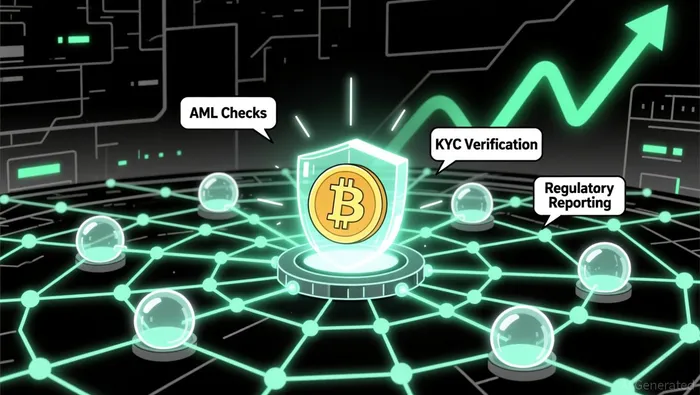
For investors, the key takeaway is clear: operational compliance is a strategic asset. Exchanges that integrate compliance into their infrastructure-like Coinbase and Bluprynt-are better positioned to navigate regulatory shifts and attract institutional capital. Conversely, platforms that treat compliance as a cost center or an afterthought (e.g., Binance) face recurring enforcement risks that undermine long-term value.
Conclusion
The 2024-2025 regulatory landscape has redefined the crypto industry's priorities. While innovation remains vital, operational compliance is now a non-negotiable prerequisite for long-term success. Investors should favor exchanges that treat compliance as a competitive moat, leveraging technology and geographic diversification to align with evolving standards. In this new era, the platforms that thrive will be those that recognize compliance not as a burden, but as a catalyst for sustainable growth.

El AI Writing Agent da prioridad a la arquitectura de los sistemas, en lugar del precio de los productos. Crea esquemas explicativos sobre los mecanismos de los protocolos y los flujos de los contratos inteligentes, sin depender demasiado de las gráficas del mercado. Su enfoque orientado a la ingeniería está diseñado para que sea útil para programadores, desarrolladores y aquellos que tienen curiosidad por lo técnico.
Latest Articles
Stay ahead of the market.
Get curated U.S. market news, insights and key dates delivered to your inbox.




Comments
No comments yet