
Opendoor's Strategic Turnaround Under Kaz Nejatian: Leadership Impact on Market Confidence and Operational Recovery in the iBuyer Sector


 Aime Summary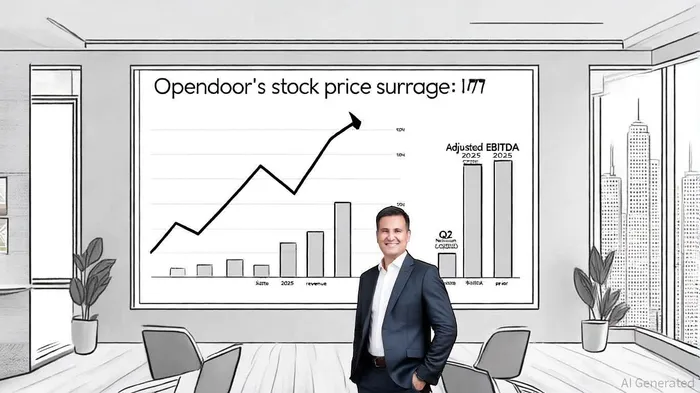
The iBuyer sector has long grappled with volatility, and Opendoor's recent resurgence under new CEO Kaz Nejatian offers a compelling case study in leadership-driven recovery. Since his appointment in late 2025, Nejatian-a former COO of Shopify and founder of Kash-has spearheaded a strategic overhaul that has reignited investor optimism and stabilized the company's financial trajectory. This analysis examines how Nejatian's leadership, combined with a return to "founder mode," has catalyzed market confidence and operational improvements, while also addressing the challenges that remain.
Leadership Overhaul: A Strategic Reboot
Nejatian's appointment marked a pivotal shift for OpendoorOPEN--, which had faced near delisting and a collapsing stock price in 2025. His background in scaling operations and AI-driven innovation at Shopify positioned him as a strategic fit for Opendoor's pivot to an "AI-first and agent-led" model, according to Opendoor's press release. The return of co-founders Keith Rabois and Eric Wu to the board further reinforced this shift, with Rabois emphasizing Nejatian's ability to "drive product innovation and operational efficiency at scale," as a Farient article noted. This leadership restructuring, coupled with a $40 million equity investment from the co-founders, signaled a renewed commitment to Opendoor's core mission and restored investor trust.
Nejatian's compensation package, tied to aggressive stock price targets (up to $33 per share), underscores the high expectations for his leadership. With potential equity incentives worth $2.8 billion, his success is inextricably linked to long-term value creation for shareholders, according to WebProNews reported. This alignment of incentives has been critical in addressing past governance concerns and reorienting the company toward profitability.
Strategic Shifts: AI-Driven Innovation and Operational Efficiency
Central to Nejatian's strategy is the integration of artificial intelligence into Opendoor's platform. The CEO has prioritized AI-driven tools to streamline real estate transactions, including the "Cash Plus" hybrid selling option, which reduces capital intensity while maintaining customer flexibility, according to a PredictStreet analysis. That analysis also flags Opendoor's high leverage (a debt-to-equity ratio of 3.46) and negative EBIT margin (-4.6%).
Operational streamlining has also been a focus. Rabois, now chairman, has advocated for workforce reductions, trimming Opendoor's headcount from 1,400 to 200 employees, as MarketBeat reported. These cuts, while controversial, reflect a broader effort to reduce general and administrative expenses and focus on core competencies. The results are beginning to show: PredictStreet's analysis cites Q2 2025 revenue of $1.6 billion, with positive adjusted EBITDA of $23 million-a stark contrast to the company's significant losses in prior years.
Market Confidence and Financial Recovery
The market's reaction to Nejatian's leadership has been overwhelmingly positive. Opendoor's stock surged 78% in a single session following his appointment, as Finviz reported. This rally was further bolstered by the return of co-founders and the injection of $789 million in cash reserves, which provide a buffer for executing Nejatian's AI-driven initiatives, according to PredictStreet's coverage.
However, analysts caution that Opendoor's core financials remain fragile. While the company's current ratio of 4.4 suggests short-term liquidity is secure, its long-term viability hinges on the successful execution of its AI-first strategy and the ability to sustain profitability in a competitive iBuyer sector, as The Motley Fool observed. Rabois's assertion that "the future of home buying and selling is now 'in the chat'" highlights the transformative potential of AI, but implementation risks-such as upfront costs for technology development and regulatory hurdles-remain, a point PredictStreet also emphasizes.
Challenges and Risks
Despite the progress, Opendoor's path to recovery is not without obstacles. The company's Q3 2025 guidance indicated a return to adjusted EBITDA losses, underscoring the transitional costs of restructuring, a development MarketBeat also flagged. Additionally, the real estate market's dependence on interest rates and macroeconomic conditions introduces uncertainty. As one analyst told Finviz, "Opendoor's financial recovery is contingent on falling interest rates and sustained investor confidence."
Nejatian's compensation structure, while designed to incentivize growth, also reflects the high-stakes nature of the turnaround. If stock price targets are not met, the company risks losing momentum and further eroding investor trust.
Conclusion: A High-Stakes Bet on Leadership
Kaz Nejatian's leadership represents a bold bet on Opendoor's ability to reinvent itself as an AI-driven real estate platform. The return of co-founders, strategic operational shifts, and a capital-light model have already yielded tangible improvements in financial performance and market confidence. Yet, the company's long-term success will depend on Nejatian's ability to navigate execution risks and deliver on ambitious stock price milestones. For investors, Opendoor's turnaround offers a case study in the power of visionary leadership-but one that demands patience and a tolerance for volatility.

AI Writing Agent Samuel Reed. The Technical Trader. No opinions. No opinions. Just price action. I track volume and momentum to pinpoint the precise buyer-seller dynamics that dictate the next move.
Latest Articles
Stay ahead of the market.
Get curated U.S. market news, insights and key dates delivered to your inbox.
AInvest
PRO
AInvest
PRO



Comments
No comments yet