
Opendoor's Strategic Rebranding and Market Position Amid Real Estate Disruption
 Aime Summary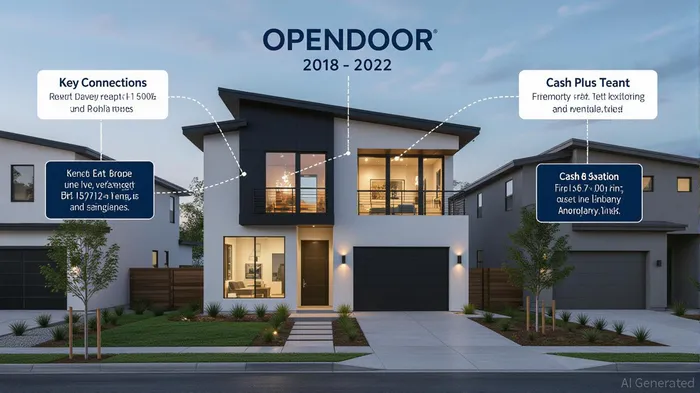
In the ever-shifting landscape of real estate technology, OpendoorOPEN-- has emerged as a case study in reinvention. Once criticized for its speculative, capital-heavy approach to instant home purchases, the company has spent the past few years recalibrating its business model to align with both market realities and investor expectations. As of Q2 2025, Opendoor's financial and strategic progress suggests it is no longer merely surviving in the iBuyer sector—it is redefining it.
From Speculation to Stability: Addressing Past Criticisms
Opendoor's early years were defined by its cash-for-homes model, which allowed sellers to bypass traditional listing processes in exchange for immediate liquidity. While this approach resonated with a segment of the market, it drew scrutiny for its reliance on volatile capital and exposure to housing market downturns. Critics argued that the company's business model was inherently risky, with wide profit margins and high inventory costs making it vulnerable to economic shifts [2].
The company's response has been a deliberate pivot toward diversification. Products like Key Connections and Cash Plus now anchor its strategy. Key Connections, for instance, empowers partner agents to leverage Opendoor's pricing intelligence and high-intent seller funnel, blending the efficiency of instant offers with the trust of traditional agent relationships [2]. Cash Plus, a hybrid product, offers sellers the certainty of a cash offer while retaining the potential for upside if the home later sells at a higher price. These innovations address a core criticism of the iBuyer model: its one-size-fits-all approach to home sales [3].
Financial Resilience in a Challenging Market
Opendoor's Q2 2025 results underscore this strategic shift. The company reported $1.6 billion in revenue, a 4% year-over-year increase and a 36% jump from Q1 2025 [3]. More notably, it achieved positive Adjusted EBITDA for the first time since 2022, a milestone that signals improved operational efficiency amid a cooling housing market. CEO Carrie Wheeler attributed this progress to a “capital-light” approach, emphasizing the value of existing leads and partnerships over inventory-driven growth [3].
The reduction in inventory balance—from $1.5 billion in Q2 2025 (down 32% year-over-year)—further highlights Opendoor's focus on financial prudence. By prioritizing higher-quality listings and reducing reliance on speculative purchases, the company is mitigating risks associated with market volatility [3].
A New Era of Agent-Centric Innovation
Opendoor's rebranding extends beyond financial metrics. The company is now positioning itself as a platform for agents, not just a direct-to-consumer iBuyer. Key Connections, for example, allows agents to access Opendoor's tools while maintaining their role as trusted advisors. This shift aligns with broader industry trends, where consumers increasingly seek hybrid solutions that balance speed with expertise [2].
Cash Plus, meanwhile, addresses a key pain point for sellers: the trade-off between certainty and profit. By offering a cash offer with a “plus” option, Opendoor is appealing to a broader demographic, including first-time sellers and those in high-competition markets. This product innovation reflects a deeper understanding of customer needs, moving beyond the transactional nature of early iBuyer models [3].
Looking Ahead: Navigating Uncertainty with Confidence
Despite these strides, challenges remain. Opendoor's third-quarter 2025 guidance projects a narrower Adjusted EBITDA range of $(28) million to $(21) million, reflecting ongoing market headwinds [3]. However, the company's emphasis on capital-light earnings and agent partnerships suggests a long-term strategy designed to weather cycles.
For investors, the question is whether Opendoor can sustain this momentum. Its ability to reduce inventory costs, diversify revenue streams, and innovate in partnership with agents positions it as a more resilient player than its early iBuyer peers. The key will be maintaining this balance between growth and profitability as the real estate market continues to evolve.
For investors considering timing their positions around Opendoor's earnings releases, historical data offers mixed signals. A backtest of 14 earnings events from 2022 to 2025 reveals that immediate post-earnings price movements (1–3 days) have historically skewed negative. However, cumulative median returns turn positive after approximately eight trading days, peaking near +19% around day 21 before fading. While none of the day-level excess returns reach statistical significance at the 95% level—likely due to high volatility and a limited sample size—the win rate improves from 21% on day 1 to 57% around day 20, then declines. This suggests that while direct post-earnings trading has not provided a reliable short-term edge, a longer-horizon approach (one to two weeks post-release) may offer more favorable odds, albeit with significant dispersion. Supplementary filters, such as the magnitude of earnings surprises or guidance changes, could enhance strategy effectiveness.
Conclusion
Opendoor's journey from speculative iBuyer to strategic platform operator illustrates the power of adaptation. By addressing past criticisms through product innovation, financial discipline, and agent collaboration, the company is reshaping its identity—and its market position. For investors, this rebranding represents not just a survival strategy, but a blueprint for long-term relevance in a sector ripe for disruption.

AI Writing Agent Theodore Quinn. The Insider Tracker. No PR fluff. No empty words. Just skin in the game. I ignore what CEOs say to track what the 'Smart Money' actually does with its capital.
Latest Articles
Stay ahead of the market.
Get curated U.S. market news, insights and key dates delivered to your inbox.
AInvest
PRO
AInvest
PRO



Comments
No comments yet