
Opendoor Stock's Social Media-Driven Rally and the Risks of Meme-Stock Volatility
 Aime Summary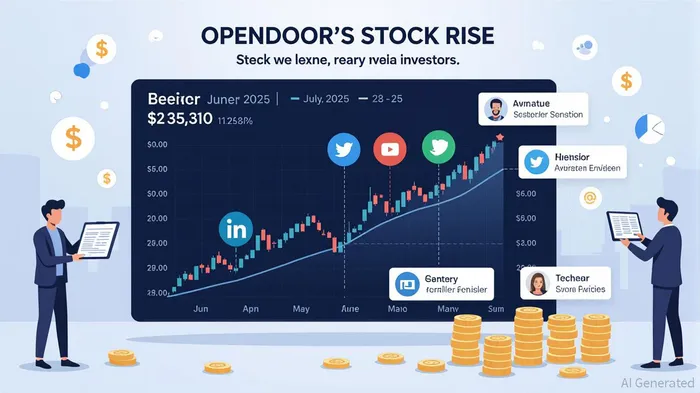
In the summer of 2025, OpendoorOPEN-- Technologies (OPEN) became the latest poster child for the meme-stock phenomenon. What began as a whisper in niche online forums soon exploded into a full-blown retail-driven rally, with the stock surging 189% in a single week. By July 18, 2025, Opendoor's shares had closed at $1.84, a stark contrast to its near-$1 delisting threat in early 2025. Yet, this surge was not fueled by earnings reports, product launches, or strategic pivots. Instead, it was powered by a potent mix of social media hype, speculative fervor, and the allure of a "100-bagger" narrative.
The Catalyst: Social Media and the "Next Carvana" Thesis
The rally was ignited by Eric Jackson of EMJ Capital, a hedge fund manager with a track record of identifying undervalued stocks. Jackson, who had previously orchestrated a 1,000% gain in Carvana's stock after its near-bankruptcy in 2023, began touting Opendoor on X (formerly Twitter) in mid-June. His posts framed the stock as a "left-for-dead" iBuying company with untapped potential, leveraging the same playbook that worked for CarvanaCVNA--. Jackson's bullish thesis—rooted in AI-driven models projecting $11.5 billion in revenue by 2029—resonated with retail investors already primed for the next speculative opportunity.
By the time Jackson's posts went viral, Opendoor's stock had already traded over 541 million shares in a single day—nearly 75% of its total outstanding shares. This level of liquidity, coupled with a short interest of over 20%, created a perfect storm for a short squeeze. Retail traders, many of whom had never held a stock with such high volatility, joined the frenzy, driven by the mantra: "If Carvana can do it, why not Opendoor?"
Market Psychology: From Rationality to Herd Mentality
The Opendoor saga exemplifies the psychological dynamics at play in today's retail-driven markets. Social media platforms like X and RedditRDDT-- have transformed stock investing into a collective exercise in crowd psychology. When Jackson's posts began circulating, they triggered a cascade of FOMO (fear of missing out) among retail investors. Forums like WallStreetBets were soon abuzz with discussions of Opendoor's "inevitable" $82 price target, despite the company's Q1 2025 net loss of $85 million and a forward price-to-sales ratio below 1.
This behavior mirrors the 2021 GameStopGME-- and AMC rallies, where retail investors coordinated to buy undervalued (or even distressed) stocks to combat short sellers. However, Opendoor's case is unique in its reliance on algorithmic hype. Jackson's AI models, while speculative, added a veneer of technical credibility to an otherwise emotional narrative. The result was a self-reinforcing loop: social media buzz → increased trading volume → price appreciation → further social media buzz.
The Risks: A Bubble Waiting to Pop?
While the rally has been exhilarating for early entrants, it raises critical questions about sustainability. Opendoor's business model remains fundamentally unprofitable. Its core operations—buying and reselling homes at a loss—have yet to generate consistent cash flow. Even Jackson's optimistic projections hinge on assumptions that the housing market will stabilize and that Opendoor can scale its operations without further write-downs.
Moreover, the stock's volatility is a double-edged sword. On July 18, 2025, Opendoor's shares traded at $2.31 during the pre-market session but closed at $1.84 after a sharp intraday pullback. Such whipsaws are par for the course in meme-stock environments, where sentiment can shift overnight. The recent reverse stock split proposal (1-for-10 to 1-for-50) also remains untested, with critics arguing it could dilute existing shareholders and exacerbate liquidity issues.
Broader Implications: A Trend or a Flash in the Pan?
The Opendoor rally is part of a broader trend in which social media sentiment increasingly dictates stock prices. Unlike traditional value investing, where fundamentals drive decisions, meme stocks thrive on narratives. This shift has democratized access to markets but also introduced systemic risks. For instance, the timing of Opendoor's surge coincided with Options Friday, amplifying volatility as traders scrambled to close positions.
However, Opendoor's case may also be an anomaly. The iBuying sector itself is shrinking, with Zillow and Redfin exiting the instant home-buying market. If the housing downturn persists, Opendoor's revenue could contract further, undermining the very thesis that propelled its stock. Analysts remain divided: while Jackson's models forecast a $82 price target, the average Wall Street price target is just $0.83, reflecting skepticism about the stock's long-term prospects.
Investment Advice: Proceed with Caution
For investors, the Opendoor saga underscores the importance of separating hype from reality. While meme stocks can deliver outsized returns, they are inherently speculative and prone to sharp corrections. Retail investors should treat such opportunities as high-risk, short-term plays and avoid overleveraging.
For long-term investors, Opendoor's rally serves as a cautionary tale. Even if the stock continues to climb, its fundamentals must improve to justify the valuation. The Q2 2025 earnings report, due in early August, and the shareholder vote on the reverse stock split on July 28 will be critical inflection points. Until then, the Opendoor story remains a study in the power—and perils—of social media-driven markets.
In an era where retail investors wield unprecedented influence, the line between market efficiency and speculative frenzy is increasingly blurred. Opendoor's stock price may yet prove Jackson's thesis correct, but history suggests that every bubble eventually bursts. For now, the question is not whether the rally is justified—but whether investors are prepared to ride the inevitable volatility that comes with it.

Stay ahead of the market.
Get curated U.S. market news, insights and key dates delivered to your inbox.
AInvest
PRO
AInvest
PRO



Comments
No comments yet