
Opendoor's Resurgence: Value or Hype in a Meme Stock Frenzy?


 Aime Summary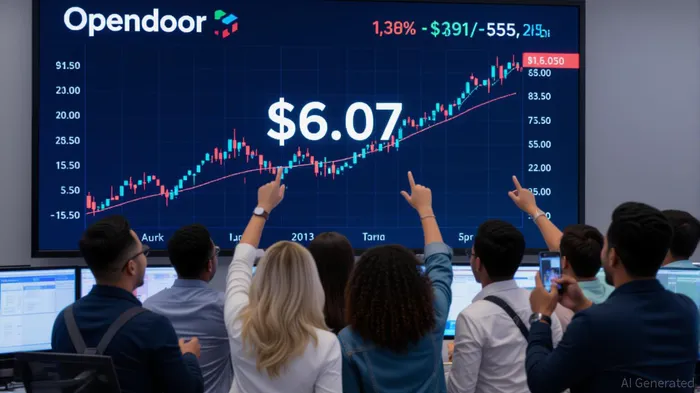
The recent 267% surge in OpendoorOPEN-- (OPEN) has ignited a debate: Is this a genuine turnaround in the real-estate tech sector, or a speculative frenzy fueled by retail investors? The stock's meteoric rise—driven by social media hype, short squeezes, and a shift in CEO strategy—has positioned it as a poster child for the 2025 meme stock phenomenon. Yet beneath the noise lies a company grappling with structural challenges in a cyclical industry.
The Fundamentals: A Fragile Foundation
Opendoor's Q2 2025 earnings report offered a mixed bag. Adjusted EBITDA turned positive at $23 million, and free cash flow hit $821 million, with $789 million in unrestricted cash. These figures suggest operational improvements, but the company's GAAP net loss narrowed to $29 million, not a profit. Its pre-tax margin remains negative at -7.9%, and its debt-to-equity ratio exceeds 4x, reflecting a capital-intensive iBuying model.
The CEO's shareholder letter acknowledged a “challenging macroeconomic environment” and a pivot to an asset-light platform. While this strategy could reduce inventory risks, it's a long-term play. Analysts like UBSUBS-- raised price targets to $1.60, citing improved unit economics, but others, including CitigroupC--, downgraded to “Sell,” warning of home price depreciation and execution risks. The company's forward P/E of 66x—a stark contrast to the mid-single-digit range considered “fair”—highlights the disconnect between valuation and fundamentals.
The Meme Stock Catalyst: Retail Fervor and Short Squeezes
Opendoor's rally mirrors the 2021 GameStopGME-- saga. Retail investors, emboldened by social media, targeted the stock due to its 24% short interest. A viral tweet from EMJ Capital's Eric Jackson, labeling OPEN a “100-bagger,” catalyzed a buying frenzy. By July 2025, the stock had nearly tripled in two weeks, with retail traders using out-of-the-money call options to amplify gains.
The role of algorithmic trading and gamma squeezes cannot be ignored. Momentum funds and bots amplified buying pressure, while platforms like TikTok and Stocktwits turned Opendoor into a cultural touchstone. This dynamic created a feedback loop: rising prices forced short sellers to cover, further inflating the stock.
Peer Comparisons: A Laggard in a Competitive Sector
Opendoor's financials pale against peers like Zillow and SoFi. While Zillow reported $352 million in net income and a forward P/S of 3x, Opendoor trades at 0.3x with a net loss. Its beta of 3.2—220% more volatile than the S&P 500—underscores its risk profile. Analysts note that Opendoor's gross margins (5–6%) lag behind Zillow's 20% and that its institutional ownership (62.4%) is offset by weak insider confidence (2.0%).
The CEO's Pivot: Tech-First or Too Little, Too Late?
Interim CEO Shrisha Radhakrishna's “tech-first” strategy aims to streamline operations and boost innovation. However, the company's recent $35 million insider sale by its former CEO raises questions about alignment with retail investors. While the shift to an asset-light model could reduce carrying costs, it requires time to bear fruit. Analysts stress that Opendoor must demonstrate margin recovery and stable leadership before gaining institutional trust.
The Bigger Picture: Meme Stocks as a Normalized Market Force
Opendoor's surge is part of a broader trend. Retail-driven rallies in Kohl'sKSS--, GoProGPRO--, and Krispy KremeDNUT-- show that speculative trading has become a normalized part of market behavior. Commission-free platforms and leveraged options have democratized access, enabling retail investors to sway stock prices. Yet this normalization carries risks. Historical parallels—dot-com bubbles, 2007 real estate crises—remind us that euphoria often precedes correction.
Investment Thesis: High-Risk, High-Reward
For Opendoor to justify its valuation, it must achieve $12–13 billion in 2026 revenue and re-rate its P/S to 0.7–1.0x—a scenario requiring housing market stability, improved unit economics, and sustained profitability. If these conditions materialize, the stock could trade in the $9–10 range. However, the risks are acute: housing market cyclicality, thin margins, and competition from Zillow and Redfin could derail this path.
Investment Advice:
- Bull Case: Retail investors with a high-risk tolerance might consider short-dated call options to capitalize on momentum.
- Bear Case: Value investors should avoid the stock until fundamentals align with valuation.
- Cautious Play: Monitor housing data and Opendoor's Q3 2025 guidance for signs of sustainable improvement.
In the end, Opendoor's story is a cautionary tale of value versus hype. While its tech-driven pivot offers long-term potential, the current rally is a speculative bet on a volatile market. As the meme stock narrative evolves, investors must ask: Is this a phoenix rising, or a flash in the pan?

Stay ahead of the market.
Get curated U.S. market news, insights and key dates delivered to your inbox.
AInvest
PRO
AInvest
PRO



Comments
No comments yet