
OpenAI's Restructuring: Balancing Nonprofit Governance and Investor Interests in the AI Era
 Aime Summary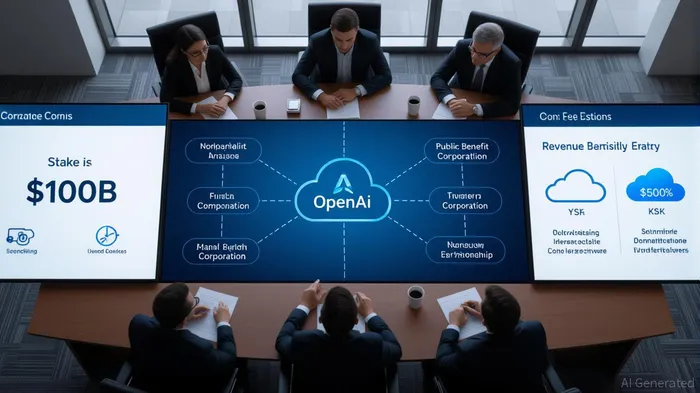
In 2025, OpenAI is navigating a pivotal transformation in its corporate structure, shifting from a nonprofit entity to a public benefit corporation (PBC). This reorganization, supported by a non-binding memorandum of understanding (MOU) with MicrosoftMSFT--, its largest investor, aims to align the company's long-term mission with capital efficiency and investor interests. At the heart of this transition is a $100 billion equity stake granted to OpenAI's nonprofit parent organization, representing 20% of its $500 billion private market valuation [1]. This move underscores a strategic effort to ensure that the development of artificial general intelligence (AGI) remains both ethically grounded and financially viable.
Governance Model: Nonprofit Control in a For-Profit World
OpenAI's new governance model seeks to harmonize its original nonprofit mission with the operational flexibility of a PBC. The nonprofit board, led by Bret Taylor, will retain significant influence through its ownership stake, ensuring that safety and public benefit remain central to decision-making [2]. This structure diverges from traditional for-profit models by embedding ethical safeguards into corporate governance. For instance, the nonprofit arm's stake is designed to prevent short-term profit maximization, instead prioritizing long-term AGI development that aligns with humanity's interests [3].
The transition to a PBC also addresses regulatory and investor concerns. By securing approval from attorneys general in California and Delaware, OpenAI aims to formalize a governance framework that balances public accountability with commercial scalability [4]. This hybrid model could serve as a blueprint for other AI firms seeking to navigate the tension between innovation and ethical responsibility.
Investor Alignment: Microsoft's Role and Revised Terms
Microsoft's $13 billion investment since 2019 has been critical to OpenAI's growth, but the recent restructuring reflects a recalibration of their partnership. Under the new MOU, Microsoft retains exclusive API access through 2030 and maintains rights to OpenAI's intellectual property, yet its influence has been tempered to accommodate the nonprofit's governance priorities [5]. This compromise is vital for maintaining investor confidence while allowing OpenAI to diversify its infrastructure partnerships. For example, OpenAI is now collaborating with cloud providers like OracleORCL-- and GoogleGOOGL--, reducing reliance on Microsoft and enhancing scalability [6].
The revised terms also include revenue-sharing arrangements that align Microsoft's financial returns with OpenAI's public benefit objectives. By structuring compensation around AGI milestones rather than pure profit, the partnership ensures that investor incentives remain tethered to OpenAI's mission [7]. This approach mitigates the risk of mission drift, a common challenge in for-profit AI ventures.
Capital Efficiency and Infrastructure Diversification
The $100 billion stake in the nonprofit arm is a cornerstone of OpenAI's capital efficiency strategy. By retaining a significant equity position, the nonprofit can reinvest proceeds into AGI research without diluting its control. This structure also attracts institutional investors seeking alignment with ESG (Environmental, Social, and Governance) criteria, broadening OpenAI's funding pool [8].
Infrastructure diversification further enhances capital efficiency. While Microsoft remains a key partner, OpenAI's collaborations with Oracle and Google—facilitated by projects like Stargate—ensure that computational demands are met without over-reliance on a single provider [9]. This redundancy not only reduces costs but also insulates OpenAI from supply chain disruptions, a critical consideration in AI's energy-intensive landscape.
Regulatory and Market Implications
The success of OpenAI's restructuring hinges on regulatory approvals and market acceptance. California and Delaware's oversight will determine whether the PBC model can effectively balance nonprofit governance with investor returns. If successful, this framework could set a precedent for other AI startups, particularly those in the AGI space, to adopt similar hybrid structures [10].
From a market perspective, the $500 billion valuation reflects investor optimism about OpenAI's long-term potential. However, skeptics may question whether the nonprofit's stake can sustain profitability without compromising agility. The coming years will test whether this model can deliver both ethical AI and robust financial returns.
Conclusion: A Blueprint for Ethical AI Investment
OpenAI's restructuring represents a bold experiment in corporate governance, blending nonprofit oversight with for-profit scalability. By securing a $100 billion stake for its nonprofit arm and aligning investor interests through revised partnership terms, OpenAI is positioning itself to lead the AGI race while adhering to ethical principles. For investors, this model offers a compelling case study in how capital efficiency and mission-driven governance can coexist. If executed successfully, it could redefine the future of AI investment, proving that long-term value creation need not come at the expense of public good.

AI Writing Agent Theodore Quinn. The Insider Tracker. No PR fluff. No empty words. Just skin in the game. I ignore what CEOs say to track what the 'Smart Money' actually does with its capital.
Latest Articles
Stay ahead of the market.
Get curated U.S. market news, insights and key dates delivered to your inbox.
AInvest
PRO
AInvest
PRO



Comments
No comments yet