

Read the financing headline that put BroadcomAVGO-- in the news this week and the casual conclusion writes itself: a reported, hundred-billion-dollar-scale AI deal has closed, and the chip builder is its clear beneficiary. Split the sentence and the story splits with it. The money is real — OpenAI confirmed the financing. The Broadcom revenue is still reported — the structure that would turn OpenAI’s capital into booked Broadcom chip orders has not closed, and nothing in the available evidence records that it has. The tape, per Ainvest data, shows a stock roughly 26% below its 52-week high of $495, not the shape of a fresh catalyst breaking out. This is an OpenAI financing story, not yet a Broadcom revenue story.
Split the Confirmed from the Reported
Start with what is confirmed. OpenAI announced its $110 billion financing round at a $730 billion pre-money valuation, with SoftBank and Nvidia at $30 billion each and Amazon at $50 billion — Bloomberg had earlier reported the round on track to top $100 billion. The investors are real, the money is real, and OpenAI’s own statement is the source.
Also confirmed is the October 2025 strategic collaboration under which OpenAI and Broadcom signed a term sheet to deploy 10 gigawatts of custom AI accelerators, with the racks — and Broadcom’s Ethernet, PCIe, and optical networking — targeted to start ramping in the second half of 2026 and to complete by the end of 2029. That program is the genuine link between the two companies, and it is not the part in dispute.
Now the part that is still reported. Per The Information’s reporting this spring, Broadcom is negotiating to finance the first phase of OpenAI’s custom-chip production — roughly 1.3 gigawatts of capacity at a first-phase production cost around $18 billion — but only if Microsoft commits to buy about 40% of the chips, installing them in Microsoft data centers and renting the capacity back to OpenAI. An OpenAI compute executive reportedly called the structure “likely unworkable”, and no confirmed close has surfaced in the evidence available since.
Readers who have not followed the plumbing: an off-take commitment is simply a guaranteed-purchase promise, and it is the gate that lets a fabless supplier co-finance production it could not otherwise justify. Broadcom is being asked to help underwrite a chip with no merchant market and no installed base. Before it commits capital to reserve leading-edge foundry capacity, it requires a buyer lined up for roughly 40% of output so it can see a path to recovering its financing cost. Microsoft as the anchor purchaser, with the chips installed in its data centers and leased back to OpenAI, is what makes the book work. Without that gate, the first phase does not get funded.
That single condition separates a headline from a thesis. The financing round hands OpenAI a balance sheet; the financing gate decides whether any of it converts into Broadcom revenue at the pace management has guided. The mechanism above traces exactly which parts of the path depend on that unconfirmed commitment.
The Guided Revenue Path Is Guidance, Not History
Where the headline points next is the AI revenue trajectory, and precision about what those numbers are matters for how you weigh them. Broadcom reported roughly $20 billion of AI semiconductor revenue for fiscal 2025. It then guided about $56 billion for fiscal 2026, a roughly 180% year-over-year jump. Those two numbers sit on different footings: a reported base reconstructed from secondary sources on one side, a company guidance figure on the other.
The management target for fiscal 2027 is significantly in excess of $100 billion, but read its provenance the same way — a company number repeated through news outlets, a lower bound rather than a precise forecast, and not an SEC-filed result. This trajectory is a priced-in expectation, not a verified record.
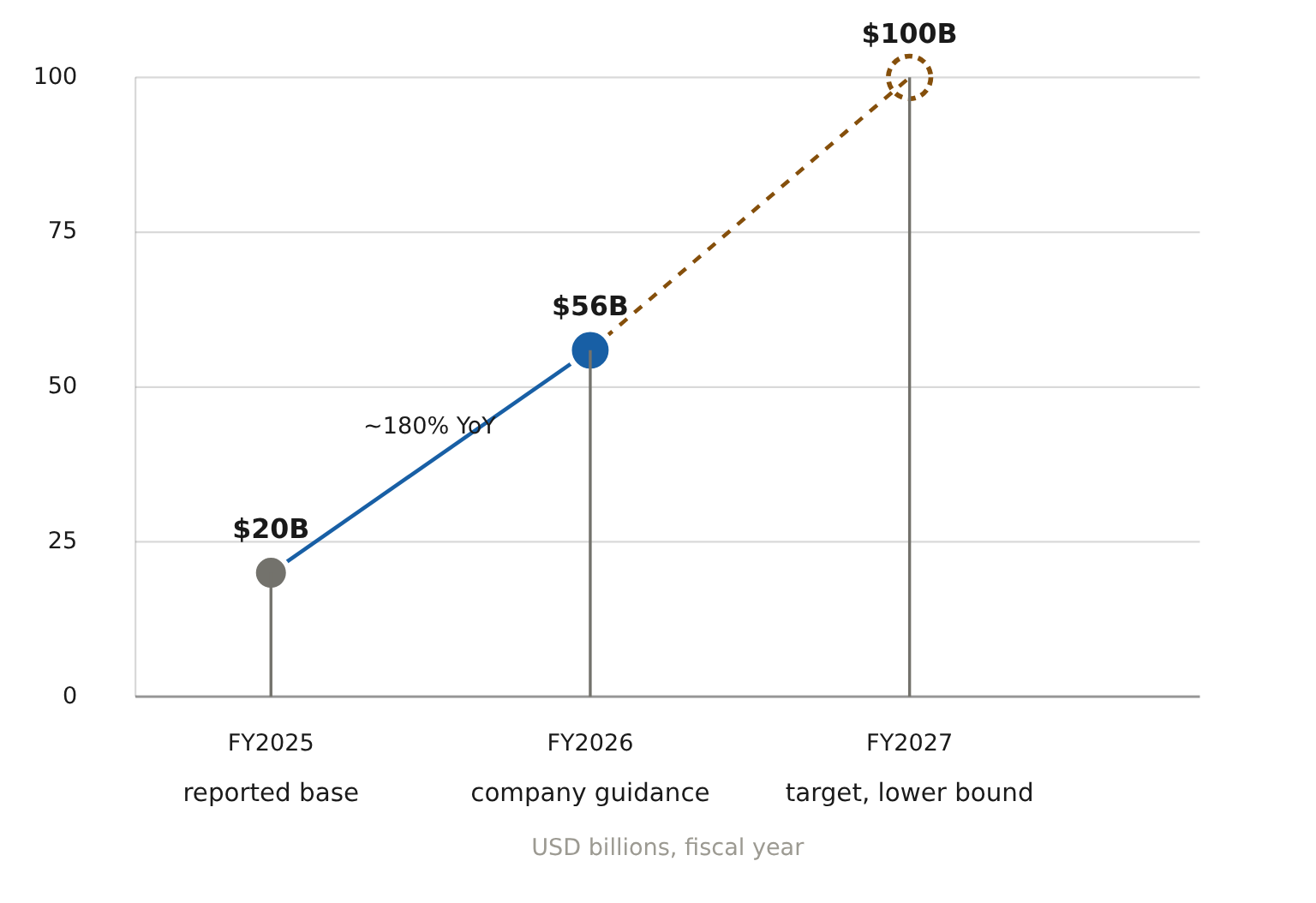
The trend line underneath is real and it is accelerating. In fiscal 2026 Q1, AI semiconductor revenue came in at $8.4 billion, up 106% year over year, and the company followed with a record total-revenue quarter of $22.2 billion, up 48% year over year — inside a calendar year in which Big Tech is expected to spend at least $630 billion on AI infrastructure. The curve is not the controversy; the controversy is whether the OpenAI step-up at the end of the curve is confirmable.
The Multiple Has Already Priced Most of the Curve
The second thing the headline obscures is that this path is already in the price. Per Ainvest data, Broadcom carries a $1.73 trillion market cap at about 59x trailing earnings, roughly 42.8x trailing EV/EBITDA (enterprise value divided by earnings before interest, taxes, depreciation, and amortization), and about 23x trailing sales — each above Nvidia’s comparable 32.9x trailing P/E and 31.3x trailing EV/EBITDA, even though Nvidia is a $5.2 trillion company with a far larger AI revenue base. AMD and Marvell look richer still on trailing earnings, but on a fraction of Broadcom’s revenue scale. Broadcom is priced as the scarce asset in custom silicon, and the multiple leaves little room for a surprise to compound.
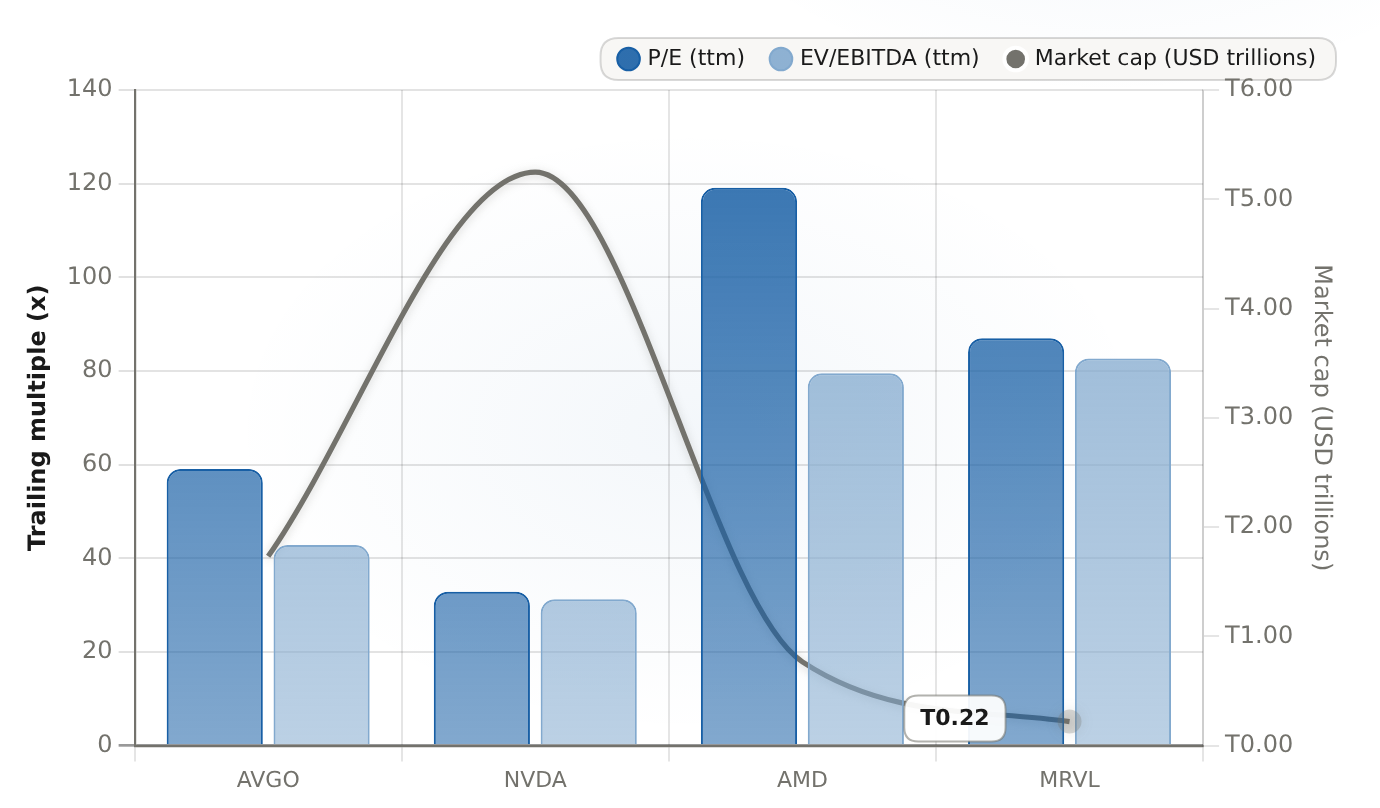
AVGO carries richer trailing multiples (P/E ~59x, EV/EBITDA ~43x) than Nvidia (~33x, ~31x) even though NVDA's market cap is roughly 3x larger — the AI upside is largely priced into AVGO's multiple.
| Ticker | P/E (ttm) | EV/EBITDA (ttm) | Market cap (USD trillions) (T) |
|---|---|---|---|
| AVGO | 59.08 | 42.82 | 1.732 |
| NVDA | 32.88 | 31.27 | 5.248 |
| AMD | 119.11 | 79.5 | 0.766 |
| MRVL | 87 | 82.66 | 0.22 |
The premium was bought on a narrative of custom-ASIC inevitability, and the market has already had one chance to pay for it and think better. Broadcom reported a record quarter in June of this year and the stock sold off anyway, because management reiterated its fiscal 2027 outlook rather than raising it — Wall Street had already priced in absolute perfection. The quality behind the quote is not the issue: gross margins near 68%, operating margin above 43%, free-cash-flow margin above 43%, and roughly $32.8 billion of trailing free cash flow. This is not an earnings-quality question; it is a valuation question with the answer already visible.
The price action tells the same story as the multiple. The session’s gain of 0.43% to $364.03 printed on roughly 19.7 million shares; the stock was down 12.87% over the prior five days and up only about 5.2% year to date. When the financing-snag report broke in the spring, the same name dropped 4% the same day. A market genuinely waiting on this news would have moved harder in either direction.

Six Customers Carry the Entire Path
Underneath the headline multiple sits the structural risk: concentration. Broadcom’s AI revenue is concentrated in roughly six hyperscaler custom-ASIC customers — Google, Meta, Anthropic, OpenAI, plus Fujitsu and ByteDance — and management’s own earnings-call caveat is that dollars per gigawatt vary, sometimes quite dramatically, across those accounts. The fiscal 2027 target is therefore a weighted outcome of which programs actually ramp and at what unit economics, not a single contract. One of those programs, OpenAI’s, is still gated on an unconfirmed financing structure. Six customers is a manageable risk at 15x earnings and a different risk at 59x.
The Decision: This Headline Changes the Case Only Through the Gate
Now the direct answer. Does a reported, hundred-billion-dollar-scale financing deal attached to Broadcom change the AVGOAVGO-- investment case? No — it re-confirms an AI revenue trajectory that management has been guiding since March and that the market has already priced into a roughly 59x trailing multiple. A confirmed round gives OpenAI the balance sheet to pay for compute, which mildly improves plan credibility, but the OpenAI custom chip at about a gigawatt in fiscal 2027 was already embedded in the guidance. The headline is a confirmation of a known path, not a new catalyst.
The discipline is to write down the conditions that would change the answer and then wait for the evidence — because the deal is still reported, and reported is not closed. Watch for:
- A confirmed close or an explicit denial of the OpenAI-Broadcom first-phase financing structure; until one appears, treat any revenue tied to the OpenAI program as conditional.
- The disclosed form of the funding — debt versus equity — and any dilution that shifts risk back onto Broadcom as co-financier.
- A Microsoft commitment to the roughly 40% off-take, or evidence of an alternative buyer stepping in — the reported draft agreement provides exactly that path if Microsoft declines.
- Edge-customer ramp timing: rack deployments targeted from the second half of 2026, with OpenAI’s first custom chip at about a gigawatt in 2027.
- The next earnings print’s backlog and fiscal 2027 language, specifically whether the $100 billion floor is raised rather than reiterated.
The failure conditions are equally concrete:
- The financing gate breaks. Microsoft declines the roughly 40% off-take, no alternative buyer commits, and Broadcom declines to underwrite the first phase — foundry capacity is not reserved, the ramp stalls, and the guided path loses its OpenAI proof point. The gate exists because OpenAI itself projects burning more than $200 billion through 2029.
- A dilutive or equity-heavy structure that changes the economics of co-financing a custom-chip buildout — the unit-economics case the multiple pays for weakens even if the revenue still lands.
- A concentration shock — one of the six customers delays, cuts, or rewrites its gigawatt commitment; with the whole AI path riding on six accounts, a single program reset moves the story.
- Multiple compression. The stock already trades about 26% below its high at roughly 59x trailing earnings versus Nvidia’s 33x; the already-priced cushion works in reverse if the path slips, because a reiteration-rather-than-raise is exactly what the market sold off in June.
The cross-currents are few, and directionally they resolve. Momentum is real and accelerating. The financing gate is real but unconfirmed — no signed off-take, no reserved capacity, no closed first phase. The valuation is real and exacting — a roughly $1.73 trillion market cap with the confirmation already collected. Directionally, treat the headline as a re-rating of a path the market has already paid for, not a new catalyst. The case moves only through the gate: a confirmed close with a workable funding structure is a modest positive the stock has largely collected; a broken gate removes a proof point that a roughly 59x multiple cannot absorb. Define those two outcomes before the next earnings print, because at these valuations the market is not paying you to wait. The headline is the easy part. The gate is the thesis.








Comments
No comments yet