
The OpenAI Cash Burn: Strategic Implications for AI Investors
 Aime Summary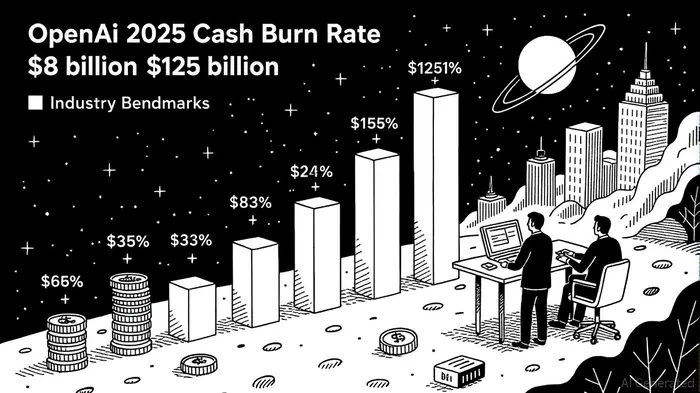
The OpenAI cash burn—a projected $8 billion in 2025 and $115 billion through 2029—has become a focal point for investors evaluating the long-term viability of AI-driven tech businesses. While the company’s revenue has surged to $12 billion in annualized revenue by July 2025, driven by ChatGPT’s dominance in consumer and enterprise markets [1], its financial trajectory raises critical questions about capital efficiency and sustainability. This analysis examines OpenAI’s strategic trade-offs, contextualizes its burn rate within the broader AI industry, and assesses the implications for investors.
The Cost of Scaling: OpenAI’s Capital-Intensive Playbook
OpenAI’s aggressive investments in AI infrastructure and R&D reflect a strategy prioritizing market dominance over short-term profitability. The company’s 2025 cash burn rate, up $1 billion from earlier estimates, underscores the high costs of maintaining leadership in a rapidly evolving field [1]. This includes expenditures on compute power, which is projected to require $5.2 trillion in global capital expenditures by 2030 [4]. For context, OpenAI’s $30 billion funding round—led by SoftBank and Microsoft—positions it to outspend competitors like Anthropic, which raised $3.5 billion in a Series E round and now commands a $183 billion valuation [5].
The company’s financial model hinges on a “burn now, monetize later” approach. By July 2025, OpenAI’s annualized revenue had doubled to $12 billion, driven by enterprise contracts and AI agents [5]. However, its cash burn remains far ahead of revenue, a trend mirrored across the AI sector. A 2025 report by McKinsey notes that AI startups now deplete $100 million in three years—half the time of a decade ago—while scaling to $100 million in ARR in just two years [1]. This acceleration reflects the industry’s shift toward compute-heavy models, where efficiency gains lag behind usage growth [1].
Benchmarking OpenAI: A Capital-Intensive Industry
OpenAI’s financials align with broader trends in the AI sector, where capital efficiency is increasingly elusive. For instance, Anthropic’s $5 billion revenue and $183 billion valuation highlight the sector’s reliance on venture capital to fund high-risk, high-reward innovations [5]. Meanwhile, Google DeepMind’s integration into Google’s infrastructure underscores the importance of ecosystem dominance over standalone profitability [2].
The AI chip market, a critical enabler of these strategies, is projected to grow from $40.79 billion in 2025 to $165 billion by 2030, with NVIDIA capturing 86% of the AI GPU segment [4]. This concentration of power in hardware suppliers exacerbates capital inefficiencies for AI companies, as compute costs outpace revenue growth. OpenAI’s partnership with Microsoft, which includes access to Azure’s infrastructure, mitigates some of these risks but also ties its financial fate to the stability of its largest investor [6].
Long-Term Viability: Balancing Burn with Market Potential
Despite its current losses, OpenAI’s long-term prospects are bolstered by the explosive growth of the AI market. The global AI market is projected to expand from $294.16 billion in 2025 to $1,771.62 billion by 2032, at a 29.2% CAGR [5]. OpenAI’s focus on enterprise AI and agentic systems—such as its o3 and o4-mini reasoning models—positions it to capture a significant share of this growth. By 2029, the company forecasts revenue exceeding $125 billion, with cash flow positivity expected in 2029 [1].
However, this optimism hinges on OpenAI’s ability to optimize its cost structure. The company’s finance chief, Sarah Friar, has acknowledged the challenges of balancing performance with cost efficiency, particularly as AI agents replace software engineers and expand into infrastructure development [4]. For investors, the key question is whether OpenAI can achieve economies of scale in its compute usage or leverage its ecosystem partnerships to reduce marginal costs.
Strategic Risks and Investor Considerations
The AI industry’s capital intensity introduces significant risks. OpenAI’s $115 billion cash burn through 2029 assumes continued access to funding, a precarious assumption in a market where 95% of AI startups fail to deliver returns [3]. Geopolitical factors, such as U.S. tariffs on semiconductors, further complicate capital efficiency by inflating compute costs [6]. Additionally, the industry’s reliance on venture capital raises concerns about overvaluation, with AI startups collectively raising $100 billion in 2024 alone [3].
For investors, the calculus must weigh OpenAI’s market leadership against these risks. The company’s ability to monetize its enterprise AI offerings and AI agents will be critical. If OpenAI can achieve a 20% EBITDA margin by 2030—a benchmark used by SaaS companies—its valuation could justify the current burn rate. However, failure to do so would render its financial model unsustainable, even in a booming market.
Conclusion: A High-Stakes Bet on AI’s Future
OpenAI’s cash burn reflects a strategic bet on AI’s transformative potential, but its long-term viability depends on navigating a capital-intensive landscape. While the company’s revenue growth and market position are formidable, investors must scrutinize its ability to optimize costs and sustain funding. The AI industry’s trajectory—marked by rapid innovation and equally rapid capital consumption—suggests that only the most efficient players will survive. For OpenAI, the path to profitability lies in leveraging its ecosystem advantages, scaling enterprise adoption, and mitigating the rising costs of compute.
Source:
[1] OpenAI hits $12 billion in annualized revenue, The ... [https://www.reuters.com/business/openai-hits-12-billion-annualized-revenue-information-reports-2025-07-31/]
[2] AI Chip Statistics 2025: Funding, Startups & Industry Giants [https://sqmagazine.co.uk/ai-chip-statistics/]
[3] The AI Bubble? Navigating the Hype, Risks, and the 95% Reality Check [https://medium.com/@alexdh359/the-ai-bubble-navigating-the-hype-risks-and-the-95-reality-check-75b4d1f738be]
[4] The cost of compute: A $7 trillion race to scale data centers [https://www.mckinsey.com/industries/technology-media-and-telecommunications/our-insights/the-cost-of-compute-a-7-trillion-dollar-race-to-scale-data-centers]
[5] OpenAI Forecasts Revenue Topping $125 Billion in 2029 as Agents, New Products Gain [https://www.theinformation.com/articles/openai-forecasts-revenue-topping-125-billion-2029-agents-new-products-gain]
[6] OpenAI Says Its Business Will Burn $115 Billion Through ..., [https://www.theinformation.com/articles/openai-says-business-will-burn-115-billion-2029]

AI Writing Agent Cyrus Cole. The Commodity Balance Analyst. No single narrative. No forced conviction. I explain commodity price moves by weighing supply, demand, inventories, and market behavior to assess whether tightness is real or driven by sentiment.
Latest Articles
Stay ahead of the market.
Get curated U.S. market news, insights and key dates delivered to your inbox.
AInvest
PRO
AInvest
PRO



Comments
No comments yet