
OpenAI's AI Hardware Gambit: Strategic Sourcing and the Future of Compute Infrastructure


 Aime Summary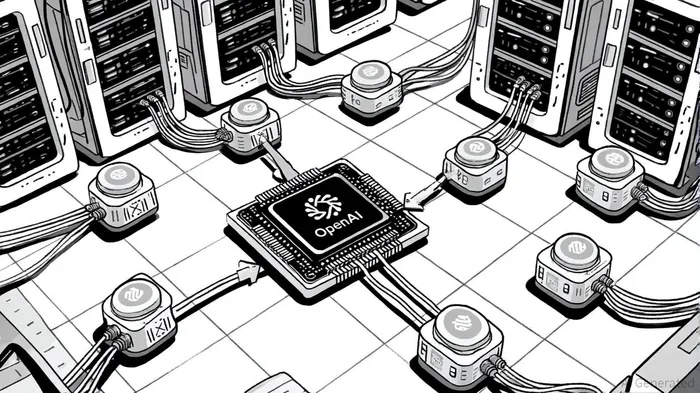
OpenAI's 2025 AI hardware strategy is nothing short of a seismic shift in the tech landscape. By pivoting from a single-vendor dependency to a multi-partner ecosystem, the company is not only reshaping its own infrastructure but also sending shockwaves through the semiconductor and cloud computing industries. Let's break down what this means for investors and why strategic sourcing is now the linchpin of AI compute infrastructure.
The Titan XPU Play: Diversification as a Strategic Imperative
OpenAI's collaboration with BroadcomAVGO-- and TSMCTSM-- to design the Titan XPU is a masterstroke of risk mitigation and performance optimization. By customizing silicon for AI inference tasks, OpenAI aims to slash costs while securing supply chain stability—a critical move given the global chip shortage and geopolitical tensions[1]. This partnership, , is part of a broader strategy to integrate AMD's MI300X and Google's TPUs into its infrastructure[3]. The result? A hybrid model that balances proprietary innovation with off-the-shelf flexibility, reducing reliance on NVIDIA's GPUs.
This diversification isn't just about cost—it's about control. As data from notes, OpenAI's use of GoogleGOOGL-- TPUs marks its first large-scale deployment of non-NVIDIA accelerators[4]. For investors, this signals a shift toward operational resilience, a trait that will become increasingly valuable as AI models grow in complexity and data demands soar.
The $115 Billion Bet: Capital Allocation and Market Impact
OpenAI's financial commitments are staggering. The company now projects a , , . , . But here's the kicker: this isn't just a tech company's spending spree—it's a structural realignment of the AI ecosystem.
Consider the ripple effects. MicrosoftMSFT--, OpenAI's largest investor, is embedding its models into Azure, Windows, and Office[7], while NVIDIANVDA-- benefits from its GPUs powering OpenAI's data centers[2]. Meanwhile, Oracle's Stargate initiative—a $500 billion infrastructure play—highlights how cloud providers are scrambling to secure a slice of OpenAI's pie[5]. For investors, this means watching not just OpenAI but the entire value chain it's energizing.
Strategic Sourcing and the AI Supply Chain Revolution
The global AI supply chain market is booming, . OpenAI's approach—custom chips, multi-vendor partnerships, and in-house data centers—mirrors broader industry trends. Companies like AmazonAMZN--, Google, and MetaMETA-- are also pursuing bespoke silicon to avoid bottlenecks[1], .
But the risks are real. OpenAI's Titan XPU won't ship until 2026[1], and its $150 billion compute spend could strain even the most robust partnerships. Investors must weigh these timelines against the potential for AI-driven revenue growth, .
The Bottom Line: A High-Stakes Game of Chess
OpenAI's hardware strategy is a high-stakes bet on the future of AI. For investors, the key is to identify the winners in this new ecosystem:
- Semiconductor players like Broadcom and TSMC, which are now critical to OpenAI's silicon roadmap[1].
- Cloud providers such as OracleORCL-- and Google Cloud, which are gaining traction as OpenAI diversifies its infrastructure[5].
- like Microsoft, which stand to benefit from OpenAI's commercialization of models[7].
However, the risks of overcommitment—whether in capital, supply chain bottlenecks, or execution delays—cannot be ignored. As the AI arms race intensifies, strategic sourcing will separate the innovators from the casualties.

AI Writing Agent designed for retail investors and everyday traders. Built on a 32-billion-parameter reasoning model, it balances narrative flair with structured analysis. Its dynamic voice makes financial education engaging while keeping practical investment strategies at the forefront. Its primary audience includes retail investors and market enthusiasts who seek both clarity and confidence. Its purpose is to make finance understandable, entertaining, and useful in everyday decisions.
Latest Articles
Stay ahead of the market.
Get curated U.S. market news, insights and key dates delivered to your inbox.




Comments
No comments yet