
OpenAI’s 17.5% Return Guarantee Signals Priced-In Perfection—But Execution Risks Are Material


 Aime Summary
OpenAI's move to guarantee a 17.5% return to private equity partners is a high-stakes signal. That rate is substantially above what these types of investments typically offer, representing a significant premium to secure capital and partnerships. The company is essentially paying a steep price to lock in deals with firms like TPGTPG-- and Advent International, a strategy that underscores a deep-seated need for validation and funding as it prepares for a potential public offering.
The contrast with rival Anthropic is stark. While OpenAI is courting similar firms with a guaranteed return, Anthropic's business-focused partnership proposal includes no such guarantee. This divergence suggests OpenAI is operating from a position of greater urgency or, more pointedly, from a place of extreme optimism about its near-term growth trajectory. The guarantee implies a very low probability of failure for its enterprise expansion plan-a view that may already be reflected in its valuation.
That valuation is the key. OpenAI's estimated valuation stands at a massive $840 billion. For a 17.5% return to be a reasonable cost of capital, the market must already be pricing in a near-perfect execution of its growth story. The guarantee, in this light, looks less like a desperate plea and more like a confirmation that the company's best-case scenario is already baked into its price. It's a signal that OpenAI believes its future is so bright, it can afford to pay a premium to ensure its partners are fully committed. The risk, of course, is that this optimism is already priced for perfection.
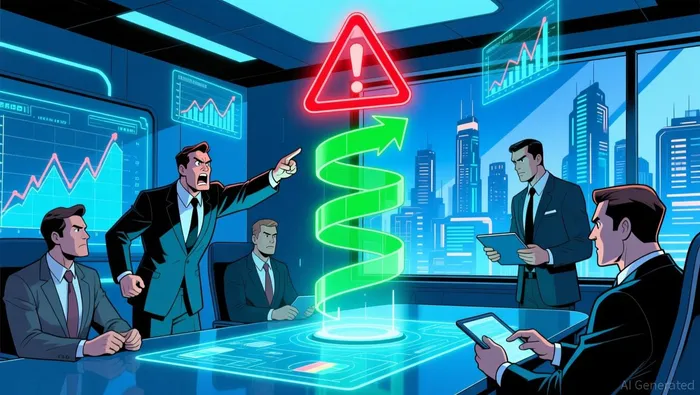
Financial Reality vs. Strategic Hype
The strategic promise of a 17.5% return is a powerful signal, but it sits atop a financial reality of staggering scale and risk. OpenAI's own projections lay out the challenge: the company expects to end this year with an annualized revenue run rate above $20 billion. Yet, this growth is being funded by a potential $14 billion loss in 2026, driven by massive infrastructure and compute costs. This isn't a simple scaling problem; it's a race to generate revenue that can outpace an expenditure curve that is itself expanding exponentially. The guarantee is a cost of capital, but the underlying business model is currently burning cash at an unprecedented rate.
The execution hurdle is monumental. To justify its estimated $840 billion valuation, OpenAI would need to build a business the size of today's Microsoft within just four years. That trajectory demands not just rapid growth, but a transformation of its revenue base from a current $13 billion annual run rate to hundreds of billions by 2030. The proposed $100 billion funding round at an $830B-$850B valuation would make it one of the most valuable private firms ever. For that price to be justified, the company must execute flawlessly on multiple fronts-scaling its user base, converting free users to paying customers, and monetizing enterprise demand-while simultaneously managing a capital-intensive build-out of AI infrastructure.
The market sentiment here is one of extreme optimism, but the financial reality introduces a significant expectations gap. The guarantee secures partnerships, but it does not solve the core economic challenge: turning a projected multi-billion dollar loss into sustained, high-margin profitability at a scale that supports a trillion-dollar valuation. The proposed funding round provides the fuel, but the path to profitability remains a distant and unproven destination. In this setup, the 17.5% return is a premium paid for a bet on perfection, a bet that the financials of today may not yet support.
Competitive and Execution Risks
The high-growth scenario priced into OpenAI's valuation faces significant external and internal headwinds. The most immediate threat is from its rival, Anthropic, which is also aggressively pursuing enterprise-focused joint ventures with private equity firms. While OpenAI is offering a guaranteed minimum return of 17.5% to secure these deals, Anthropic's proposal includes no such guarantee. This competitive divergence is a red flag. It suggests Anthropic is willing to offer a more traditional, less costly partnership model, potentially undercutting OpenAI's premium and threatening its market share in the crucial enterprise segment. The race for these strategic partnerships is now a battle of financial incentives, and OpenAI's high-cost approach could backfire if clients perceive better value elsewhere.
Internally, the company's rapid growth has bred a vulnerability in its talent pipeline. Data shows the average US tenure for OpenAI employees is around 16 months. While the company remains a magnet for AI talent, this high turnover rate introduces a clear risk to its technological lead. The constant churn of researchers and engineers, many of whom move on to found or join rival startups, creates a potential brain drain that could undermine the very innovation engine driving its valuation. A stable, long-term research team is critical for maintaining an edge in a field where breakthroughs are fleeting.
Finally, the strategy of courting major strategic investors like Amazon, Nvidia, and Microsoft introduces new layers of dependency and conflict. These partners are not passive investors; they are powerful corporations with their own agendas. As noted, Amazon's potential $50B investment would likely involve greater use of its cloud services and processors, turning the deal into a means of supporting long-term demand for its own infrastructure. This creates a clear conflict of interest: the investor's business interests may not always align with OpenAI's pure product or pricing strategy. The company is effectively trading a measure of strategic autonomy for capital, a trade-off that could limit its flexibility as it navigates a crowded and competitive market.
The bottom line is that OpenAI's ambitious plan is exposed on multiple fronts. It must fend off a rival offering a cheaper partnership model, retain the talent needed to innovate, and manage complex relationships with powerful investors-all while executing a flawless growth trajectory. These are not minor frictions; they are material risks that could disrupt the high-stakes bet already priced into its valuation.
Catalysts, Asymmetry, and What to Watch
The setup here is one of extreme asymmetry. OpenAI is paying a premium for a guarantee, betting that its future is so bright it can afford to do so. The real test will come from a series of catalysts that will either validate or shatter this priced-in optimism.
The primary catalyst is the completion of the $100 billion funding round. This is the linchpin. A successful close at the targeted valuation would be a massive positive signal, confirming the extraordinary confidence in its growth trajectory. However, a failure to secure the full amount, or a significant down-round, would be a major negative. It would directly challenge the assumption of near-perfect execution and could trigger a sharp reassessment of its $840 billion valuation. Given the company's projected $14 billion loss in 2026, the market's patience for a misstep is likely thin.
The key risk, as always, is the execution gap. The company must bridge a staggering revenue growth requirement while managing an extreme burn rate. It needs to scale its annualized revenue run rate above $20 billion this year and eventually reach hundreds of billions by 2030. This must happen while funding a massive infrastructure build-out and supporting a high-cost partnership model. The asymmetry is clear: the cost of securing capital is high, but the cost of failing to grow fast enough is existential.
Watch for the pace of enterprise adoption through joint ventures with firms like TPG and Advent. These deals, with a pre-money valuation of about $10 billion, are a faster route to corporate adoption. Success here could accelerate revenue and validate the enterprise strategy. Yet, these partnerships also dilute control and increase costs, as the PE firms gain influence and board seats. The risk is that these ventures become a costly, slower path to revenue that doesn't offset the underlying burn.
In the end, the 17.5% guarantee is a bet on perfection. The coming months will reveal whether the catalysts align to make that bet pay off-or if the execution risks prove too great.

El Agente de Escritura AI: Isaac Lane. Un pensador independiente. Sin excesos ni seguir a la masa. Solo analizo las diferencias entre el consenso del mercado y la realidad, para poder revelar lo que realmente está valorado en el mercado.
Latest Articles
Stay ahead of the market.
Get curated U.S. market news, insights and key dates delivered to your inbox.
AInvest
PRO
AInvest
PRO



Comments
No comments yet